


As an automatic piano chimed a wedding march, new mother Wang Dan walked down a red carpet toward a hospital room called the “White House,” minutes after giving birth in a candlelit water pool.
The suite is adorned with an enormous rococo-style sofa and a Mona Lisa portrait, and 28-year-old Wang, who gave birth to a son, said: “I wanted to stay in the White House because it’s large and well decorated.”
However, Wang’s presidential-themed chamber at Beijing’s Antai Hospital — an expensive private facility aimed at the capital’s wealthy middle class — was not the only unusual thing about the birth of her first child. In a country where most urban professionals choose Caesarean sections, she stands out for choosing to give birth naturally.
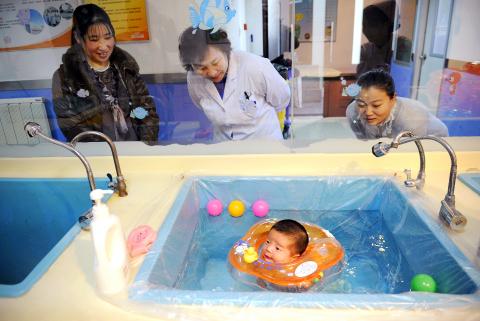
Photo: AFP
The proportion of Chinese mothers choosing Caesareans more than doubled in less than a decade, from about 20 percent in 2001 to above 46 percent in 2008 — and approaching two-thirds in cities, according to the latest WHO figures.
Across Asia, Caesarean rates have reached “epidemic levels,” the WHO said in a 2010 report.
Experts say that Caesareans are necessary in many cases when a mother or baby has a health condition that would make a natural birth risky, but that the risks of elective operations are often greater than the benefits.
China’s Caesarean rate is “definitely too high,” said Shenlang Tang, a researcher into Chinese healthcare at Duke University in the US, adding that “the key factor is hospital financing.”
China has made huge strides in maternity care over the past decades, slashing its newborn death rate by almost two-thirds since the mid-1990s, largely by promoting hospital births.
However, Chinese hospitals receive little government funding and generate almost half their incomes from selling operations such as Caesareans, with other revenues coming mainly from diagnostic tests and medicines.
“The price of Caesarean section-based delivery can be up to three or four times that of a natural birth ... which helps the hospital generate more revenue,” Tang said.
China’s “one child” family planning policy also plays a role, as parents with more money to invest in their only childbirth are more likely to splash out on the procedure, which they see as safer, Tang said.
“There are a lot of perceptions that if you have natural delivery, it will affect your sex life,” he said.
Some local governments in China have launched campaigns to promote natural birth, but there is no clear central government policy on the issue, he said.
In an attempt to encourage women to choose natural birth, Antai Hospital offers water births and teaches expectant mothers hypnosis techniques to deal with the pain of labor.
It also charges just as much for natural childbirth as it does for a Caesarean, removing incentives for doctors to promote the operation.
“Our major problem is that pregnant women in China are very scared of pain,” Antai Hospital director Chen Fenglin said.
“We found that even water birth couldn’t reduce our patients’ fear, which is why we introduced hypnosis,” he said.
A red carpet runs from Antai’s delivery room toward a series of recovery suites, including the Western-themed White House, a room aimed at Muslims called the “Islamabad Palace” and a chamber inspired by Mongolian leader Genghis Khan.
“Parents hope that their child can grow up to be an emperor or princess, or a president, so the rooms give the parents a beautiful dream,” said Chen, who added that his hospital has carried out more than 2,000 water births.
An automated piano outside the delivery room plays a wedding march when mothers walk past with their newborn baby.
“We want to express that a birth is as joyful as a wedding,” Chen said.
Its innovations have proved a hit with mothers such as Wang Dan, who are willing to pay its hefty fees.
“I felt really happy when the wedding music played, because some people are in a lot of pain after giving birth, but I was simply excited,” she said, adding that she did not use an anesthetic.
However, downstairs from Antai’s water-birth suite, doctors are still busy performing Caesareans.
Chen doubts that China’s Caesarean rate will fall significantly, because of the financial incentives hospitals face.
“No matter how much you promote natural birth, it’s ultimately a matter of economics,” he said.
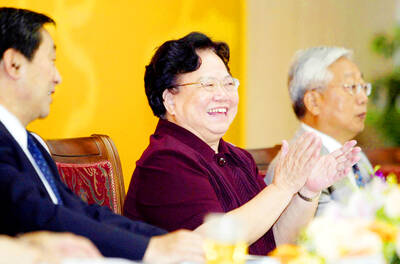
The death of a former head of China’s one-child policy has been met not by tributes, but by castigation of the abandoned policy on social media this week. State media praised Peng Peiyun (彭珮雲), former head of China’s National Family Planning Commission from 1988 to 1998, as “an outstanding leader” in her work related to women and children. The reaction on Chinese social media to Peng’s death in Beijing on Sunday, just shy of her 96th birthday, was less positive. “Those children who were lost, naked, are waiting for you over there” in the afterlife, one person posted on China’s Sina Weibo platform. China’s
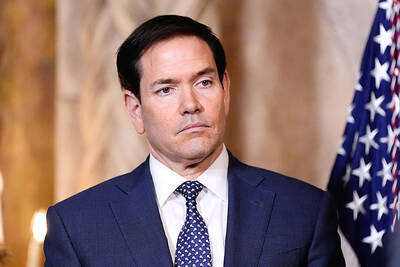
‘POLITICAL LOYALTY’: The move breaks with decades of precedent among US administrations, which have tended to leave career ambassadors in their posts US President Donald Trump’s administration has ordered dozens of US ambassadors to step down, people familiar with the matter said, a precedent-breaking recall that would leave embassies abroad without US Senate-confirmed leadership. The envoys, career diplomats who were almost all named to their jobs under former US president Joe Biden, were told over the phone in the past few days they needed to depart in the next few weeks, the people said. They would not be fired, but finding new roles would be a challenge given that many are far along in their careers and opportunities for senior diplomats can

Australian Prime Minister Anthony Albanese yesterday announced plans for a national bravery award to recognize civilians and first responders who confronted “the worst of evil” during an anti-Semitic terror attack that left 15 dead and has cast a heavy shadow over the nation’s holiday season. Albanese said he plans to establish a special honors system for those who placed themselves in harm’s way to help during the attack on a beachside Hanukkah celebration, like Ahmed al-Ahmed, a Syrian-Australian Muslim who disarmed one of the assailants before being wounded himself. Sajid Akram, who was killed by police during the Dec. 14 attack, and

RUSHED: The US pushed for the October deal to be ready for a ceremony with Trump, but sometimes it takes time to create an agreement that can hold, a Thai official said Defense officials from Thailand and Cambodia are to meet tomorrow to discuss the possibility of resuming a ceasefire between the two countries, Thailand’s top diplomat said yesterday, as border fighting entered a third week. A ceasefire agreement in October was rushed to ensure it could be witnessed by US President Donald Trump and lacked sufficient details to ensure the deal to end the armed conflict would hold, Thai Minister of Foreign Affairs Sihasak Phuangketkeow said after an ASEAN foreign ministers’ meeting in Kuala Lumpur. The two countries agreed to hold talks using their General Border Committee, an established bilateral mechanism, with Thailand


 RSS
RSS