


Self-exiled tycoon Boris Berezovsky lost his multibillion-dollar legal battle against fellow Russian mogul Roman Abramovich on Friday after a British judge ruled that he did not tell the truth in the clash over vast oil wealth.
The case in London’s High Court sparked broad interest because of its focus on the two oligarchs’ personal and business relationship in the chaotic days of post-Soviet Russia. The months of testimony included juicy details about their rise to riches, their jet-set lifestyles on yachts and in luxury hotels, and allegations of “gangster” behavior.
The 64-year-old Berezovsky, a former Kremlin power broker who fell out with Russian President Vladimir Putin, alleged that Abramovich had betrayed and intimidated him into selling his oil stakes vastly beneath their true value, and sold his gas shares without his consent. Berezovsky had sought more than US$5.6 billion in damages.
Abramovich had denied all the charges.
On Friday, Judge Elizabeth Gloster scathingly dismissed Berezovsky’s case, calling him “an unimpressive and inherently unreliable witness, who regarded truth as a transitory, flexible concept, which could be molded to suit his current purposes.”
“I regret to say that the bottom line of my analysis of Mr Berezovsky’s credibility is that he would have said almost anything to support his case,” Gloster said in a 38-page summary of her judgment.
In contrast, she found the 45-year-old Abramovich, the owner of Chelsea soccer club, to be “a truthful, and on the whole reliable, witness.”
Berezovsky, who had alleged blackmail and breach of contract, shook his head in court on Friday as his defeat became clear. Abramovich did not attend.
“I am absolutely amazed by what happened today,” Berezovsky told reporters. “Sometimes I have the impression that Putin himself wrote this judgement.”
A statement issued by Abramovich’s representatives said he was “pleased and grateful” that his position had been “comprehensively vindicated by the court.”
In Moscow, Putin’s spokesman Dmitry Peskov expressed satisfaction with the decision.
“It’s always pleasant when slander is called by its own name,” he told news agency RIA Novosti.
A mathematician turned Mercedes dealer, Berezovsky amassed his wealth during Russia’s chaotic privatization of state assets in the early 1990s. In return for backing former Russian President Boris Yeltsin, he gained political clout and opportunities to buy state assets at knockdown prices. Berezovsky said he mentored Abramovich, treating him like a son, and founded the oil giant Sibneft with him and a third partner. Berezovsky claimed that the friendship faltered when he fell out with Putin, at which point Abramovich “intimidated” him into selling US$1.3 billion of his Sibneft shares, which he claimed were really worth almost US$6 billion.
Abramovich said Berezovsky never had “a cent” of investment in Sibneft. He said he had paid more than US$2.5 billion to Berezovsky for his services as his “political godfather” and reluctantly funded Berezovsky’s extravagant lifestyle of yachts and vacation homes because he feared retaliation from Berezovsky, who he alleged had connections to gangsters in Chechnya.
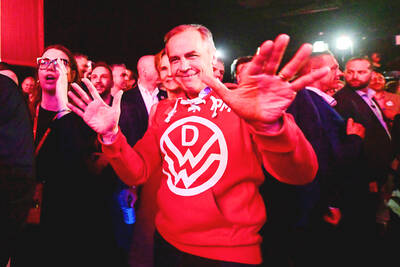
TRUMP EFFECT: The win capped one of the most dramatic turnarounds in Canadian political history after the Conservatives had led the Liberals by more than 20 points Canadian Prime Minister Mark Carney yesterday pledged to win US President Donald Trump’s trade war after winning Canada’s election and leading his Liberal Party to another term in power. Following a campaign dominated by Trump’s tariffs and annexation threats, Carney promised to chart “a new path forward” in a world “fundamentally changed” by a US that is newly hostile to free trade. “We are over the shock of the American betrayal, but we should never forget the lessons,” said Carney, who led the central banks of Canada and the UK before entering politics earlier this year. “We will win this trade war and
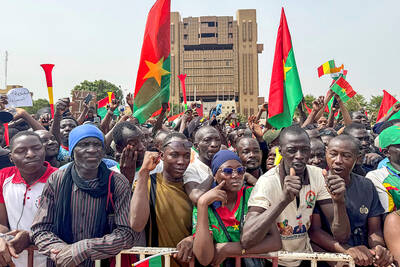
Kehinde Sanni spends his days smoothing out dents and repainting scratched bumpers in a modest autobody shop in Lagos. He has never left Nigeria, yet he speaks glowingly of Burkina Faso military leader Ibrahim Traore. “Nigeria needs someone like Ibrahim Traore of Burkina Faso. He is doing well for his country,” Sanni said. His admiration is shaped by a steady stream of viral videos, memes and social media posts — many misleading or outright false — portraying Traore as a fearless reformer who defied Western powers and reclaimed his country’s dignity. The Burkinabe strongman swept into power following a coup in September 2022

‘BODIES EVERYWHERE’: The incident occurred at a Filipino festival celebrating an anti-colonial leader, with the driver described as a ‘lone suspect’ known to police Canadian police arrested a man on Saturday after a car plowed into a street party in the western Canadian city of Vancouver, killing a number of people. Authorities said the incident happened shortly after 8pm in Vancouver’s Sunset on Fraser neighborhood as members of the Filipino community gathered to celebrate Lapu Lapu Day. The festival, which commemorates a Filipino anti-colonial leader from the 16th century, falls this year on the weekend before Canada’s election. A 30-year-old local man was arrested at the scene, Vancouver police wrote on X. The driver was a “lone suspect” known to police, a police spokesperson told journalists at the
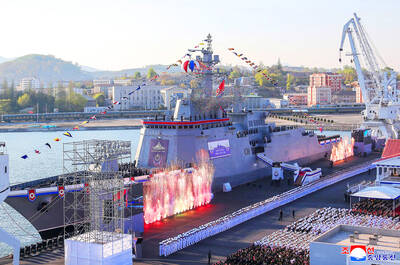
North Korean leader Kim Jong-un has unveiled a new naval destroyer, claiming it as a significant advancement toward his goal of expanding the operational range and preemptive strike capabilities of his nuclear-armed military, state media said yesterday. North Korea’s state-run Korean Central News Agency (KCNA) said Kim attended the launching ceremony for the 5,000-tonne warship on Friday at the western port of Nampo. Kim framed the arms buildup as a response to perceived threats from the US and its allies in Asia, who have been expanding joint military exercises amid rising tensions over the North’s nuclear program. He added that the acquisition


 RSS
RSS