


A unique species of near-toothless rat that lives off earthworms and does not chew or gnaw has been discovered in Indonesia.
The shrew-like animal with a long, pointed snout was described online in this week’s British journal Biology Letters.
Paucidentomys vermidax, which translates loosely to “few-toothed rat” and “worm eater,” is the only rodent out of more than 2,200 known species that does not have molars and instead has bicuspid upper incisors, the article said.
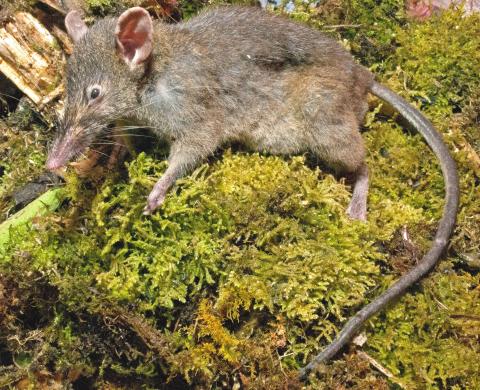
Photo: EPA / MUSEUM VICTORIA AUSTRALIA AND NEW ZEALAND
Two rats were found in the mountainous rain forest of southern Sulawesi Island last year on Mount Latimojong and 100km northwest on Mount Gandangdewata.
Since it lacks cheek teeth, the rat sucks in earthworms and slices them with its incisors before spitting out the pieces and then slurping bites down whole, said co-author of the article Anang Achmadi, from Indonesia’s Museum Zoologicum Bogoriense.
The researchers said the discovery is important because it shows how rodents, which are known for biting and chewing, were forced to evolve to survive in Sulawesi’s environment.
“What defines rodents is their capacity to gnaw with their ever-growing incisors, which are worn down to form chisels,” said co-author Kevin Rowe, senior curator of mammals at Museum Victoria in Melbourne, Australia.
“It’s a remarkable evolution that a trait that’s been so successful [and] has allowed rodents to chew into everything from seeds to felling trees to eating our garbage and chewing their way into our house, this species has given up on that capacity in the pursuit of its lifestyle, which appedars to include eating earthworms,” Rowe added.
The new rat demonstrates the island’s unique biodiversity despite human threats from illegal logging and mining, Achmadi said.

‘CROSSING THE LINE’: China’s embassy in Seoul criticized US Forces Korea Commander General Xavier Brunson, asking if his ‘hostile’ remarks were authorized by Washington South Korea and the US are in talks over recent public remarks by the commander of US Forces Korea, Seoul’s presidential office said yesterday, after the comments drew sharp criticism from China. In a recent podcast interview, US Forces Korea Commander General Xavier Brunson described South Korea as “the dagger in the heart of Asia” from China’s east coast, prompting the Chinese embassy in Seoul to say that he had “truly crossed the line.” The interview came amid growing speculation that Washington might seek to expand the role of US Forces Korea in countering the growing regional influence of China, a key

Through the noise of rushing papers and whirring belts at a print factory in Kyoto, two creators watch their photo essay come to life in broadsheet form — part of an effort to win new audiences in the age of artificial intelligence (AI). Despite the decline of the publishing industry, self-publication and handmade “zine” magazines are growing in popularity in Japan, reflecting the nation’s enduring love of paper in the digital era. While speaking to Agence France-Presse at the plant, his hands black with ink, one of the creators, Kazuma Obara, said: “I think [paper] is a medium that engages all five

Australian researchers have trained lab-grown brain cells on a silicon computer chip to play the 1990s shooter game Doom and said they are just scratching the surface of what the neurons could be capable of doing. It is the science-fiction work of biotech boffins at Cortical Labs, who researched and developed the technology that harnesses the workings of the brain’s networking system. Each so-called “biological computer” contains about 200,000 living human brain cells, grown from stem cells that were harvested from blood donations. Having mastered the simple computer game Pong, where a paddle is moved up and down to send a ball
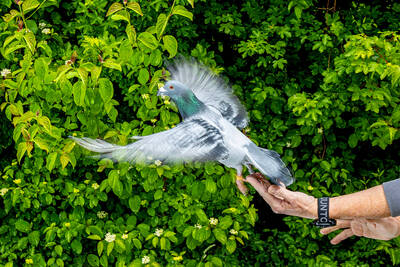
A surprising gut feeling may help pigeons find their way home. Animals use various techniques to navigate, including following the stars and remembering key landmarks. Birds, fish and turtles orient themselves using Earth’s magnetic field as a compass, but it is not yet clear how exactly they do this. Pigeons are a well-known group of frequent flyers that can traverse hundreds of kilometers in a single day. For thousands of years, humans have used them to carry news, notes and military messages. Scientists have long tried to untangle how pigeons travel without getting lost. Some think the birds detect magnetic cues using light-sensitive


 RSS
RSS