


Global hacking movement Anonymous called for protesters to take to the streets in 16 cities around India yesterday over what it considers growing government censorship of the Internet.
The call for demonstrations by the Indian arm of the group followed a March 29 court order issued in the southern city of Chennai demanding 15 Indian Internet providers block access to file-sharing Web sites such as Pirate Bay.
The order has resulted in access being denied to a host of Web sites that carry pirated films and music among other legal content, including www.isohunt.com and www.pastebin.com.
On Wednesday, the Anonymous forum fired an opening shot by attacking the Web site of state-run telecom provider MTNL, pasting the logo of the group — a mask of 17th-century revolutionary Guy Fawkes — on www.mtnl.net.in.
In an open letter the same day, the group accused the government of trying to create a “Great Indian Firewall” to establish control of the Web and issuing a “declaration of war from yourself ... to us.”
Internet users and supporters have been asked to join peaceful rallies in cities including the capital New Delhi and the tech hub of Bangalore, with detailed instructions issued online to participants.
Tech Web site www.pluggd.in reported the demonstrators have been asked to wear Guy Fawkes masks, download a recorded message to play to police, and are to chant: “United as one! Divided as zero! We are Anonymous! We are legion!”
Concerns about Internet freedom in India go beyond the court order in Chennai, however, and stem from an update to India’s Information Technology Act that was given by the IT and communications ministry in April last year.
The new rules regulating Internet companies — providers, Web sites and search engines — instruct them that they must remove “disparaging” or “blasphemous” content within 36 hours if they receive a complaint by an “affected person.”
Groups such as the Center for Internet and Society, a Bangalore-based research and advocacy group, have waged a year-long campaign for amendments to the rules, which were quietly released in April.
Industry groups have also objected, saying they are unclear on the changes, which are in any case impossible to implement when it comes to acting on individual complaints about specific content.
“A lot of education is required in this field,” Internet Service Providers Association of India secretary S.P. Jairath said.
The government has also become embroiled in a row with social networks after Telecoms Minister Kapil Sibal held a series of meetings with IT giants Google, Yahoo and Facebook last year to discuss the prescreening of content.
The minister was said to have shown Internet executives examples of obscene images found online that risked offending Muslims or defamed politicians, including his boss, the head of the ruling Congress party, Sonia Gandhi.
Since these meetings, 19 Internet firms including Google, Yahoo and Facebook have been targeted in criminal and civil cases lodged in lower courts, holding them responsible for content posted by users of their platforms.
Anonymous is a secretive “hacker-activist” network and is thought to be a loosely knit collective with no clearly defined leadership structure.
It has claimed dozens of online attacks on sites ranging from the Vatican to Los Angeles Police Canine Association, but is increasingly the target of law enforcement agencies who have arrested dozens of members.
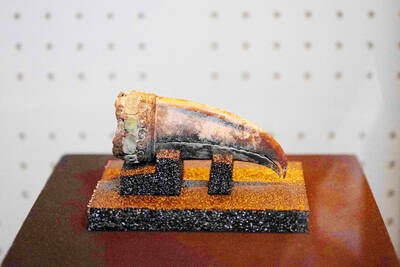
Archeologists in Peru on Thursday said they found the 5,000-year-old remains of a noblewoman at the sacred city of Caral, revealing the important role played by women in the oldest center of civilization in the Americas. “What has been discovered corresponds to a woman who apparently had elevated status, an elite woman,” archeologist David Palomino said. The mummy was found in Aspero, a sacred site within the city of Caral that was a garbage dump for more than 30 years until becoming an archeological site in the 1990s. Palomino said the carefully preserved remains, dating to 3,000BC, contained skin, part of the

TRUMP EFFECT: The win capped one of the most dramatic turnarounds in Canadian political history after the Conservatives had led the Liberals by more than 20 points Canadian Prime Minister Mark Carney yesterday pledged to win US President Donald Trump’s trade war after winning Canada’s election and leading his Liberal Party to another term in power. Following a campaign dominated by Trump’s tariffs and annexation threats, Carney promised to chart “a new path forward” in a world “fundamentally changed” by a US that is newly hostile to free trade. “We are over the shock of the American betrayal, but we should never forget the lessons,” said Carney, who led the central banks of Canada and the UK before entering politics earlier this year. “We will win this trade war and

‘BODIES EVERYWHERE’: The incident occurred at a Filipino festival celebrating an anti-colonial leader, with the driver described as a ‘lone suspect’ known to police Canadian police arrested a man on Saturday after a car plowed into a street party in the western Canadian city of Vancouver, killing a number of people. Authorities said the incident happened shortly after 8pm in Vancouver’s Sunset on Fraser neighborhood as members of the Filipino community gathered to celebrate Lapu Lapu Day. The festival, which commemorates a Filipino anti-colonial leader from the 16th century, falls this year on the weekend before Canada’s election. A 30-year-old local man was arrested at the scene, Vancouver police wrote on X. The driver was a “lone suspect” known to police, a police spokesperson told journalists at the

North Korean leader Kim Jong-un has unveiled a new naval destroyer, claiming it as a significant advancement toward his goal of expanding the operational range and preemptive strike capabilities of his nuclear-armed military, state media said yesterday. North Korea’s state-run Korean Central News Agency (KCNA) said Kim attended the launching ceremony for the 5,000-tonne warship on Friday at the western port of Nampo. Kim framed the arms buildup as a response to perceived threats from the US and its allies in Asia, who have been expanding joint military exercises amid rising tensions over the North’s nuclear program. He added that the acquisition


 RSS
RSS