


If roaring sales of his Aung San Suu Kyi T-shirts are a yardstick, then businessman Swe Yie thinks Myanmar’s tentative steps to democracy are on the right track.
The father-of-two is struggling to keep up with demand for his shirts bearing the images of the Nobel laureate and her revered late father, General Aung San, in recent weeks as the regime eases its iron grip on the nation.
“Before, you wouldn’t even dare talk about ‘The Lady’ much less openly sell any merchandise that would be associated with her,” Swe Yie said at his shop.
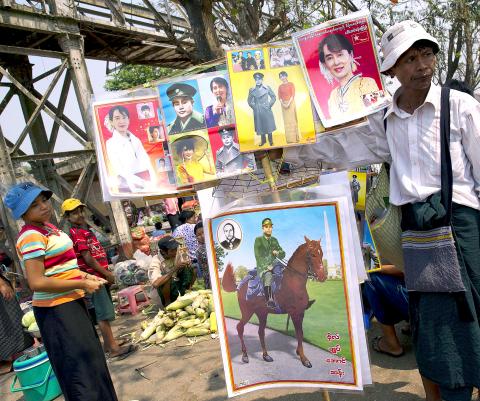
Photo: AFP
“These shirts are our best sellers now,” the 56-year-old said.
The low-quality garments fetch about one or two US dollars apiece, and at a print run of more than 3,000 a day, Swe Yie said it was fair to say he could dream of running a business empire soon.
His success is all the more surprising because his tiny shop is located just meters away from the nearest police station, in a country where the authorities previously crushed any sign of political dissent.
In a rundown building in Yangon, lit by two flickering fluorescent bulbs, his wife works their sole manual sewing machine, churning out miniature National League for Democracy flags, as T-shirts for sale flap in the tropical breeze outside.
Four workers sit on the concrete floor using a silkscreen to print images on a mound of colorful T-shirts, some of which are bought by re-sellers, including hawkers who attend Aung San Suu Kyi’s campaign rallies.
Many of Swe Yie’s customers are foreign tourists enamored by Aung San Suu Kyi, the heroine who emerged from years of house arrest in late 2010 and is now running for a seat in parliament for the first time in by-elections next month.
The dissident’s face also is often seen on T-shirts worn by people among the crowds of supporters who have greeted her on the campaign trail.
It is part of a boom in sales of Aung San Suu Kyi memorabilia, including posters and keyrings.
Portraits of the opposition leader are prominently displayed in tea shops, restaurants and on the sidewalks.
Illegal copies of Luc Besson’s The Lady, a two-hour biopic about the pro-democracy icon’s private life, have also flooded the streets of Yangon as vendors push the boundaries of new-found freedoms.
Aung San Suu Kyi’s release in 2010 was among a host of reforms by the generals who ruled the impoverished country outright for almost half a century until installing a nominally civilian government last year. The new government has freed hundreds of political prisoners, agreed tentative ceasefire pacts with several armed ethnic minority groups and suspended work on a controversial dam project backed by China.
In the main city of Yangon, more tourists can be seen on the streets, nearly all the hotels are fully booked, and people are becoming less afraid of discussing politics in public.
“There are many, many reforms needed, but at least there seem to be some small steps,” Swe Yie said.
“I feel it is easier to make a living now in these changing times. Life remains difficult in a lot of ways, but we have a chance now. I call sell openly without fear of being arrested,” he added. “I hope one day everyone in Myanmar will be able to live comfortably, free to work and choose what they want to do in life. My country is very poor, but I hope we will become rich like other countries.”

An American scientist convicted of lying to US authorities about payments from China while he was at Harvard University has rebuilt his research lab in Shenzhen, China, to pursue technology the Chinese government has identified as a national priority: embedding electronics into the human brain. Charles Lieber, 67, is among the world’s leading researchers in brain-computer interfaces. The technology has shown promise in treating conditions such as amyotrophic lateral sclerosis and restoring movement in paralyzed people. It also has potential military applications: Scientists at the Chinese People’s Liberation Army have investigated brain interfaces as a way to engineer super soldiers by boosting
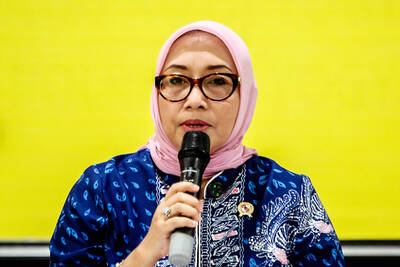
Indonesian police have arrested 13 people after shocking images of alleged abuse against small children at a daycare center went viral, sparking outrage across the nation, officials said on Monday. Police on Friday last week raided Little Aresha, a daycare center in Yogyakarta on Java island, following a report from a former employee. CCTV footage circulating on social media showed children, most younger than two, lying on the floor wearing only diapers, their hands and feet bound with rags. The police have confirmed that the footage is authentic. Police said they also found 20 children crammed into a room just 3m by 3m. “So
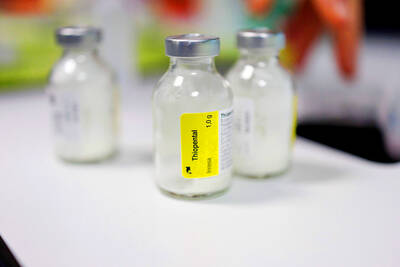
A grieving mother has ended her life at a clinic in Switzerland four years after the death of her only child. Wendy Duffy, 56, a physically healthy woman, died at the Pegasos clinic in Basel after struggling to cope with the death of her 23-year-old son, Marcus. The former care worker, from the West Midlands, England, had previously attempted to take her own life. The case comes as assisted dying would not become law in England and Wales after proposed legislation, branded “hopelessly flawed” by opponents, ran out of time. Ruedi Habegger, the founder of Pegasos, described Duffy’s death as
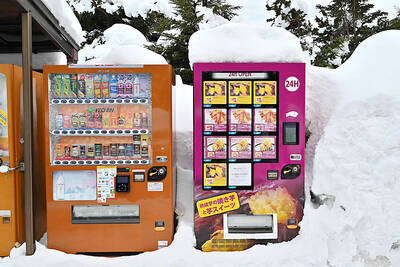
From post offices and parks to stations and even the summit of Mount Fuji, Japan’s vending machines are ubiquitous, but with the rapid pace of inflation cooling demand for their drinks, operators are being forced to rethink the business. Last month beverage giant DyDo Group Holdings announced it would remove about 20,000 vending machines — about 7 percent of their stock nationwide — by January next year, to “reconstruct a profitable network.” Pokka Sapporo Food & Beverage, based in Nagoya, also said last month it would sell its 40,000-machine operation to Osaka-based Lifedrink Co. “The strength of the vending machine


 RSS
RSS