


When professor Qian Nairong (錢乃榮) published his dictionary of the Shanghai dialect in 2007, he was in some ways documenting a dying language.
The number of people speaking the rapid-fire language — a badge of identity for residents of China’s commercial capital of more than 20 million people — is shrinking.
As the government maintains a decades-old drive to promote Mandarin Chinese as the official language, banning dialects from media broadcasts and schools, many young people are unable to fluently speak the native Shanghai tongue.
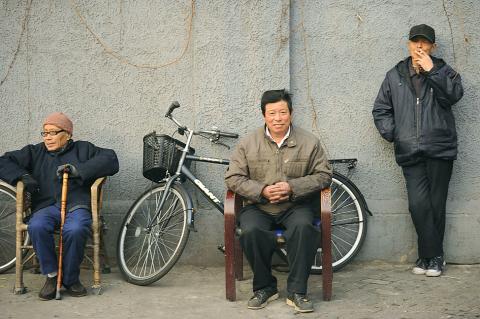
Photo: AFP
An influx of migrants from outside Shanghai and the city’s drive to become more international have also combined to water down the local patois.
“A language is like a living thing, after it gets old, it must die,” said Qian, a retired professor of language studies at Shanghai University. “People born in the 1990s cannot really speak Shanghai dialect.”
Shanghai is not alone. China’s southern Guangdong Province has announced plans requiring broadcasters to get special permission to use the Cantonese dialect in programs from March 1, causing a storm of controversy.
However, there are signs that Shanghai’s residents will not give up on their language that easily.
Shanghai comedian Zhou Libo (周立波) has helped revitalize interest in the dialect with his witty routines, which often mock outsiders.
“The weakening of dialects means the weakening of local culture. Why must our children speak [Mandarin] Chinese? Shanghai people who cannot speak the Shanghai dialect. What stupidity!” he said on a talk show.
City buses have recently introduced announcements in Shanghainese and there are plans for the metro system to follow suit to cater to older people, especially those with no formal education, who do not understand Mandarin.
Shanghai Airlines has just added an announcement about the city’s attractions to market the unique features of Shanghai. However, the airline had to train young flight attendants to pronounce the words.
Not long after the Chinese Communist Party took power in 1949, it made Mandarin Chinese the official language to promote unity.
The government has been unable to stamp out local dialects, but it has discouraged their use, barring them from the classroom in most cases.
Although millions of people — mainly those aged from their 40s — still speak the Shanghai dialect, the version Qian heard in the 1980s is now found only in the mouths of elderly people and in the city’s distant suburbs.
Also lost to time are colorful curse words like “corpse floating on the river” and “ghost of an executed criminal,” which were once common insults in the Shanghai dialect.
In the 1990s, the local government pulled radio and TV broadcasts using the Shanghai dialect as part of a national campaign.
A popular Shanghai radio show, A Fu Gen, which featured discussions of current events, was among the victims.
Xiao Ling, a host for the show, struggled for 10 years before a sympathetic official revived the program.
Xiao is one of only two hosts at the radio station who have formal broadcast training in the Shanghai dialect.
Last year, the program was forced to hold open auditions to find candidates with Shanghai language skills to fill open positions.
“My colleagues joke that we are giant pandas,” Xiao said.
Shanghai’s prestigious Tongji University organized a voluntary class in the dialect, after finding that student volunteers were unable to communicate with elderly Shanghai people, teaching basic phrases like: “Nong hao” (hello).
Tongji also offers a class for foreign students.
“We thought it was good to have people from outside the organization and even outside the school to join the class,” organizer Shen Yiwen said.

PARLIAMENT CHAOS: Police forcibly removed Brazilian Deputy Glauber Braga after he called the legislation part of a ‘coup offensive’ and occupied the speaker’s chair Brazil’s lower house of Congress early yesterday approved a bill that could slash former Brazilian president Jair Bolsonaro’s prison sentence for plotting a coup, after efforts by a lawmaker to disrupt the proceedings sparked chaos in parliament. Bolsonaro has been serving a 27-year term since last month after his conviction for a scheme to stop Brazilian President Luiz Inacio Lula da Silva from taking office after the 2022 election. Lawmakers had been discussing a bill that would significantly reduce sentences for several crimes, including attempting a coup d’etat — opening up the prospect that Bolsonaro, 70, could have his sentence cut to
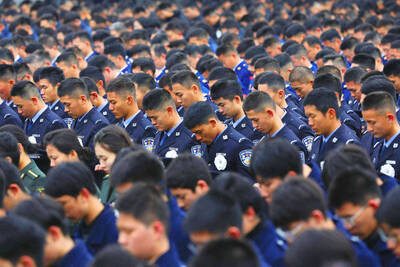
China yesterday held a low-key memorial ceremony for the 1937 Nanjing Massacre, with Chinese President Xi Jinping (習近平) not attending, despite a diplomatic crisis between Beijing and Tokyo over Taiwan. Beijing has raged at Tokyo since Japanese Prime Minister Sanae Takaichi last month said that a hypothetical Chinese attack on Taiwan could trigger a military response from Japan. China and Japan have long sparred over their painful history. China consistently reminds its people of the 1937 Nanjing Massacre, in which it says Japanese troops killed 300,000 people in what was then its capital. A post-World War II Allied tribunal put the death toll

‘UNWAVERING ALLIANCE’: The US Department of State said that China’s actions during military drills with Russia were not conducive to regional peace and stability The US on Tuesday criticized China over alleged radar deployments against Japanese military aircraft during a training exercise last week, while Tokyo and Seoul yesterday scrambled jets after Chinese and Russian military aircraft conducted joint patrols near the two countries. The incidents came after Japanese Prime Minister Sanae Takaichi triggered a dispute with Beijing last month with her remarks on how Tokyo might react to a hypothetical Chinese attack on Taiwan. “China’s actions are not conducive to regional peace and stability,” a US Department of State spokesperson said late on Tuesday, referring to the radar incident. “The US-Japan alliance is stronger and more
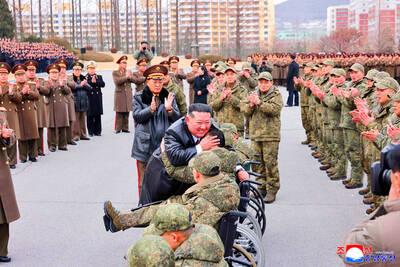
FALLEN: The nine soldiers who were killed while carrying out combat and engineering tasks in Russia were given the title of Hero of the Democratic People’s Republic of Korea North Korean leader Kim Jong-un attended a welcoming ceremony for an army engineering unit that had returned home after carrying out duties in Russia, North Korean state media KCNA reported on Saturday. In a speech carried by KCNA, Kim praised officers and soldiers of the 528th Regiment of Engineers of the Korean People’s Army (KPA) for “heroic” conduct and “mass heroism” in fulfilling orders issued by the ruling Workers’ Party of Korea during a 120-day overseas deployment. Video footage released by North Korea showed uniformed soldiers disembarking from an aircraft, Kim hugging a soldier seated in a wheelchair, and soldiers and officials


 RSS
RSS