


Libyan children are returning to schools closed for months by civil war to find one teacher gone — former Libyan leader Muammar Qaddafi, whose portraits have been stripped from classroom walls and once-revered words erased from the curriculum.
For decades, lessons based on his “teachings” were mandatory and his sometimes bizarre ideas permeated everything from history lessons to Arabic textbooks.
Educators are now scratching their heads over how to fill the gaps left by the expunging of the former dictator, the education minister said as more than 1.2 million children returned to schools on Saturday.
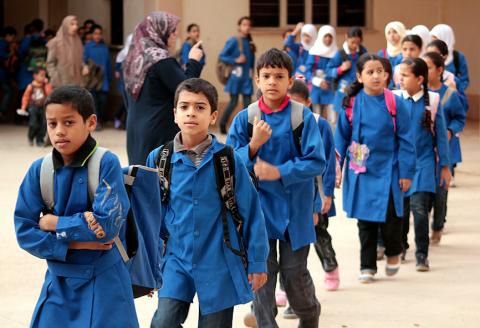
Photo: AFP
“The subjects of political awareness and community studies have been canceled,” Libyan Minister of Education Suliman al-Sahli said. “There are suggestions for substitute subjects and ... proposals are still under study.”
“The history subject has been canceled and replaced by a new one put together by experts in this area to give us real history,” al-Sahli said.
The start of the current school year, which should have been in September last year, has been postponed to this month. The last school year overran its schedule by months because schools were closed for so much of the nine-month civil war that ended Qaddafi’s 42-year rule. This school year will have to be be shortened.
One of the first things the now-ruling National Transitional Council did after taking up arms against Qaddafi was to set up a committee to wipe his teachings from the curriculum.
The three-volume Green Book, which contains Qaddafi’s musings on politics, economics and everyday life, used to be required reading for schools. Quotations from it used to adorn classroom walls, but all have now disappeared.
The book laid out his “Third Universal Theory,” which seeks to chart a course between Islam and socialism.
Children were tested by their ability to learn by heart as much quotes from the Green Book as possible.
A typical final exam question would be to explain the economic benefits of a rule promulgated by Qaddafi: “The house belongs to the dweller,” meaning that tenants renting houses had the right to take over the property if they wished to do so.
Abdul Majid Ghonia, director of curriculum at the Ministry of Education, said the entire stock of textbooks in ministry warehouses related to Qaddafi’s regime would be destroyed and replaced with 453 new textbooks.
However, the content of those new books is as yet undecided. The challenge now is to agree on alternatives to Qaddafi’s versions of history, society and morality.
“We need to completely rethink the subjects taught in our schools, especially the cultural and political aspects which were abused by Qaddafi’s regime to serve its propaganda purposes,” said Suleiman Khoja, a senior ministry official.
Khoja said the government would organize a national conference to discuss ideas for alternative textbooks.
“We will not start that process [of replacing textbooks] without the participation of people who can come up with a new vision,” he said.

‘CROSSING THE LINE’: China’s embassy in Seoul criticized US Forces Korea Commander General Xavier Brunson, asking if his ‘hostile’ remarks were authorized by Washington South Korea and the US are in talks over recent public remarks by the commander of US Forces Korea, Seoul’s presidential office said yesterday, after the comments drew sharp criticism from China. In a recent podcast interview, US Forces Korea Commander General Xavier Brunson described South Korea as “the dagger in the heart of Asia” from China’s east coast, prompting the Chinese embassy in Seoul to say that he had “truly crossed the line.” The interview came amid growing speculation that Washington might seek to expand the role of US Forces Korea in countering the growing regional influence of China, a key

Through the noise of rushing papers and whirring belts at a print factory in Kyoto, two creators watch their photo essay come to life in broadsheet form — part of an effort to win new audiences in the age of artificial intelligence (AI). Despite the decline of the publishing industry, self-publication and handmade “zine” magazines are growing in popularity in Japan, reflecting the nation’s enduring love of paper in the digital era. While speaking to Agence France-Presse at the plant, his hands black with ink, one of the creators, Kazuma Obara, said: “I think [paper] is a medium that engages all five

Australian researchers have trained lab-grown brain cells on a silicon computer chip to play the 1990s shooter game Doom and said they are just scratching the surface of what the neurons could be capable of doing. It is the science-fiction work of biotech boffins at Cortical Labs, who researched and developed the technology that harnesses the workings of the brain’s networking system. Each so-called “biological computer” contains about 200,000 living human brain cells, grown from stem cells that were harvested from blood donations. Having mastered the simple computer game Pong, where a paddle is moved up and down to send a ball

France experienced its hottest spring on record, the French weather service said on Tuesday, after an exceptional early heat wave that also broke highs for the season in England and Wales. Meteo-France said the average nationwide temperature over March to May was 13.8°C — about 1.7°C above the norm, and surpassing records set in 2011 and 2020. “The warmest spring since records began in 1900,” it said in a bulletin. All three months were warmer than average, but the onset of an “unprecedented heatwave” late last month pushed the mercury to highs typically seen at the height of the summer. “Our country had never


 RSS
RSS