


Water fowl, monitor lizards and stray dogs have replaced the throngs of tourists at one of Thailand’s greatest historical sites. Record flooding has turned Ayutthaya’s ancient temples into islands, and a giant statue of the reclining Buddha appears to float miraculously on the lapping water.
Experts fear that at least half of the more than 200 waterlogged monasteries, fortresses and other monuments in the one-time royal capital have been damaged.
“Imagine a thousand tonnes of brick and stone resting on soft foundations, with no modern-style pilings. We are very worried,” said Chaiyanand Busayarat, director of the Ayutthaya Historic Park.
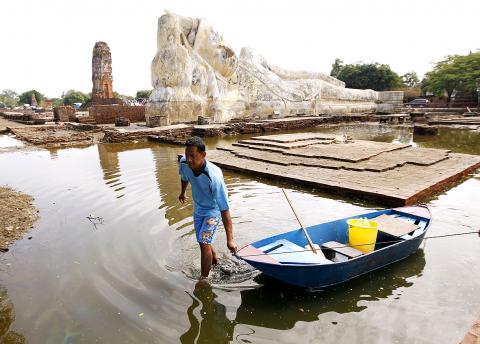
Photo: EPA
And as flood waters recede, some experts are proposing a radical change to prevent similar disasters in the future: Turn back the clock about four centuries to emulate the city’s urban planners and engineers of that time.
“We can’t prevent flooding so we have to learn to live with water again, like those who created Ayutthaya. Let’s take out the old city maps,” said Anek Sihamat, deputy -director-general of the Thai government’s Fine Arts Department.
He recommended digging up old canals that have been paved over for roads and curbing the urban sprawl and industrial parks that block the natural runoff of water.
Capital of a powerful state for 417 years, seat of 33 kings, Ayutthaya has been described as one of the greatest cities on water ever, with a canal network that measured more than 140km. Built on the flood plain of central Thailand at the confluence of three rivers, it was inundated annually, but its citizens lived in stilt-raised houses and used boats for transport.
Water also defended Ayutthaya, which once held as many as 1 million residents, until a brutal sacking by the Burmese in 1767 forced relocation of the capital to Bangkok, 80km to the south — where the same floodwaters that inundated Ayutthaya are now nearing the inner city.
The surge of water from the northern highlands, which began in late July and has killed more than 520 people, is the worst since the 1940s, although Ayutthaya experiences flooding almost every monsoon season.
In coming weeks, experts will assess damage and determine what will be needed to revive and protect the city, which was added to the UNESCO World Heritage list in 1991.
Advisers from Venice and the Netherlands, two places that have grappled with the challenges of watery environments, are prepared to come, while several countries, including Germany and Japan, have provided or promised funds. Anek estimated that some US$20 million would be needed.
“Clearly what we hope for from this experience will be a more solid, more thorough flood mitigation plan,” said Tim Curtis, head of the culture unit at UNESCO’s regional office in Bangkok.
He said that Amsterdam’s 19th-century water-based defense line — another World Heritage site — and Venice may be used as models.
Ayutthaya Governor Witthaya Pewpong said a dam has been proposed to shield the historic area while flooding would be eased by setting aside a large, -construction-free area of the nearby countryside to absorb excess water.
Nevertheless, authorities “know that they will have to learn to live with water because it will always be there,” UNESCO cultural expert Montira Horayangura Unakul said.
As such, urban planning should be consistent with Ayutthaya’s design as a city of water, she said.
To date, Ayutthaya has not scored well on the urban management front. The city of 82,000 people is mushrooming helter-skelter and has bid to host World Expo 2020.
Four years ago, amid concern in Thailand that UNESCO might take the city off its list, one Bangkok newspaper wrote that the city was destroyed twice, “first by invading Burmese, and now by greedy and insensitive Thais.”
Adding to its watery woes, said Curtis, are problems common to heritage sites: the looting of artifacts, inadequate waste disposal, corrosive vehicle fumes, ugly and inappropriate new construction and mass tourism.
There’s also a running battle between heritage and municipal authorities, often allied with business interests.
The Fine Arts Department controls development in the core historic area of 3km2, where no structures more than 8m are permitted. However, it exercises little power in outlying zones, which include numerous important monuments and where modern buildings have sprouted next to graceful relics of the past.
Most immediately, however, heritage authorities are focused on the floods.
With water up to 3m high flooding the area for weeks, there is concern that the foundations of larger structures may have been undermined, and bricks, plasterwork and murals damaged. Visitor facilities and once grassy areas emerging as a sea of mud will need to be restored at what is one of the country’s top tourist destinations.
Also worrisome is salt residue that seeps up with the groundwater, causing damage to monuments.
Chaiyanand said the stupas, or Buddhist reliquary, in Ayutthaya were built with an outer core of brick. The hollow portions inside were filled with sand. When the floods came, the water was absorbed upward into this inner chamber of sand, which became heavier. He fears the weight could cause cracks of the outer brick shell.
Water that is hard to detect and remove may also remain within walls after the floodwaters recede. Chaiyanand said he was particularly concerned about the bricks that were the key building blocks of old Ayutthaya.
“They’re like crackers,” he said, noting the mossy, water-stained bricks at the base of a stupa at the 15th-century Phra Srisanphet monastery. “When soaked they become easy to break.”

‘CROSSING THE LINE’: China’s embassy in Seoul criticized US Forces Korea Commander General Xavier Brunson, asking if his ‘hostile’ remarks were authorized by Washington South Korea and the US are in talks over recent public remarks by the commander of US Forces Korea, Seoul’s presidential office said yesterday, after the comments drew sharp criticism from China. In a recent podcast interview, US Forces Korea Commander General Xavier Brunson described South Korea as “the dagger in the heart of Asia” from China’s east coast, prompting the Chinese embassy in Seoul to say that he had “truly crossed the line.” The interview came amid growing speculation that Washington might seek to expand the role of US Forces Korea in countering the growing regional influence of China, a key

Through the noise of rushing papers and whirring belts at a print factory in Kyoto, two creators watch their photo essay come to life in broadsheet form — part of an effort to win new audiences in the age of artificial intelligence (AI). Despite the decline of the publishing industry, self-publication and handmade “zine” magazines are growing in popularity in Japan, reflecting the nation’s enduring love of paper in the digital era. While speaking to Agence France-Presse at the plant, his hands black with ink, one of the creators, Kazuma Obara, said: “I think [paper] is a medium that engages all five

Australian researchers have trained lab-grown brain cells on a silicon computer chip to play the 1990s shooter game Doom and said they are just scratching the surface of what the neurons could be capable of doing. It is the science-fiction work of biotech boffins at Cortical Labs, who researched and developed the technology that harnesses the workings of the brain’s networking system. Each so-called “biological computer” contains about 200,000 living human brain cells, grown from stem cells that were harvested from blood donations. Having mastered the simple computer game Pong, where a paddle is moved up and down to send a ball

A surprising gut feeling may help pigeons find their way home. Animals use various techniques to navigate, including following the stars and remembering key landmarks. Birds, fish and turtles orient themselves using Earth’s magnetic field as a compass, but it is not yet clear how exactly they do this. Pigeons are a well-known group of frequent flyers that can traverse hundreds of kilometers in a single day. For thousands of years, humans have used them to carry news, notes and military messages. Scientists have long tried to untangle how pigeons travel without getting lost. Some think the birds detect magnetic cues using light-sensitive


 RSS
RSS