


Hurricane Jova slammed into Mexico’s Pacific coast as a Category 2 storm early on Wednesday, killing three people and injuring six, while a tropical depression hit farther south and unleashed steady rains that contributed to 13 deaths across the border in Guatemala.
Jova came ashore west of the Mexican port of Manzanillo and the beach town of Barra de Navidad before dawn with 160kph winds and heavy rains, before moving inland and weakening to a tropical depression by the afternoon. It continued to dump rain over a large swath of northwest Mexico, including Jalisco State where rainfall this year had been low.
A 71-year-old woman drowned in Colima State after a strong current swept away the car in which she and her son were riding. Her son survived, Colima Governor Mario Anguiano said.
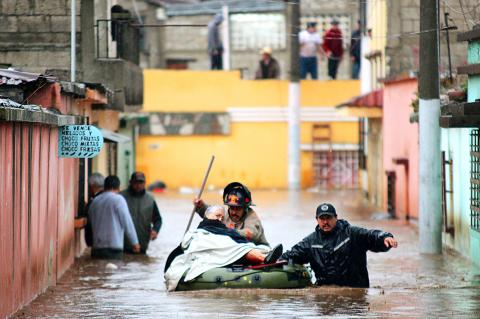
Photo: EPA
In the neighboring state of Jalisco, Jova triggered a mudslide in the town of Cihuatlan, just inland from Barra de Navidad, that swept away a house on a hillside, killing two of its occupants, said Oscar Mejia, the spokesman for the Jalisco State Red Cross rescue division.
Farther northwest along the Mexican coast, in the town of Tomatlan, two children suffered head injuries when the walls of their brick home collapsed under the force of the wind and rains, Mejia said.
The new tropical depression formed in the Pacific off far--southern Mexico near the Guatemala border, with maximum sustained winds near 55kph, the US National Hurricane Center said.
The storm quickly moved ashore over Mexico and was expected to move slightly north before dissipating before the day’s end.
The storm was smaller and less powerful than Jova, but the mountainous terrain of the southern Mexican state of Chiapas and neighboring Guatemala is particularly vulnerable to flash flooding and mudslides. Numerous Indian villages perch precariously on hillsides.
Guatemalan President Alvaro Colom blamed rain from the storm for the deaths of 13 people in his country.
At least four of those were electrocuted, Colom said. Others died in mudslides or were swept away by swollen rivers.
Hurricane center forecaster John Cangialosi said the rains in Guatemala probably were linked to the tropical depression, even though it had not yet hit land.
“If they’re in Guatemala, they’re pretty close to the circulation center of the system, and it has been a very slow-moving system ... so it’s likely linked to this feature,” he said.
Farther north on Mexico’s coast, flooding from Jova was so bad in Cihuatlan that the Red Cross office had to be evacuated because it was filled with 1.5m of water.
Mexico’s navy said it evacuated a total of 2,600 people in flood-prone areas hit by Jova and set up kitchens at shelters to feed 1,600 evacuees.
Meanwhile, Tropical Storm Irwin lost strength farther out in the Pacific with winds near 65kph.

An American scientist convicted of lying to US authorities about payments from China while he was at Harvard University has rebuilt his research lab in Shenzhen, China, to pursue technology the Chinese government has identified as a national priority: embedding electronics into the human brain. Charles Lieber, 67, is among the world’s leading researchers in brain-computer interfaces. The technology has shown promise in treating conditions such as amyotrophic lateral sclerosis and restoring movement in paralyzed people. It also has potential military applications: Scientists at the Chinese People’s Liberation Army have investigated brain interfaces as a way to engineer super soldiers by boosting

Indonesian police have arrested 13 people after shocking images of alleged abuse against small children at a daycare center went viral, sparking outrage across the nation, officials said on Monday. Police on Friday last week raided Little Aresha, a daycare center in Yogyakarta on Java island, following a report from a former employee. CCTV footage circulating on social media showed children, most younger than two, lying on the floor wearing only diapers, their hands and feet bound with rags. The police have confirmed that the footage is authentic. Police said they also found 20 children crammed into a room just 3m by 3m. “So
A grieving mother has ended her life at a clinic in Switzerland four years after the death of her only child. Wendy Duffy, 56, a physically healthy woman, died at the Pegasos clinic in Basel after struggling to cope with the death of her 23-year-old son, Marcus. The former care worker, from the West Midlands, England, had previously attempted to take her own life. The case comes as assisted dying would not become law in England and Wales after proposed legislation, branded “hopelessly flawed” by opponents, ran out of time. Ruedi Habegger, the founder of Pegasos, described Duffy’s death as

From post offices and parks to stations and even the summit of Mount Fuji, Japan’s vending machines are ubiquitous, but with the rapid pace of inflation cooling demand for their drinks, operators are being forced to rethink the business. Last month beverage giant DyDo Group Holdings announced it would remove about 20,000 vending machines — about 7 percent of their stock nationwide — by January next year, to “reconstruct a profitable network.” Pokka Sapporo Food & Beverage, based in Nagoya, also said last month it would sell its 40,000-machine operation to Osaka-based Lifedrink Co. “The strength of the vending machine


 RSS
RSS