


A Taliban suicide bomber yesterday detonated a vehicle packed with explosives outside the home of a senior police officer tasked with cracking down on militants in Pakistan’s largest city. The blast killed at least eight people and left a crater 3m deep, police said.
The Pakistani Taliban claimed responsibility for the early morning attack in the southern port city of Karachi. The target of the bombing, Chaudhry Aslam, escaped unscathed and said he would not be cowed by the attack.
“This is a cowardly act,” Aslam told local television. “I’m not scared. I will not spare them.”
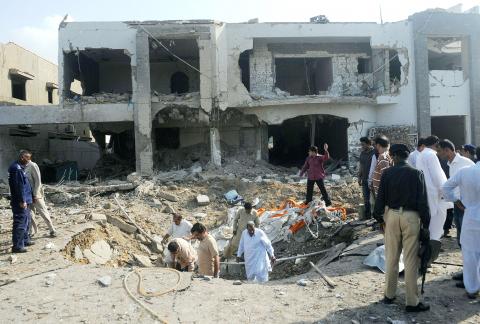
Photo: AFP
The eight people killed included six policemen guarding Aslam’s house and a mother and daughter who were passing by, Aslam said.
He estimated that at least 200kg of explosives were used in the attack.
The death toll could have been even worse if it had happened a few minutes later when many children would have been headed to schools near Aslam’s house in the Defense neighborhood of Karachi, an upscale residential area that rarely experiences militant attacks or other forms of violence that plague the city.
“Thank God it was half an hour before school time,” said former Pakistani cricket team captain Moin Khan, who passed by the site of the attack shortly after the blast.
“It was horrible. I saw four bodies,” Khan said. “Broken pieces of vehicles were scattered more than 100 feet [30.5m].”
Local TV footage showed extensive damage from the blast. The fronts of several two-story concrete buildings were totally blown away. Rubble littered the streets amid the burned wreckage of cars hit by the explosion.
Aslam is a top police officer in the Crime Investigation Department, which works to arrest Taliban fighters and other militants in Karachi, a bustling city that is home to about 18 million people and is also Pakistan’s main commercial hub.
Karachi has not seen as many militant attacks as other major cities in Pakistan, but it is believed to be home to many Taliban militants who have fled army operations in the northwest near the Afghan border.
Pakistani Taliban spokesman Ahsanullah Ahsan claimed responsibility for the attack.
“We will continue targeting all such officers who are involved in the killing of our comrades,” Ahsan said by telephone from an undisclosed location.
In related news, Pakistani intelligence officials said yesterday soldiers seized the wreckage of a suspected US drone that crashed in the South Waziristan tribal area near the Afghan border and was initially snatched by the Taliban.
Troops fought the militants for roughly 24 hours and eventually called in helicopter gunships to wrest control of the wreckage, the officials said on condition of anonymity because they were not authorized to talk to the media.
Eight militants were killed and three soldiers were wounded in the fighting, they said.
Ahsan, the Taliban spokesman, confirmed the army had seized control of the wreckage, but denied any militants died in the fighting. He claimed the Taliban shot down the drone on Saturday night using an anti-aircraft gun.
Intelligence officials said army engineers were inspecting the wreckage to determine the cause of the crash.
Neither the army nor the US embassy has responded to requests for comment on the crash.
The US normally does not acknowledge the covert CIA-run drone program in Pakistan, but US officials have said privately that the attacks have killed many high-level militants. Drone crashes have happened before in Pakistan, but they are rare.
ROCKY RELATIONS: The figures on residents come as Chinese tourist numbers drop following Beijing’s warnings to avoid traveling to Japan The number of Chinese residents in Japan has continued to rise, even as ties between the two countries have become increasingly fractious, data released on Friday showed. As of the end of December last year, the number of Chinese residents had increased by 6.5 percent from the previous year to 930,428. Chinese people accounted for 22.6 percent of all foreign residents in Japan, making them by far the largest group, Japanese Ministry of Justice data showed. Beijing has criticized Tokyo in increasingly strident terms since Japanese Prime Minister Sanae Takaichi last year suggested that a military conflict around Taiwan could

A pro-Iran hacking group claimed to breach FBI Director Kash Patel’s personal e-mail inbox and posted some of the contents online. The e-mails provided by the hacking group include travel details, correspondence with leasing agents in Washington and global entry, and loyalty account numbers. The e-mail address the hackers claim to have compromised has been previously tied to Patel’s personal details, and the leaked e-mails contain photos of Patel and others, in addition to correspondence with family members and colleagues. “The FBI is aware of malicious actors targeting Director Patel’s personal email information,” the agency said in a statement on

RIVALRY: ‘We know that these are merely symbolic investigations initiated by China, which is in fact the world’s most profligate disrupter of supply chains,’ a US official said China has started a pair of investigations into US trade practices, retaliating against similar probes by US President Donald Trump’s administration as the superpowers stake out positions before an expected presidential summit in May. The move, announced by the Chinese Ministry of Commerce on Friday, is a direct mirror of steps Trump took to revive his tariff agenda after the US Supreme Court last month struck down some of his duties. “China expresses its strong dissatisfaction and firm opposition to these actions,” a ministry spokesperson said in a statement, referring to the so-called Section 301 investigations initiated on March 11.

When a hiker fell from a 55m waterfall in wild New Zealand bush, rescuers were forced to evacuate the badly hurt woman without her dog, which could not be found. After strangers raised thousands of dollars for a search, border collie Molly was flown to safety by a helicopter pilot who was determined to reunite the pet and the owner. A week earlier, an emergency rescue helicopter found the woman with bruises and lacerations after a fall at a rocky spot at the waterfall on the South Island’s West Coast. She was airlifted on March 24, but they were forced to


 RSS
RSS