


They rappel off an 11m height in seconds, run with an open parachute strapped to their shoulders, march with a heavy pack and brave a gas-filled chamber.
It could be a typical day at the South Korean army’s Special Warfare Command base in western Seoul — except that the “soldiers” are teenage boys and young women, often accompanied by their families.
The army’s twice-yearly “boot camps” for civilians, offering basic military training for four days, began in 2003 and have proved a big hit. They are open to anyone aged over 13 who pays 40,000 won (US$36) and have drawn more than 17,000 people so far.
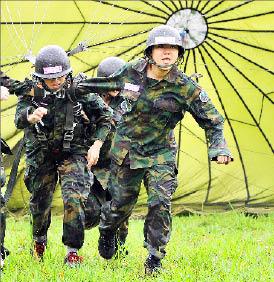
Photo: AFP
Military culture is deeply ingrained in South Korea and all able-bodied men are subject to a mandatory two years of conscription to guard against attacks from North Korea.
Boot camps — run by the military or private firms — have become increasingly popular in recent years, drawing people ranging from nostalgic veterans to schoolchildren, company employees and those seeking special family vacations.
“Boys obviously make up the biggest part because they have the mandatory service coming up,” said Major Lee Joo-ho, a boot camp spokesman. “But more young women are showing an interest, since they were allowed to join a college-based officer commissioning program last year.”
On a typical day this month the muddy training field at Gangseo echoed to squeals, screams and shouts from 230 participants on their third day of training.
In pouring rain, youths practiced a mock parachute landing — jumping into a sandbox with their hands in the air and repeating instructions to land on the balls of the feet.
“Yes, sir! I can do it!” they shouted, hitching up baggy, rain-drenched uniform trousers with sneakers peeking out underneath.
“Let me hear your voice! Shout out your girlfriend’s name real loud!” a military instructor commands a boy climbing down a cable from a 20m platform to simulate a descent from a helicopter.
The nervous-looking trainee murmurs inaudibly, prompting the stern-looking commando to grab the cable and leave him in mid-air.
“Is this what you got? Louder!” he orders repeatedly, until the boy finally yells “I love you, Choi Yoon!” and is allowed to descend.
Fifteen-year-old Yeom Hyuck said he was “very nervous but thrilled” before he hurled himself off an 11m parachute jump tower and ziplined to the ground.
“Everything is fun — but right now I miss my parents,” he said.
Kim Tae-Hoon, 17, said his father’s dream of joining the army was foiled by poor eyesight. The father pushed his son to attend camp as soon as he turned 13. Since then, Kim has been back every summer and winter — a total of nine times.
“This is so good at relieving stress and much more fun than just playing computer games,” he said.
Since last winter Kim has been joined by his younger brother Tae-Hun, who found it “so thrilling” even to experience the gas-filled chamber, designed to test training against chemical attacks.
“I’m glad I’ve lost some weight ... and I feel more like a man,” said the chubby, red-cheeked 13-year-old.
Not everyone was so thrilled. Cho Byung-Chan, panting hard after rappel training, said he was “a little bit” angry with his parents for sending him.
“They said I need to grow up,” said the 15-year-old, who usually spends school breaks playing computer games.
“It’s hard ... I’m hungry,” he said.
Former army commando Yoon Jeong-Sik was spending his summer vacation at the boot camp with his two daughters and wife, 24 years after retiring from the same unit.
Yoon said he wants his family to learn what he did — self-confidence, pride and how to get along with others.
“So I cajoled my ladies into coming here for character education,” said the 47-year-old, water dripping from his hair and soaking his uniform after a mock river crossing.
“At first they were pretty jolly since they had no idea how hard it would be ... now I’m trying not to meet their eyes,” he said, bursting into laughter with his family.
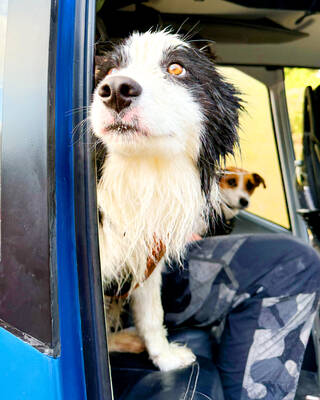
When a hiker fell from a 55m waterfall in wild New Zealand bush, rescuers were forced to evacuate the badly hurt woman without her dog, which could not be found. After strangers raised thousands of dollars for a search, border collie Molly was flown to safety by a helicopter pilot who was determined to reunite the pet and the owner. A week earlier, an emergency rescue helicopter found the woman with bruises and lacerations after a fall at a rocky spot at the waterfall on the South Island’s West Coast. She was airlifted on March 24, but they were forced to
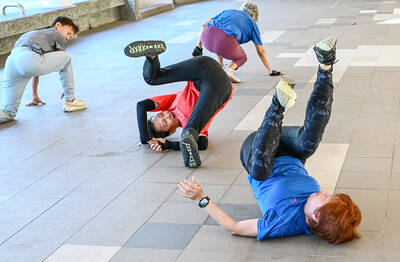
CONFIDENCE BOOSTER: ’After parkour ... you dare to do a lot of things that you think only young people can do,’ a 67-year-old parkour enthusiast said In a corner of suburban Singapore, Betty Boon vaults a guardrail, crawls underneath a slide, executes forward shoulder rolls and scales a steep slope, finishing the course to applause. “Good job,” the 69-year-old’s coach cheers. This is “geriatric parkour,” where about 20 retirees learned to tackle a series of relatively demanding exercises, building their agility and enjoying a sense of camaraderie. Boon, an upbeat grandmother, said learning parkour has aided her confidence and independence as she ages. “When you’re weak, you will be dependent on someone,” she said after sweating it out with her parkour classmates in suburban Toa Payoh,

Chinese dissident artist Gao Zhen (高兟), famous for making provocative satirical sculptures of former Chinese leader Mao Zedong (毛澤東), was tried on Monday over accusations of “defaming national heroes and martyrs,” his wife and a rights group said. Gao, 69, who was detained in 2024 during a visit from the US, faces a maximum three-year prison sentence, said his wife, Zhao Yaliang (趙雅良), and Shane Yi, a researcher at the Chinese Human Rights Defenders group which operates outside the nation. The closed-door, one-day trial took place at Sanhe City People’s Court in Hebei Province neighboring the capital, Beijing, and ended without a

‘TOXIC CLIMATE’: ‘I don’t really recognize Labour anymore... The idea that you can implement far-right ideas in order to stop the far right is nonsense,’ a protester said Tens of thousands of people on Saturday marched through central London to protest against the far right, weeks ahead of local elections and six months after Britain saw one of its largest far-right demonstrations. Organized by hundreds of civic groups, including trade unions, anti-racism campaigners and Muslim representative bodies, Saturday’s Together Alliance event was billed as the biggest in UK history to counter right-wing extremism. A separate pro-Palestinian march had also converged with the main rally. While organizers claimed 500,000 had turned out in total, the police gave a figure of about 50,000. Protesters carrying placards with slogans such as


 RSS
RSS