


Mexico’s popular songs glorifying its drug traffickers, known as narcocorridos, have attracted a growing following in recent years, from Mexico City to Los Angeles.
However, authorities in Sinaloa State for the first time banned the ballads in May, surprising many in the home state of Mexico’s oldest drug cartel, the Sinaloa cartel, where drug trafficking and its often ostentatious culture are omnipresent.
The ballads are part of a -decades-old drug culture, but the new wave of narcocorrido is more gruesome than ever with tales of the life and loves of drug traffickers and accounts of bloody clashes with security forces.
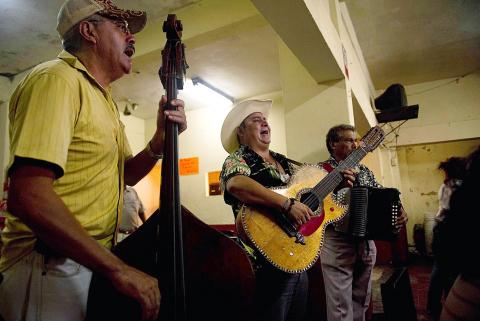
PHOTO: AFP
Sinaloa State, which lies on the Pacific coast, is one of the three most violent states in the country, recording 2,505 murders last year, according to national statistics.
Killings in parts of Mexico have shot up in recent years amid a military crackdown on organized crime that has sent soldiers onto the streets.
Sinaloa authorities issued the ban on narcocorridos in places selling alcohol to avoid “excuses for crime” and to try to reduce the murder rate, Sinaloa Governor Gerardo Vargas Landeros said.
Narcocorridos gained popularity in the 1970s and 1980s, with their tales of danger and the exciting lives of drug barons, such as Felix Gallardo, who is now in jail.
However, the newer songs have taken a darker turn, in what is nicknamed Movimiento Alterado or “Altered Movement,” with songs focusing on weapons and the ever more gruesome ways in which scores are being settled.
“They had very sophisticated weapons in their possession. They had .50 caliber [weapons] and they used grenades, bazookas and AK-47s. They came in armored cars ... They put up a roadblock ... and all hell broke loose. They fought for almost an hour ... the men died under a hail of bullets,” one ballad recounts.
That song, the tale of a clash between soldiers and hitmen for “El Chapo” — the billionaire fugitive head of the Sinaloa cartel — is one of the most popular, said Aldo Alberto Garcia, a member of a band called Los Tres de Sinaloa.
The Altered Movement got its start distributing songs on the Internet shortly after Mexican President Felipe Calderon ordered 50,000 troops into battle against organized crime gangs at the end of 2006.
Since then, beheadings, mutilations and shootouts have increased as the gangs fight each other and security forces in a bloodletting that has claimed 41,000 lives, according to media counts.
The songs reflect the shifting realities.
“We’ve started to see a change in narcocorrido toward hyper--violence,” said Juan Carlos Ramirez-Pimienta, an academic from the University of San Diego, California, who recently published a book on the ballads.
“The production of narcocorridos is immense, it’s impossible to work out how many bands exist,” he added.
And despite the ban in Sinaloa, which follows similar moves in the country’s most violent state of Chihuahua and the border city of -Tijuana, the music plays on.
The Sinaloa government has so far closed 36 establishments out of 5,400 in the state for playing narcocorridos, according to official figures.
“I don’t play them any more on my program,” said radio presenter Jorge Ramos, whose company toes the government line and sees the songs as a small part of the overall market.
However, narcocorridos ring out from other radio stations on the streets and in music videos in bars and restaurants throughout the mountainous state.
Bands still play in seedy bars near the market in Culiacan, the state capital, where stalls sell narcocorrido CDs as well as bright T-shirts bearing images of weapons and jewel-incrusted gun handles.
Performers in cowboy hats gather every night on a central street of Culiacan, where they hope to be hired to play a song.
They may be paid by drug lords to write about their exploits and some are also known to perform for the drug gangs.
“Whether narcocorridos exist or not, the violence won’t stop. As long as there’s drug trafficking, this music will continue,” said one singer, a guitar slung over his back.

Through the noise of rushing papers and whirring belts at a print factory in Kyoto, two creators watch their photo essay come to life in broadsheet form — part of an effort to win new audiences in the age of artificial intelligence (AI). Despite the decline of the publishing industry, self-publication and handmade “zine” magazines are growing in popularity in Japan, reflecting the nation’s enduring love of paper in the digital era. While speaking to Agence France-Presse at the plant, his hands black with ink, one of the creators, Kazuma Obara, said: “I think [paper] is a medium that engages all five

‘CROSSING THE LINE’: China’s embassy in Seoul criticized US Forces Korea Commander General Xavier Brunson, asking if his ‘hostile’ remarks were authorized by Washington South Korea and the US are in talks over recent public remarks by the commander of US Forces Korea, Seoul’s presidential office said yesterday, after the comments drew sharp criticism from China. In a recent podcast interview, US Forces Korea Commander General Xavier Brunson described South Korea as “the dagger in the heart of Asia” from China’s east coast, prompting the Chinese embassy in Seoul to say that he had “truly crossed the line.” The interview came amid growing speculation that Washington might seek to expand the role of US Forces Korea in countering the growing regional influence of China, a key

Australian researchers have trained lab-grown brain cells on a silicon computer chip to play the 1990s shooter game Doom and said they are just scratching the surface of what the neurons could be capable of doing. It is the science-fiction work of biotech boffins at Cortical Labs, who researched and developed the technology that harnesses the workings of the brain’s networking system. Each so-called “biological computer” contains about 200,000 living human brain cells, grown from stem cells that were harvested from blood donations. Having mastered the simple computer game Pong, where a paddle is moved up and down to send a ball

France experienced its hottest spring on record, the French weather service said on Tuesday, after an exceptional early heat wave that also broke highs for the season in England and Wales. Meteo-France said the average nationwide temperature over March to May was 13.8°C — about 1.7°C above the norm, and surpassing records set in 2011 and 2020. “The warmest spring since records began in 1900,” it said in a bulletin. All three months were warmer than average, but the onset of an “unprecedented heatwave” late last month pushed the mercury to highs typically seen at the height of the summer. “Our country had never


 RSS
RSS