


Singapore yesterday took over an historic train station and large tracts of railway land from Malaysia as part of a multibillion US dollar deal that removed an old irritant between the neighbors.
The last train to Malaysia’s capital, Kuala Lumpur, left before the Thursday midnight deadline from Tanjong Pagar station, a 79-year-old art deco structure in downtown Singapore that will be preserved as a monument.
Starting yesterday, all rail services to Kuala Lumpur will leave from a modern facility in northern Singapore, linked by a causeway to Malaysia’s Johor state.
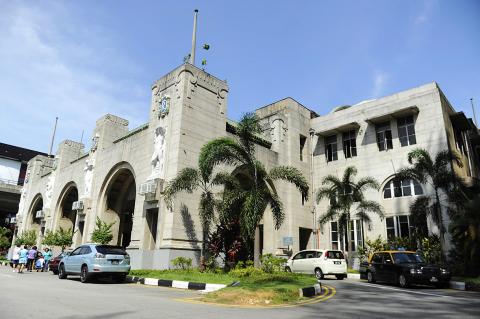
Photo: AFP
With a sentimental final blast of a horn, Johor’s Sultan Ibrahim Iskandar drove a train carrying railway staff in their blue uniforms back to Malaysia as hundreds of onlookers recorded the event with cameras and mobile phones.
The festive handover resolved a longstanding gripe among Singaporeans over Malaysia’s continued ownership of land running deep into Singapore’s territory, well after the two countries’ acrimonious separation.
Ownership of the railway property was among the issues that took decades to negotiate after Singapore was ejected from the Malaysian federation in 1965 over differences in racial and other policies with Kuala Lumpur.
In a statement, Singaporean Prime Minister Lee Hsien Loong (李顯龍) called the handover an “historic breakthrough in bilateral relations” and thanked Malaysian Prime Minister Najib Razak for making the deal possible.
“With the closing of this chapter, our countries can now move ahead to advance our many shared interests,” Lee added.
In addition to the station, built in 1932 when the two countries were still British colonies, Singapore took possession of 174 hectares of rail land, some cutting through exclusive residential areas.
For its part in the deal, Malaysia received 60 percent control of a joint company that will develop prime land parcels around Marina Bay, Singapore’s fashionable new financial and entertainment zone.
The six plots have an estimated market value of S$11 billion (US$8.8 billion) after development, according to state investment agencies from both countries.
Singapore could also reap a fortune from the recovered rail land, but to its fans, the closure of the iconic Tanjong Pagar station represented more than commercial gain and territorial pride.
The station earned widespread affection as a transport hub, meeting place, tourist attraction and colorful home for Malay, Indian and Chinese food stalls reflecting the two countries’ immigrant roots.
Singapore says the three-story station, with four prominent sculptures on its stone facade, will be preserved as a national monument, easing fears it would be torn down to make way for another shopping mall or condominium.
The government has not decided what to do with the rail land between Tanjong Pagar and the new station that now handles train services to Malaysia.
Nature and heritage groups have urged Singapore authorities to turn the land into a green corridor of parks and paths.

An American scientist convicted of lying to US authorities about payments from China while he was at Harvard University has rebuilt his research lab in Shenzhen, China, to pursue technology the Chinese government has identified as a national priority: embedding electronics into the human brain. Charles Lieber, 67, is among the world’s leading researchers in brain-computer interfaces. The technology has shown promise in treating conditions such as amyotrophic lateral sclerosis and restoring movement in paralyzed people. It also has potential military applications: Scientists at the Chinese People’s Liberation Army have investigated brain interfaces as a way to engineer super soldiers by boosting

Indonesian police have arrested 13 people after shocking images of alleged abuse against small children at a daycare center went viral, sparking outrage across the nation, officials said on Monday. Police on Friday last week raided Little Aresha, a daycare center in Yogyakarta on Java island, following a report from a former employee. CCTV footage circulating on social media showed children, most younger than two, lying on the floor wearing only diapers, their hands and feet bound with rags. The police have confirmed that the footage is authentic. Police said they also found 20 children crammed into a room just 3m by 3m. “So
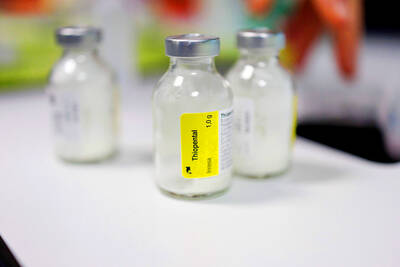
A grieving mother has ended her life at a clinic in Switzerland four years after the death of her only child. Wendy Duffy, 56, a physically healthy woman, died at the Pegasos clinic in Basel after struggling to cope with the death of her 23-year-old son, Marcus. The former care worker, from the West Midlands, England, had previously attempted to take her own life. The case comes as assisted dying would not become law in England and Wales after proposed legislation, branded “hopelessly flawed” by opponents, ran out of time. Ruedi Habegger, the founder of Pegasos, described Duffy’s death as

From post offices and parks to stations and even the summit of Mount Fuji, Japan’s vending machines are ubiquitous, but with the rapid pace of inflation cooling demand for their drinks, operators are being forced to rethink the business. Last month beverage giant DyDo Group Holdings announced it would remove about 20,000 vending machines — about 7 percent of their stock nationwide — by January next year, to “reconstruct a profitable network.” Pokka Sapporo Food & Beverage, based in Nagoya, also said last month it would sell its 40,000-machine operation to Osaka-based Lifedrink Co. “The strength of the vending machine


 RSS
RSS