


Dancers writhe between bedposts to the thumping beat of a Lady Gaga anthem, surrounded by patrons on oversized gold sofas sipping whisky cut with green tea.
Decadence is the central theme at Shanghai’s Phebe 3D, which looks like a psychedelic 21st-century Chinese imperial court.
Between the chandeliers and strobe lights, paintings of French aristocrats hang above the packed dance floor. The crush of bodies parts for parades of waiters carrying ice buckets, with champagne and burning sparklers inside.
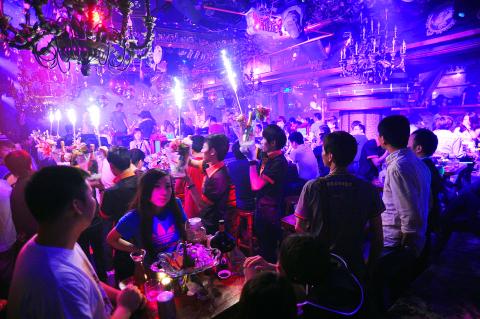
Photo: AFP
Welcome to Shanghai’s new nightlife, provincial-style.
Phebe 3D is one of several clubs developed by owners from China’s hinterlands who are breaking the mould, bringing local flair to a scene once dominated by uber-chic establishments like those in New York, London or Berlin. Their success is even more impressive in Shanghai, whose residents are known for looking down on people from the rest of China.
At No. 88, a concept transported from southern Nanning near the Vietnam border, the decor is Versailles-meets-Jules Verne — chandeliers, stained glass and mahogany walls compete with giant gears, steam pipes and steel fan blades.
“Customers are always surprised the first time they come in. They never thought a bar could look like this,” No. 88 manager Xue Ye said.
The quirky style is the vision of a group of singers, dancers and other entertainment veterans from Nanning, who started their first club in their hometown in 2005 and quickly expanded, Xue said.
They will open five new clubs this year around the country for a total of 24 which, in addition to the No. 88 brand, operate under the names In, Show, Latte and No. 66.
The group opened bars in second and third-tier cities such as Maoming, Zhuhai and Haikou — little known outside China, but home to millions — before tackling Shanghai in 2009.
“When we came to Shanghai, our competitors all laughed at us, saying we wouldn’t last six months. They thought waidiren could not succeed in the bar industry in Shanghai,” Xue said, using the word for people from outside Shanghai. “There had been many failures.”
Xue credits his group’s success in Shanghai on its outsider perspective.
“We understood what people from other places want to find in a unfamiliar city: warmth,” Xue said.
After the pressure valves and velvet, the other striking characteristic of No. 88 is the peppiness of the waiters, who Xue said are encouraged to dance with customers to US R&B and hip hop hits.
Despite the opulence inside, and the Porsches and Ferraris parked outside, students and middle-class patrons are crucial.
“We need the atmosphere. Even rich people don’t want to drink in a quiet place,” Xue said.
Unlike the club scenes in other major Chinese cities, which are often built on underground and anti-corporate movements, No. 88 and Phebe 3D are all about projecting wealth, said Jake Newby, nightlife editor for Time Out Shanghai.
“The big VIP tables are positioned on raised platforms and you look out over the whole club and you feel like you’re a mafioso don, running the whole thing. A waiter walks through the entire club with a bottle of champagne and sparklers and heads are turning, looking in your direction,” Newby said. “They are must-see places. They’re fascinating places to take people to.”
China is entering a golden age for nightlife, said Huang Xixi, chairman of Phebe 3D in Shanghai.
“Chinese people’s taste and consumption patterns are maturing,” Huang said. “People born in the ’90s know how to enjoy life. They are very different from their parents’ generation.”
Launching in Shanghai last year was an important milestone for his club’s group, which started in the southeastern shipbuilding city of Fuzhou, he said.
“Shanghai is a very good platform for us to expand because once you’ve made it in Shanghai, you can move on to the world,” Huang said.
The Phebe 3D team recently took over the Paramount — a legendary 1930s Art Deco Shanghai dance hall — but Huang declined to talk about further expansion plans.

Through the noise of rushing papers and whirring belts at a print factory in Kyoto, two creators watch their photo essay come to life in broadsheet form — part of an effort to win new audiences in the age of artificial intelligence (AI). Despite the decline of the publishing industry, self-publication and handmade “zine” magazines are growing in popularity in Japan, reflecting the nation’s enduring love of paper in the digital era. While speaking to Agence France-Presse at the plant, his hands black with ink, one of the creators, Kazuma Obara, said: “I think [paper] is a medium that engages all five
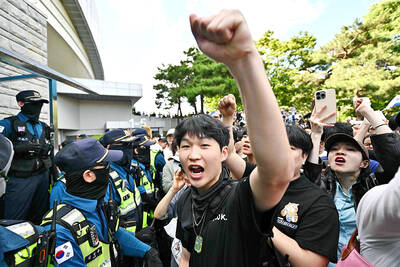
‘ABSURD MISTAKE’: The election commission said that there had been a failure to anticipate turnout after 14 polling stations ran short of ballot papers South Korean riot police yesterday cleared protesters from a Seoul polling station after a 35-hour blockade sparked by a shortage of ballot papers during local elections earlier this week. Wednesday’s election was the first nationwide vote since South Korean President Lee Jae-myung took office following the ouster of Yoon Suk-yeol over his short-lived martial law declaration. Lee’s ruling Democratic Party swept most races, but failed to flip the crucial Seoul mayoral seat. The South Korean National Election Commission apologized, blaming a failure to anticipate turnout after 14 polling stations in Seoul ran short of ballot papers. Some polling stations stayed open until 10pm to

Australian researchers have trained lab-grown brain cells on a silicon computer chip to play the 1990s shooter game Doom and said they are just scratching the surface of what the neurons could be capable of doing. It is the science-fiction work of biotech boffins at Cortical Labs, who researched and developed the technology that harnesses the workings of the brain’s networking system. Each so-called “biological computer” contains about 200,000 living human brain cells, grown from stem cells that were harvested from blood donations. Having mastered the simple computer game Pong, where a paddle is moved up and down to send a ball

France experienced its hottest spring on record, the French weather service said on Tuesday, after an exceptional early heat wave that also broke highs for the season in England and Wales. Meteo-France said the average nationwide temperature over March to May was 13.8°C — about 1.7°C above the norm, and surpassing records set in 2011 and 2020. “The warmest spring since records began in 1900,” it said in a bulletin. All three months were warmer than average, but the onset of an “unprecedented heatwave” late last month pushed the mercury to highs typically seen at the height of the summer. “Our country had never


 RSS
RSS