


Chinese riot police brought a semblance of calm to the riot-torn southern Chinese city of Zengcheng yesterday, but the anger of migrant workers at being discriminated against by the authorities remained palpable in this key export hub.
In the wake of the latest protests, a state think-tank warned that China’s tens of millions of workers pouring into cities from the countryside would become a serious threat to stability unless they were treated more fairly.
Riot police poured into Zengcheng after migrant workers went on the rampage over the weekend to protest the abuse of a pregnant street hawker who had become a symbol of simmering grassroots discontent.
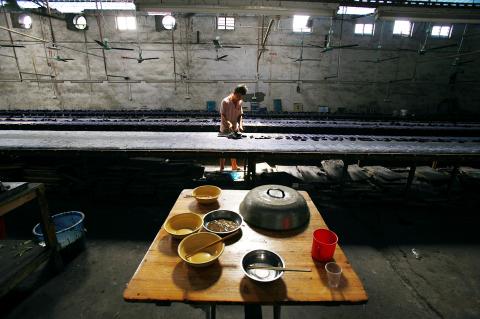
Photo: Reuters
The protesters wrecked the government office in the city’s Dadun suburb, setting alight at least six vehicles. Parts of iron gates and spiked fence lay twisted and broken.
“We’re angry,” a migrant worker from Sichuan Province said, nervous about revealing his name given the massive deployment of riot police in his neighborhood.
“I feel the rule of law here doesn’t seem to exist ... the local officials can do what they want,” he said.
Zengcheng is about an hour’s drive from Guangzhou, the affluent capital of Guangdong Province, which produces about a third of the country’s exports. About 150 million workers have moved from the countryside to the city in search of a better standard of living.
SECOND-CLASS CITIZENS
Wages have improved, but there remains a stark gap between migrant workers and those originally from the city, which has fomented resentment and made many feel like second-class citizens.
Other clashes have erupted in southern China in recent weeks, including in Chaozhou, where hundreds of migrant workers demanding payment of wages at a ceramics factory attacked government buildings and set vehicles ablaze.
“We have seen these kinds of disturbance on a regular basis in China for several years now. I think you can possibly say there has been a bit of an upsurge, certainly visible disturbance in the last few weeks,” said Geoffrey Crothall of workers’ rights group China Labour Bulletin.
“I don’t think it will affect the investment environment in China as a whole. I think the impact of these disturbances on the Chinese economy as a whole are still very low level,” he added.
Zengcheng, surrounded by a warren of tenement blocks and small jeans factories, has become a vibrant export hub for garments. More than half of the city’s population of 800,000 are migrant workers, many of whom are from Sichuan.
Like millions of other migrant workers in the Pearl River Delta, those at Zengcheng say their already grim lives have become worse because of rampant inflation and discrimination.
Many migrant workers in Dadun complained about corrupt officials making random street arrests of hawkers, imposing discretionary “hygiene” charges and security fines on family-run denim factories, further eroding razor-thin earnings as the price of cotton yarn and wholesale denim fabric rise.
“We sometimes only earn several hundred yuan a month because we’re paid per garment. There tend to be less orders in the first half of the year,” a middle-aged woman from Sichuan said as she stitched a pile of black-denim shorts while colleagues used abrasive tools to rip and scar jeans for a modish look.
Pork, a staple for many migrant workers, has increased from about 9 yuan (US$1.39) to 13 yuan for half a kilogram over the past year, said Yu, the elderly migrant worker.
NO CHOICE
“We have no choice, we just have to make a living,” he said in a grimy jeans factory where he was printing labels for a local brand. “We can’t go home.”
The state think-tank report said the majority of migrant workers had no intention of returning to their rural origins, making them a serious threat to China’s stability if their needs in the cities they now call home, were not better addressed.
“If they are not absorbed into urban society, and do not enjoy the rights that are their due, many conflicts will accumulate,” the report published yesterday said.
“If mishandled, this will create a major destabilizing threat,” it said of the festering resentment.
ROCKY RELATIONS: The figures on residents come as Chinese tourist numbers drop following Beijing’s warnings to avoid traveling to Japan The number of Chinese residents in Japan has continued to rise, even as ties between the two countries have become increasingly fractious, data released on Friday showed. As of the end of December last year, the number of Chinese residents had increased by 6.5 percent from the previous year to 930,428. Chinese people accounted for 22.6 percent of all foreign residents in Japan, making them by far the largest group, Japanese Ministry of Justice data showed. Beijing has criticized Tokyo in increasingly strident terms since Japanese Prime Minister Sanae Takaichi last year suggested that a military conflict around Taiwan could

A pro-Iran hacking group claimed to breach FBI Director Kash Patel’s personal e-mail inbox and posted some of the contents online. The e-mails provided by the hacking group include travel details, correspondence with leasing agents in Washington and global entry, and loyalty account numbers. The e-mail address the hackers claim to have compromised has been previously tied to Patel’s personal details, and the leaked e-mails contain photos of Patel and others, in addition to correspondence with family members and colleagues. “The FBI is aware of malicious actors targeting Director Patel’s personal email information,” the agency said in a statement on

RIVALRY: ‘We know that these are merely symbolic investigations initiated by China, which is in fact the world’s most profligate disrupter of supply chains,’ a US official said China has started a pair of investigations into US trade practices, retaliating against similar probes by US President Donald Trump’s administration as the superpowers stake out positions before an expected presidential summit in May. The move, announced by the Chinese Ministry of Commerce on Friday, is a direct mirror of steps Trump took to revive his tariff agenda after the US Supreme Court last month struck down some of his duties. “China expresses its strong dissatisfaction and firm opposition to these actions,” a ministry spokesperson said in a statement, referring to the so-called Section 301 investigations initiated on March 11.

When a hiker fell from a 55m waterfall in wild New Zealand bush, rescuers were forced to evacuate the badly hurt woman without her dog, which could not be found. After strangers raised thousands of dollars for a search, border collie Molly was flown to safety by a helicopter pilot who was determined to reunite the pet and the owner. A week earlier, an emergency rescue helicopter found the woman with bruises and lacerations after a fall at a rocky spot at the waterfall on the South Island’s West Coast. She was airlifted on March 24, but they were forced to


 RSS
RSS