


At the tender age of 13, Nathan Voogd already had his dad Piet’s permission to help “drive” the family’s 165-year-old Dutch windmill called “De Hoop” (The Hope), which towers over the quaint southern Dutch town of Ouddorp.
About 160km to the northeast, Eric Dudink, 49, keeps out a close eye for a breeze on a quiet day to turn the massive wings of his own windmill, “De Krijgsman” (The Warrior), a windmill that traces its history as far back as 1602.
However, unlike more than 1,000 other tourist-attracting counterparts that dot the Dutch landscape and are as iconic as tulips and cheese, you will not find sightseers at the Voogd family and Dudink’s windmills.
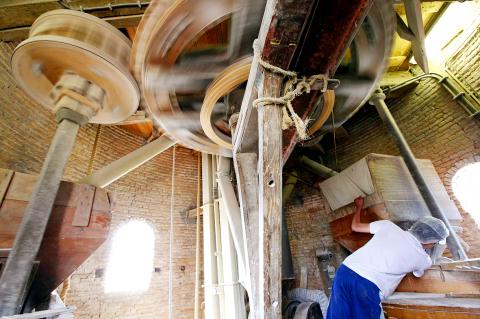
Photo: AFP
For these are so-called “trades mills” and remain part of a handful of old Dutch windmills still used today by their owners to commercially produce flour.
“In the whole of the Netherlands, there are about 20 or so mills left that produce flour from their millstones,” said Dudink, who bought the “De Krijgsman” 16 years ago in the northern Dutch fishing town of Hoorn. “Of those 20 or so, only eight have full-time millers.”
Dependent on the strong breezes sweeping in over the Marker lake, Dudink reminds one of Hoorn’s famous ancient seafarers, as he stands on the 20m scaffolding of the “De Krijgsman.”
The old mill’s innards bear a remarkable resemblance to the inside of an ancient sailing ship as it creaks and strains against the wind that drives its wooden cogs and gears.
It is here where the two millstones are housed to rotate and grind out top quality flour, including what Dudink claims to be “the best pancake flour in the Netherlands,” packaged in bags of 1kg, 2kg and 5kg bearing the “De Krijgsman” logo.
In Ouddorp, in southern Holland, the “De Hoop” windmill is run by Piet Voogd, 51, and his sons Niels, 21, Jordi, 17, and Nathan — who at the age of eight started helping and is now well on his way to become the sixth-generation of Voogd millers.
“We grew up with this mill,” said Nathan Voogd as he steers “De Hoop’s” wings into the wind.
Both the “De Hoop” mill and “De Krijgsman” are used to drive the massive milling stones — which can weigh as much as 1.3 tonnes.
Total production at the Voogd mill runs to about 50 tonnes a week, of which five tonnes are produced by the windmill. The other 45 tonnes are made inside the Voogds’ milling factory by a set of electrically driven stones.
A well-regarded brand in the Netherlands, Voogd milling supplies flour to the mega-supermarket chain Albert Hein and exports to Belgium as well.
While at “De Krijgsman” — Dudink supplies Spar supermarkets among others, and is also looking for export -opportunities including to Canada — production on a yearly basis is split in half between “green” wind power and electricity.
Despite hardships, traditional Dutch millers believe their age-old art will endure and that they will continue to produce flour in the old way — flour with a taste they say can not be replicated through any mechanical process.
Fred Prins, who runs another Dutch trades mill, the 217-year-old “De Walvisch” (The Whale) in Schiedam, south of The Hague, says: “In 200 years from now, things like computers and cellphones made today will most certainly not be there any more, but like 200 years before today, old mills will remain and continue to make top-quality flour.”

An American scientist convicted of lying to US authorities about payments from China while he was at Harvard University has rebuilt his research lab in Shenzhen, China, to pursue technology the Chinese government has identified as a national priority: embedding electronics into the human brain. Charles Lieber, 67, is among the world’s leading researchers in brain-computer interfaces. The technology has shown promise in treating conditions such as amyotrophic lateral sclerosis and restoring movement in paralyzed people. It also has potential military applications: Scientists at the Chinese People’s Liberation Army have investigated brain interfaces as a way to engineer super soldiers by boosting

Indonesian police have arrested 13 people after shocking images of alleged abuse against small children at a daycare center went viral, sparking outrage across the nation, officials said on Monday. Police on Friday last week raided Little Aresha, a daycare center in Yogyakarta on Java island, following a report from a former employee. CCTV footage circulating on social media showed children, most younger than two, lying on the floor wearing only diapers, their hands and feet bound with rags. The police have confirmed that the footage is authentic. Police said they also found 20 children crammed into a room just 3m by 3m. “So
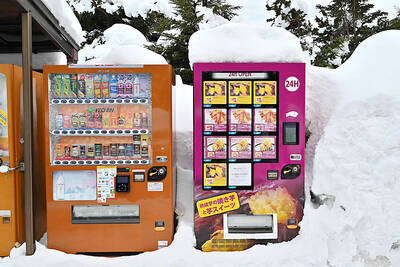
From post offices and parks to stations and even the summit of Mount Fuji, Japan’s vending machines are ubiquitous, but with the rapid pace of inflation cooling demand for their drinks, operators are being forced to rethink the business. Last month beverage giant DyDo Group Holdings announced it would remove about 20,000 vending machines — about 7 percent of their stock nationwide — by January next year, to “reconstruct a profitable network.” Pokka Sapporo Food & Beverage, based in Nagoya, also said last month it would sell its 40,000-machine operation to Osaka-based Lifedrink Co. “The strength of the vending machine

A highway bomb attack in a restive region of southwestern Colombia on Saturday killed 14 people and injured at least 38, the latest spate of violence ahead of next month’s presidential election. Authorities blamed the attack in the Cauca department — a conflict-ridden, coca-growing region — on dissidents of the now-disbanded FARC guerrilla army, who have been sowing violence across the country. “Those who carried out this attack ... are terrorists, fascists and drug traffickers,” Colombian President Gustavo Petro said on social media. “I want our very best soldiers to confront them,” he added. The leftist leader blamed the bombing


 RSS
RSS