


Hackers operating from China stole sensitive information from Western oil companies, a US security firm reported on Thursday, adding to complaints about pervasive Internet crime traced to the country.
The report by McAfee did not identify the companies, but said the “coordinated, covert and targeted” attacks began in November 2009 and targeted computers of oil and gas companies in the US, Taiwan, Greece and Kazakhstan. It said the attackers stole information on operations, bidding for oil fields and financing.
“We have identified the tools, techniques and network activities used in these continuing attacks — which we have dubbed Night Dragon — as originating primarily in China,” the report said.
The report gave no indication the attacks were anything other than standard corporate espionage that plagues businesses around the world, which the US and China have both accused each other of being deeply involved in.
The fact that oil companies were targeted may speak more to the value of their inside information than any attempt to cause damage to pipelines. McAfee called the attack methods “unsophisticated,” but said the culprits were patient: They may have been inside the networks for years.
“It looked to me like the traditional hack-to-steal-valuable-stuff,” said Josh Shaul, vice president of product management at Application Security, a New York-based database security software maker that wasn’t involved in McAfee’s research.
Application Security counts -energy companies, including oil firms, among its clients.
“It all seemed to me like someone trying to get ahead in the oil industry rather than doing something more nefarious,” Shaul said.
The intruders were prolific in their purloining, snatching files including configurations for the oil companies’ control systems, but Dmitri Alperovitch, vice president of threat research for McAfee, said they didn’t appear to be trying to figure out how to blow up a pipeline or destroy equipment.
“I got a very strong sense that was not their goal,” he said. “They expressed a much stronger interest in financial information.”
McAfee said it identified an individual in Heze, Shandong Province, who provided servers that hosted an application that controlled computers at the victim companies.
The report did not identify the man, but US news reports citing McAfee gave his name as Song Zhiyue.
Contacted by phone, Song said he was a salesman for a company, Science and Technology Internet, which rents server space. He said some of his customers were hackers, but he declined to comment on the attacks cited by McAfee. Song said he has not been contacted by Chinese authorities.
“I recently heard about Chinese hackers using US servers provided by companies like ours to attack oil companies in the US. Our company alone has a great number of hackers” as customers, Song said. “I have several hundred of them among all my customers as far as I know.”
Song said hackers using his company’s services had an estimated 10,000 “meat computers” controlled remotely without the owners’ knowledge. He said “yes” when asked whether such activities might be improper, but he said Chinese authorities never have contacted him about them. He hung up the telephone when a reporter asked for other details.
Spokesmen from several US, British and Greek oil companies said they were either unaware of the hacking or that they could not comment on security matters.
A vice president of Taiwan’s biggest oil company, CPC Corp, Taiwan, said it had detected no hacking of its computers.
The executive, Paul Chen (陳綠蔚), said it would investigate.
Taiwan’s computer crime office was not aware of the attacks, a police official said. He spoke on condition of anonymity because he was not permitted to talk to reporters.
China’s police ministry did not respond yesterday to questions about whether it knew of the attacks or was investigating them.
McAfee, based in Santa Clara, California, said the hackers worked through servers in the US and the Netherlands and used techniques -including taking advantage of vulnerabilities in the Microsoft Windows operating system.
McAfee said extraction of information occurred from 9am to 5pm Beijing time on weekdays. It said that suggested the attackers were “company men” on a regular job, rather than freelance or amateur hackers.
The attackers used hacking tools of Chinese origin that are prevalent on Chinese underground hacking forums, McAfee said.
There are no estimates of losses attributable to hacking traced to China, but McAfee has said previously that intellectual property worth an estimated US$1 trillion was stolen worldwide through the Internet in 2008.
McAfee’s report was released ahead of the annual RSA Conference next week in San Francisco. Security firms issue a flurry of reports around such conferences to promote their products and call attention to new hacking trends.

A humanoid robot that won a half-marathon race for robots in Beijing on Sunday ran faster than the human world record in a show of China’s technological leaps. The winner from Honor, a Chinese smartphone maker, completed the 21km race in 50 minutes and 26 seconds, said a WeChat post by the Beijing Economic-Technological Development Area, also known as Beijing E-Town, where the race began. That was faster than the human world record holder, Ugandan Jacob Kiplimo, who finished the same distance in about 57 minutes in March at the Lisbon road race. The performance by the robot marked a significant step forward

Four contenders are squaring up to succeed Antonio Guterres as secretary-general of the UN, which faces unprecedented global instability, wars and its own crushing budget crisis. Chile’s Michelle Bachelet, Argentina’s Rafael Grossi, Costa Rica’s Rebeca Grynspan and Senegal’s Macky Sall are each to face grillings by 193 member states and non-governmental organizations for three hours today and tomorrow. It is only the second time the UN has held a public question-and-answer, a format created in 2016 to boost transparency. Ultimately the five permanent members of the UN’s top body, the Security Council, hold the power, wielding vetoes over who leads the
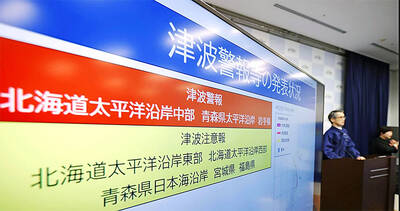
An earthquake registering a preliminary magnitude of 7.7 off northern Japan on Monday prompted a short-lived tsunami alert and the advisory of a higher risk of a possible mega-quake for coastal areas there. The Cabinet Office and the Japan Meteorological Agency said there was a 1% chance for a mega-quake, compared to a 0.1% chance during normal times, in the next week or so following the powerful quake near the Chishima and Japan trenches. Officials said the advisory was not a quake prediction but urged residents in 182 towns along the northeastern coasts to raise their preparedness while continuing their daily lives. Prime
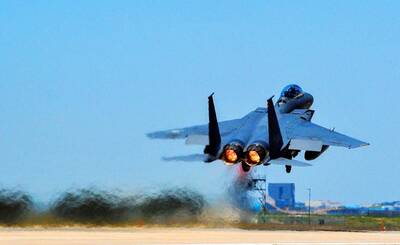
South Korea’s air force yesterday apologized for a 2021 midair collision involving two fighter jets, a day after auditors said the pilots were taking selfies and filming during the flight and held them responsible for the accident. “We sincerely apologize to the public for the concern caused by the accident that occurred in 2021,” an air force spokesman told a news conference, adding that one of the pilots involved had been suspended from flying duties, received severe disciplinary action and has since left the military. The apology followed a report released on Wednesday by the South Korean Board of Audit and Inspection,


 RSS
RSS