


Cambodian Prime Minister Hun Sen led an emotional memorial ceremony yesterday at the site of a bridge stampede in the capital that killed almost 350 people in the worst national tragedy for decades.
Hun Sen, dressed in black, wiped away a tear and burnt incense at a small altar erected at the foot of the narrow bridge, now cleared of the shoes, clothing and plastic bottles that were a grim reminder of Monday’s disaster.
Officials said throngs of revelers celebrating the nation’s annual water festival apparently panicked as rumors rippled through the crowds that the bridge to an island in Phnom Penh was about to give way.
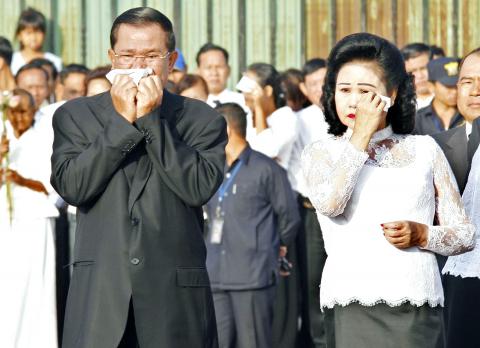
PHOTO: EPA
The death toll was revised down to 347 from 456 because some victims had been mistakenly included twice, the Social Affairs Ministry said. Of those who perished, 221 were women. Hospitals reported 395 people were injured.
At the memorial ceremony, Hun Sen’s wife, Bun Rany, stood at her husband’s side and openly cried as a military band played a somber tune. Other government officials, including Foreign Minister Hor Namhong and National Assembly President Heng Samrin, also paid their respects.
The women wore white shirts, a color of mourning in Cambodia.
Flags were flying at half-mast at government buildings across the capital, while many schools were closed and dozens of uniformed school children carrying flowers attended the early morning service.
Afterwards, streams of people, including foreigners, lined up to lay out fruit, rice and water — sustenance for the spirits of the dead — at the altar.
King Sihamoni did not attend the event, but his father, Norodom Sihanouk, the former monarch who is still highly revered by Cambodians, sent out a public letter of condolence from Beijing, where he is receiving medical treatment.
The message, which appeared in full on the front page of a local newspaper, said the event had filled him and his wife “with very profound sadness.”
Initial findings from a probe into the stampede released on Wednesday suggested a combination of factors was to blame.
“The deaths happened because the bridge was overcrowded and there was panic that the bridge was collapsing because it is hung by cables and it was swaying,” said Prum Sokha, who heads a panel investigating the tragedy.
The government has admitted it overlooked issues of crowd control, but says a private firm was in charge of security on the island and bridge where the disaster unfolded.
Phnom Penh’s police chief Touch Naruth estimated that at least 7,000 people were on the 8m wide, 100m long bridge when the stampede happened.
“It’s unfortunate, but even if we had had tens of thousands of policemen, we would still not have been able to help them because they were stuck on the bridge,” he said.
More than 4,000 police officers were deployed during the festival and thousands of other security personnel were on guard, he said.
Funerals and cremations have been taking place across the country as distressed relatives and survivors searched for answers.
“I was stamped on for an hour but I didn’t see any police coming to save me before I jumped into the water,” said Nol Socheata, an 18-year-old student.
Hun Sen has described the disaster as Cambodia’s worst tragedy since the Khmer Rouge’s 1975 to 1979 reign of terror. He said a memorial stupa would be built “to commemorate the souls of the people who lost their lives ... and to remember the serious tragedy for the nation and the Cambodian people.”
Festivalgoers had been crossing the bridge to reach an island hosting concerts and food stalls when the stampede began.
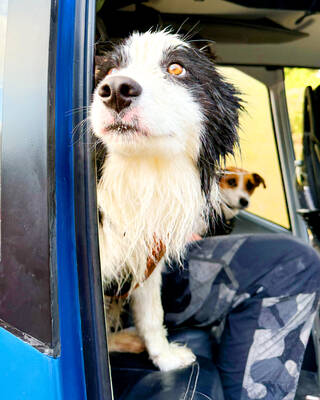
When a hiker fell from a 55m waterfall in wild New Zealand bush, rescuers were forced to evacuate the badly hurt woman without her dog, which could not be found. After strangers raised thousands of dollars for a search, border collie Molly was flown to safety by a helicopter pilot who was determined to reunite the pet and the owner. A week earlier, an emergency rescue helicopter found the woman with bruises and lacerations after a fall at a rocky spot at the waterfall on the South Island’s West Coast. She was airlifted on March 24, but they were forced to
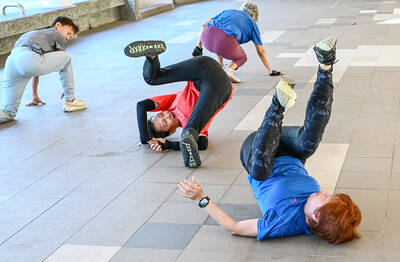
CONFIDENCE BOOSTER: ’After parkour ... you dare to do a lot of things that you think only young people can do,’ a 67-year-old parkour enthusiast said In a corner of suburban Singapore, Betty Boon vaults a guardrail, crawls underneath a slide, executes forward shoulder rolls and scales a steep slope, finishing the course to applause. “Good job,” the 69-year-old’s coach cheers. This is “geriatric parkour,” where about 20 retirees learned to tackle a series of relatively demanding exercises, building their agility and enjoying a sense of camaraderie. Boon, an upbeat grandmother, said learning parkour has aided her confidence and independence as she ages. “When you’re weak, you will be dependent on someone,” she said after sweating it out with her parkour classmates in suburban Toa Payoh,
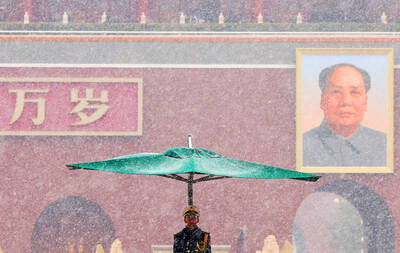
Chinese dissident artist Gao Zhen (高兟), famous for making provocative satirical sculptures of former Chinese leader Mao Zedong (毛澤東), was tried on Monday over accusations of “defaming national heroes and martyrs,” his wife and a rights group said. Gao, 69, who was detained in 2024 during a visit from the US, faces a maximum three-year prison sentence, said his wife, Zhao Yaliang (趙雅良), and Shane Yi, a researcher at the Chinese Human Rights Defenders group which operates outside the nation. The closed-door, one-day trial took place at Sanhe City People’s Court in Hebei Province neighboring the capital, Beijing, and ended without a
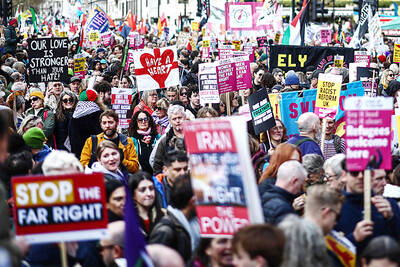
‘TOXIC CLIMATE’: ‘I don’t really recognize Labour anymore... The idea that you can implement far-right ideas in order to stop the far right is nonsense,’ a protester said Tens of thousands of people on Saturday marched through central London to protest against the far right, weeks ahead of local elections and six months after Britain saw one of its largest far-right demonstrations. Organized by hundreds of civic groups, including trade unions, anti-racism campaigners and Muslim representative bodies, Saturday’s Together Alliance event was billed as the biggest in UK history to counter right-wing extremism. A separate pro-Palestinian march had also converged with the main rally. While organizers claimed 500,000 had turned out in total, the police gave a figure of about 50,000. Protesters carrying placards with slogans such as


 RSS
RSS