


Tel Aviv has long prided itself on being a secular, cosmopolitan outpost in a land overflowing with religions, saints and shrines, but now it has its very own “messiah.”
Sitting cross-legged on the ground in a gritty part of town by a bustling open-air market, he exudes the air of a Biblical character, down to his long hair, beard and sandals.
“One year and two months ago I was an ordinary person and then a snake bit me in Bethlehem. And then I started to see God,” he said, describing how he died and was “resurrected” as the messiah.
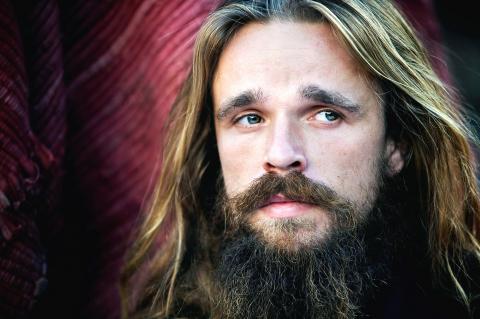
PHOTO: AFP
Calling himself only “The Messiah of Tel Aviv,” this 31-year-old Russian-born immigrant has become a fixture in a neighborhood more accustomed to beggars and bohemians before he announced he was a prophet, bringing dark warnings of the approaching apocalypse.
His story is unusual in Tel Aviv, but some observers say the “Messiah of Tel Aviv” fits a pattern all too familiar in the Holy City, which gives its name to a rare condition called Jerusalem Syndrome.
That condition largely affects tourists who come to Israel and the Palestinian territories, where holy sites of Christianity, Judaism and Islam intersect, and suddenly find themselves overwhelmed by it all, believing themselves to be characters from the Bible.
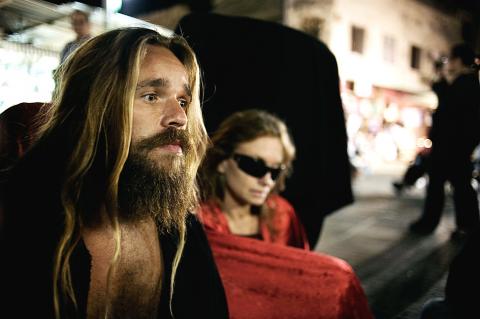
PHOTO: AFP
“They come to Jerusalem, usually to see holy places. They are so overwhelmed with feelings and expectations that, in some cases, they develop some so-called manic, ecstatic, psychotic condition,” said Grigory Katz, a psychiatrist in Jerusalem’s Kfar Shaul mental facility, and an expert on the syndrome.
The syndrome is rare, but when it strikes, it usually affects Protestant pilgrims from small-town America or Scandinavia raised in pious families whose trip to the Holy Land may be their first ever abroad, he said.
Many become convinced that they are Jesus Christ, the Virgin Mary or some other character from the Bible. Usually symptoms don’t last long.
“Some minor tranquilizers” brought one such patient back to “normalcy” within days, Katz said.
Back in Tel Aviv, the “messiah” is trying to turn on its head the adage that “Tel Aviv plays when Jerusalem prays.”
However, he has not been warmly welcomed.
“They hate me, bite me, spit on me, try to kill me,” he said of passers-by, whose jibes and jabs he endures on a daily basis. “This is the kind of thing you have to be ready for if you are messiah.”
Several months ago, he was briefly propelled to national celebrity after a YouTube clip showed him being beaten up by a burly man in a black T-shirt with the Star of David emblazoned on the back.
However, the attack, and the subsequent attention, seems only to have emboldened him.
“I wasn’t hurt because God protected me,” he said. “I don’t care if they are going to beat me once again.”
Tel Aviv’s “chosen one” claims variously to be Jesus or Moses and his philosophy seems to borrow heavily from texts associated with the Jewish mystical discipline of Kabbalah, which incorporates elements of gnosticism.
His mission, he says, is to teach people to give more, take less and let go of their ego, all before the apocalypse comes in 2012. -However, in Israel, where many hold fast to religious texts that predict that a true savior will one day come to earth to redeem humanity, claims about being the messiah are not a joking matter.
“One of the foundations of the Jewish religion is the belief in the arrival of the messiah,” said Rabbi Menachem Brod, a spokesman for the Chabad, a Hassidic Jewish movement that also has its own distinct ideas about the messiah.
“The messiah is no joke or a funny story, and he is not some kind of a weirdo. The messiah is supposed to be a very serious and great person,” he said.
Christians teach that Jesus is the messiah, a belief rejected by Judaism.
Out on the streets, another Chabadnik is slightly more blunt than Brod.
“If this guy is the Messiah, we’re screwed,” he says while handing out flyers promoting the teachings of the movement’s late leader, -Menachem Mendel Schneerson, whom many believe will eventually come back as the true messiah.
Although the Messiah of Tel Aviv has not yet attracted the masses, he does have his fans.
Sitting next to him is a thin blond in dark glasses. She is his third “wife” in less than a year, he says.
The first disappeared after she was hustled away from the market in a car by her parents. She has since started a Facebook page claiming the “messiah” abused his female followers.
The second, a Moldovan, who was deported for overstaying her visa, appears to still be a believer.
“The time will come, and it is already near, when it will be too late for you to believe that he is the true Christ, our savior,” she said in an e-mail.
ROCKY RELATIONS: The figures on residents come as Chinese tourist numbers drop following Beijing’s warnings to avoid traveling to Japan The number of Chinese residents in Japan has continued to rise, even as ties between the two countries have become increasingly fractious, data released on Friday showed. As of the end of December last year, the number of Chinese residents had increased by 6.5 percent from the previous year to 930,428. Chinese people accounted for 22.6 percent of all foreign residents in Japan, making them by far the largest group, Japanese Ministry of Justice data showed. Beijing has criticized Tokyo in increasingly strident terms since Japanese Prime Minister Sanae Takaichi last year suggested that a military conflict around Taiwan could
A pro-Iran hacking group claimed to breach FBI Director Kash Patel’s personal e-mail inbox and posted some of the contents online. The e-mails provided by the hacking group include travel details, correspondence with leasing agents in Washington and global entry, and loyalty account numbers. The e-mail address the hackers claim to have compromised has been previously tied to Patel’s personal details, and the leaked e-mails contain photos of Patel and others, in addition to correspondence with family members and colleagues. “The FBI is aware of malicious actors targeting Director Patel’s personal email information,” the agency said in a statement on
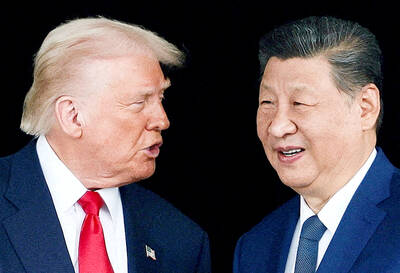
RIVALRY: ‘We know that these are merely symbolic investigations initiated by China, which is in fact the world’s most profligate disrupter of supply chains,’ a US official said China has started a pair of investigations into US trade practices, retaliating against similar probes by US President Donald Trump’s administration as the superpowers stake out positions before an expected presidential summit in May. The move, announced by the Chinese Ministry of Commerce on Friday, is a direct mirror of steps Trump took to revive his tariff agenda after the US Supreme Court last month struck down some of his duties. “China expresses its strong dissatisfaction and firm opposition to these actions,” a ministry spokesperson said in a statement, referring to the so-called Section 301 investigations initiated on March 11.

When a hiker fell from a 55m waterfall in wild New Zealand bush, rescuers were forced to evacuate the badly hurt woman without her dog, which could not be found. After strangers raised thousands of dollars for a search, border collie Molly was flown to safety by a helicopter pilot who was determined to reunite the pet and the owner. A week earlier, an emergency rescue helicopter found the woman with bruises and lacerations after a fall at a rocky spot at the waterfall on the South Island’s West Coast. She was airlifted on March 24, but they were forced to


 RSS
RSS