


At a construction site in northern China, a billboard boasts of a “liveable city” where residents can drink tap water, travel on clean energy public transport and enjoy acres of parkland.
For now, the ambitious “eco-city,” covering 30km2 of non-arable salt pans and former fishing villages, has more cranes than wind turbines and will not be finished for at least another decade.
However, its developers hope the settlement near the port city of Tianjin will serve as an ultra-efficient alternative to ill-planned and heavily polluting mega-cities not only elsewhere in the country, but around the world.
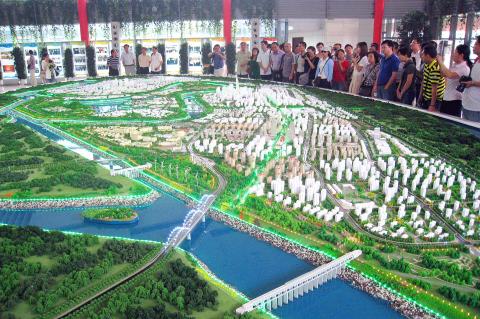
PHOTO: AFP
“We hope to influence our neighbors,” said Goh Chye Boon, chief executive of Sino-Singapore Tianjin Eco-City Investment & Development Co. “With the right ingredients, with the right eco mindset, I think together we can change the environment.”
The governments of China and Singapore have combined their expertise and finances to develop the future city, which has a planned population of 350,000 and includes schools, medical facilities and business districts.
Foreign companies such as Japan’s Hitachi and Dutch electronics giant Philips will provide green technology for the development, where buildings will be insulated and have double-glazed windows to increase energy efficiency.
Nearly two-thirds of household waste will be recycled and 20 percent of the city’s power will come from renewable energy sources such as wind and solar — with the rest coming from other sources such as highly polluting coal.
Treated sewage will be channeled into a lake which will supplement water supplies for local communities.
“Eco-cities are needed because China is facing a huge challenge of pollution,” said Hiroaki Suzuki, a top specialist in the Finance, Economic and Urban Department at the World Bank, which is assisting on the project.
“China’s serious pollution problems do not mean that it cannot develop an eco-city,” he said.
Top leaders in Beijing also hope the project will serve as a model for a long-term solution to the country’s ballooning urban population, which is putting enormous pressure on already strained water and energy resources.
China is undergoing an unprecedented urbanization process as hundreds of millions of people have headed to fast-growing metropolitan areas since the nation’s economy embarked on a fast-paced growth track more than 30 years ago.
To handle the massive influx of people, China may need to invest up to US$3.6 trillion in urban infrastructure by 2020, state media said last month, citing a report by the state think-tank China Development Research Foundation.
Greenpeace supports the development of “eco-cities” as a way to handle urban overcrowding, which it says could prevent China from curbing its world-leading carbon emissions and meeting its ambitious energy targets.
“It’s a really good idea because that is where change has to happen,” said Yang Ailun, climate and energy campaign manager for the environmental watchdog in China.
However, Yang cautioned it was very difficult for Beijing to develop truly low-carbon cities when there was no clear definition of the term, and given that the country was still developing.
China has already broken ground on a separate ecologically friendly settlement that has yet to been finished.
In 2005, then-British prime minister Tony Blair and Chinese President Hu Jintao (胡錦濤) agreed the two countries could collaborate on building the world’s first so-called “eco-city” Dongtan, near Shanghai.
The “city of the future” was meant to be showcased at this year’s World Expo in Shanghai but the settlement remains in the planning stages.
Plans for dozens of other low-carbon “eco-cities” and towns are springing up around the country, as developers rush to cash in on the green movement and government authorities seek to attract foreign investors to their regions.
China recently carried out low-carbon technology pilot projects in five provinces and eight municipalities, with the aim of rolling them out nationwide, said the country’s chief climate change official, Xie Zhenhua (謝振華).
“We hope that through our concerted efforts, we can work out incentives and policy measures that support upgrading of technologies and changing people’s consumption patterns,” Xie told reporters this week.
Goh insists the Tianjin development will not be another Dongtan — construction of the first stage is under way, with the first batch of apartments on sale and residents due to start moving in as early as next year.
“We are far from the Dongtan example — we have got over the master plan stage and are executing it now,” he said.
At the sprawling site, several buildings are under construction, some streets have been paved and marked, trees planted and wind-solar powered street lights erected.
It is a long way from the miniaturized model on display in the exhibition hall, which shows hundreds of high-rise buildings surrounded by 1,500 hectares of parks and wetlands, broken up by crystal-clear waterways.

When a hiker fell from a 55m waterfall in wild New Zealand bush, rescuers were forced to evacuate the badly hurt woman without her dog, which could not be found. After strangers raised thousands of dollars for a search, border collie Molly was flown to safety by a helicopter pilot who was determined to reunite the pet and the owner. A week earlier, an emergency rescue helicopter found the woman with bruises and lacerations after a fall at a rocky spot at the waterfall on the South Island’s West Coast. She was airlifted on March 24, but they were forced to

CONFIDENCE BOOSTER: ’After parkour ... you dare to do a lot of things that you think only young people can do,’ a 67-year-old parkour enthusiast said In a corner of suburban Singapore, Betty Boon vaults a guardrail, crawls underneath a slide, executes forward shoulder rolls and scales a steep slope, finishing the course to applause. “Good job,” the 69-year-old’s coach cheers. This is “geriatric parkour,” where about 20 retirees learned to tackle a series of relatively demanding exercises, building their agility and enjoying a sense of camaraderie. Boon, an upbeat grandmother, said learning parkour has aided her confidence and independence as she ages. “When you’re weak, you will be dependent on someone,” she said after sweating it out with her parkour classmates in suburban Toa Payoh,
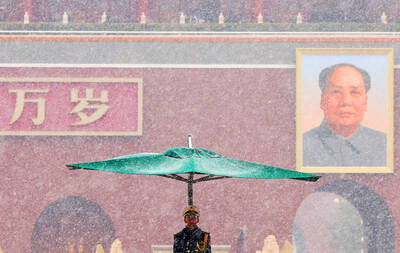
Chinese dissident artist Gao Zhen (高兟), famous for making provocative satirical sculptures of former Chinese leader Mao Zedong (毛澤東), was tried on Monday over accusations of “defaming national heroes and martyrs,” his wife and a rights group said. Gao, 69, who was detained in 2024 during a visit from the US, faces a maximum three-year prison sentence, said his wife, Zhao Yaliang (趙雅良), and Shane Yi, a researcher at the Chinese Human Rights Defenders group which operates outside the nation. The closed-door, one-day trial took place at Sanhe City People’s Court in Hebei Province neighboring the capital, Beijing, and ended without a
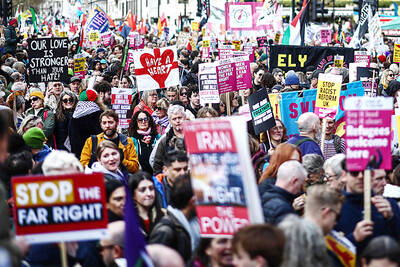
‘TOXIC CLIMATE’: ‘I don’t really recognize Labour anymore... The idea that you can implement far-right ideas in order to stop the far right is nonsense,’ a protester said Tens of thousands of people on Saturday marched through central London to protest against the far right, weeks ahead of local elections and six months after Britain saw one of its largest far-right demonstrations. Organized by hundreds of civic groups, including trade unions, anti-racism campaigners and Muslim representative bodies, Saturday’s Together Alliance event was billed as the biggest in UK history to counter right-wing extremism. A separate pro-Palestinian march had also converged with the main rally. While organizers claimed 500,000 had turned out in total, the police gave a figure of about 50,000. Protesters carrying placards with slogans such as


 RSS
RSS