


Dutch troops were to leave Afghanistan after four years yesterday, handing over control of military operations in central Uruzgan Province after a political row at home forced their draw-down.
A Netherlands embassy spokeswoman said a small ceremony would take place to handover to a US-led coalition of soldiers.
“Dutch forces have served with distinction in Uruzgan, and we honor their sacrifice and that of their Afghan counterparts during the Netherlands’ tenure in the province,” the NATO-led International Security Assistance Force (ISAF) said in a statement.
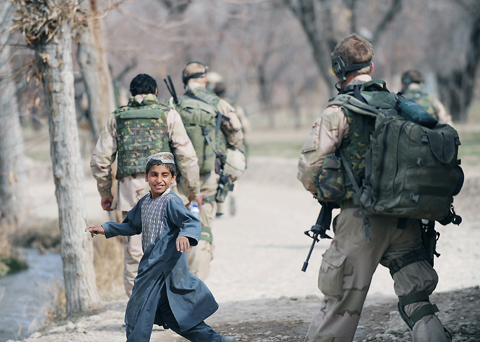
PHOTO: AFP
Around 1,950 Dutch troops have been deployed in Afghanistan under ISAF, mainly in Uruzgan, where opium production is high and the Taliban very active.
NATO had asked the Netherlands to extend the mission, which started in 2006 and has cost the lives of 24 soldiers, by a year to August next year.
However, the request sparked a political row at home that led to the collapse of the coalition government in February and the end of the Dutch deployment.
The Dutch will be replaced by US, Australian, Slovak and Singaporean soldiers.
“We have planned for the transfer to the new multi-national operation to ensure a smooth transition … We will maintain current capabilities,” ISAF said.
The Dutch mission, known for its “3D” approach of defense, development and diplomacy, has been described by NATO Secretary General Anders Fogh Rasmussen as “the benchmark for others,” and by US President Barack Obama as “one of the most outstanding” in Afghanistan.
Since the start of its lead role in Uruzgan, at a cost of some 1.4 billion euros (US$1.8 billion) to the Dutch state, the number of NGOs doing development work in the province has risen from six to 50, according to a Dutch embassy document.
Chief of the Netherlands Defense Staff General Peter van Uhm has said his troops had achieved “tangible results that the Netherlands can be proud of.”
The Taliban have welcomed the Dutch withdrawal and urged other countries with troops in Afghanistan to follow suit.
Canada is withdrawing its entire force of 2,800 troops in Afghanistan next year, while Britain and the US have signaled that some troops will also leave next year.
In other developments, a minibus full of civilians struck a roadside bomb in southern Afghanistan early yesterday, killing six on board, officials said.
Another nine people were wounded in the explosion in Kandahar Province’s Maiwand district, said provincial spokesman Zalmai Ayubi.
The civilian death toll has climbed along with military casualties amid a summer push into Taliban strongholds in the southern provinces of Kandahar and Helmand. It was not clear if the bombing was targeted or if the bus had struck a bomb planted in the hope of killing NATO or Afghan troops.
To counter an influx of international forces in recent months, the Taliban have stepped up assassination campaigns against government sympathizers and bombings, as well as attacks on government or NATO forces.
Threats have also appeared more frequently in Kabul, the capital to the north. On Sunday, NATO said Afghan and international forces killed an insurgent in the city while pursuing a tip that militants were planning a double suicide bombing.
The man started firing on troops when they searched a neighborhood believed to harbor insurgents, the coalition said in a statement.
Meanwhile, more than 400 demonstrators marched toward the presidential palace in Kabul to protest the alleged killing of 52 civilians by a NATO rocket strike in the south. NATO has disputed the report of civilian deaths.
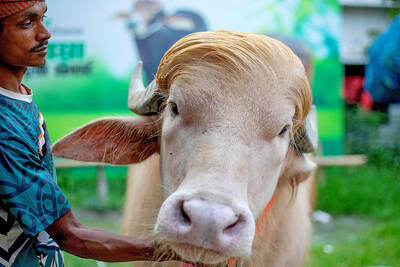
Crowds in Bangladesh are flocking to snap photographs with an unlikely social media star — an albino buffalo with flowing blond hair nicknamed “Donald Trump” that is due to be sacrificed within days. Owner Zia Uddin Mridha, 38, said his brother named the 700kg bull over its flowing helmet of hair resembling the signature look of the US president. “My younger brother picked this name because of the buffalo’s extraordinary hair,” he said at his farm in Narayanganj, just outside the capital, Dhaka. Mridha said that a constant stream of curious visitors — social media fans, onlookers and children — have come throughout

It began as a satirical online project. Now millions of young people in India are flocking to it as an outlet for their frustration. A parody political party called the Cockroach Janta Party, with the insect as its symbol, has exploded across India’s social media by turning absurdist humor into protest. Memes and short videos mocking corruption, joblessness and political dysfunction have flooded social media sites, where millions of users are embracing the cockroach — known for its ability to survive harsh conditions — as a tongue-in-cheek symbol of endurance. The online movement’s rise has been unusually rapid. The Cockroach Janta Party (CJP)
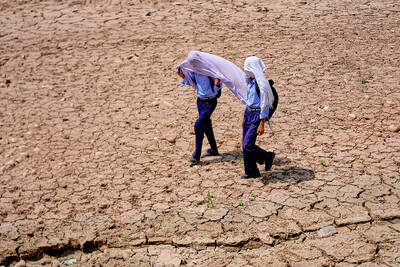
HOTTER: While Indians are accustomed to summer heat, climate change has caused northwestern India to warm faster than other parts of the country, an academic said Roads and markets have emptied during afternoons and some farmers have switched to nighttime work to avoid scorching temperatures as a heat wave grips large parts of India. The India Meteorological Department forecast maximum temperatures for yesterday of about 45°C in the capital, New Delhi, where authorities have opened temporary “cooling zones” to help people cope. The weather department warned that conditions would likely persist across several northern regions in the coming days, with temperatures staying well above seasonal averages. Authorities urged people to stay indoors during the hottest hours and take precautions against heat-related illnesses. India declares a heat wave whenever maximum temperatures
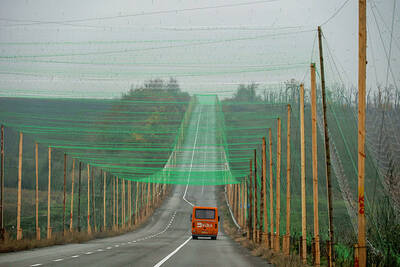
BIGGER ROLE: Beijing has said it maintains an impartial stance on the war in Ukraine, but by training Russian troops, China is far more involved than previously known China’s armed forces secretly trained about 200 Russian military personnel in China late last year, and some have since returned to fight in Ukraine, according to three European intelligence agencies and documents seen by Reuters. While China and Russia have held a number of joint military exercises since Moscow’s full-scale invasion of Ukraine in 2022, Beijing has repeatedly said that it is neutral in the conflict and presents itself as a peace mediator. The covert training sessions, which predominantly focused on the use of drones, were outlined in a dual-language Russian-Chinese agreement signed by senior Russian and Chinese officers in Beijing on


 RSS
RSS