


Just a few hours from the glittering Malaysian capital is a pitiful scene of hungry children and desperate parents, in an indigenous village home to the “forgotten Malaysians.”
Naked youngsters with the tell-tale signs of malnourishment — bulging stomachs and brown tinged hair — sit listlessly in a hut, while others cling to their mothers as they suckle milk.
Welcome to Bertang Lama village, home of some of Malaysia’s Semai people, an indigenous tribe mired in poverty and struggling to adapt as the multicultural nation races towards modernity.
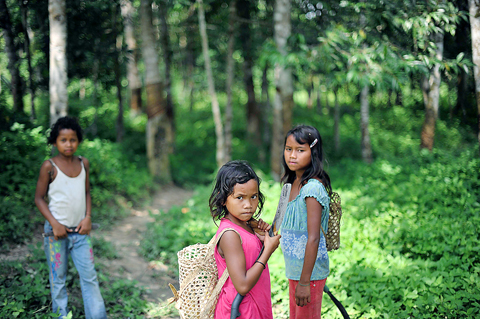
PHOTO: AFP
The village, which houses about 300 people, is located close to Cheroh, a small town in central Pahang state that sits along the Titiwangsa mountains which form the backbone of Peninsular Malaysia.
The Semai, once nomadic but now largely settled, are seeking recognition of their traditional land rights as well as basic needs — piped water, electricity, medicine, education and tarred roads.
There is little food in the village where families live a subsistence life, hunting and gathering to trade in jungle products like rattan and agarwood.
Neither is there much money, as the forest they depend on is fast being depleted of its resources thanks to deforestation caused by logging, and the rapid expansion of rubber and palm oil plantations.
There are an estimated 45,000 Semai in Peninsular Malaysia, among some 150,000 indigenous people divided among 19 linguistic groups who live on the country’s mainland.
Colin Nicholas, coordinator of the Center for Orang Asli Concerns, said the people of Bertang Lama and others like them have become “the forgotten and invisible Malaysians.”
Nicholas said the Semai played a valuable role in the British offensive against communist insurgents in the 1950s due to their stealth and tracking skills, but are now seen as irrelevant.
“Come elections, ruling party politicians make promises in exchange for votes but after that they renege on their words. Because of their small population, they are easily ignored by the government,” he said.
“The indigenous people have been pushed to the brink. Their situation will only get worse. After nearly 53 years of independence, the government is in a state of denial,” Nicholas said.
Not all Semai or Orang Asli people are impoverished, and some communities, particularly those located closer to urban infrastructure, have done much better in terms of education, employment and health.
However, the plight of Bertang Lama village was highlighted when Lim Ka Ea, an executive officer with the Malaysian Bar Council visited recently and recounted her shock at the scene there in a newspaper article.
“The Orang Asli have been regarded as invisible by many people,” she said. “What we do see in them is their ‘primitive’ form of lifestyle and the entrenched stereotype that they serve no purpose to the advancement of our nation except to make our tourism advertisements look exotic and attractive.”
In the village, 11-year-old Jolisa returns home from the forest, armed with a machete and a bamboo basket on her back as she skips along with three other barefoot friends.
“We went looking for wild vegetables,” she says.
“Yes I would like to go to school if there was one in our village,” she replies with a smile to a visitor’s question.
Nearby, inside a dilapidated hut, a naked two-year-old child with mucus dripping from his nose and an expressionless face holds a bowl containing only mashed tapioca, a flavorless starch, for his breakfast.
The chidren are mostly illiterate, and mostly hungry as their families can only provide them with vegetables and tapioca sourced from the jungle.
The village is located just 11km from a main road but it is a tedious drive along an unsealed logging track.
“We sell rattan, bamboo and agarwood sourced from the forest. But it is hard to find them now,” says Yoke Ham, a 47-year-old father of 12 children who says his ancestors settled here hundreds of years ago.
“The average income per month is less than 300 ringgit [US$94],” he adds, as crying babies drown out the chirp of insects.
Malaysian Prime Minister Najib Razak, who is striving for Malaysia to achieve developed-nation status by 2020, earlier this month assured all Malaysians that no one will be left behind.
“I promise you, as prime minister I will be fair to everybody. We will help all communities to move forward. We will make Malaysia a high-income country,” he said.
The lofty goals mean little to Robina, who looks in her thirties but does not know her age. She holds her sick three-year-old daughter, Sinar, on her lap and appeals for help as tears roll down her face.
“My child has a fever. I have no money to buy food and rice for her,” she says. “We have not had our breakfast yet. Life is difficult.”

ROCKY RELATIONS: The figures on residents come as Chinese tourist numbers drop following Beijing’s warnings to avoid traveling to Japan The number of Chinese residents in Japan has continued to rise, even as ties between the two countries have become increasingly fractious, data released on Friday showed. As of the end of December last year, the number of Chinese residents had increased by 6.5 percent from the previous year to 930,428. Chinese people accounted for 22.6 percent of all foreign residents in Japan, making them by far the largest group, Japanese Ministry of Justice data showed. Beijing has criticized Tokyo in increasingly strident terms since Japanese Prime Minister Sanae Takaichi last year suggested that a military conflict around Taiwan could

A pro-Iran hacking group claimed to breach FBI Director Kash Patel’s personal e-mail inbox and posted some of the contents online. The e-mails provided by the hacking group include travel details, correspondence with leasing agents in Washington and global entry, and loyalty account numbers. The e-mail address the hackers claim to have compromised has been previously tied to Patel’s personal details, and the leaked e-mails contain photos of Patel and others, in addition to correspondence with family members and colleagues. “The FBI is aware of malicious actors targeting Director Patel’s personal email information,” the agency said in a statement on

RIVALRY: ‘We know that these are merely symbolic investigations initiated by China, which is in fact the world’s most profligate disrupter of supply chains,’ a US official said China has started a pair of investigations into US trade practices, retaliating against similar probes by US President Donald Trump’s administration as the superpowers stake out positions before an expected presidential summit in May. The move, announced by the Chinese Ministry of Commerce on Friday, is a direct mirror of steps Trump took to revive his tariff agenda after the US Supreme Court last month struck down some of his duties. “China expresses its strong dissatisfaction and firm opposition to these actions,” a ministry spokesperson said in a statement, referring to the so-called Section 301 investigations initiated on March 11.

When a hiker fell from a 55m waterfall in wild New Zealand bush, rescuers were forced to evacuate the badly hurt woman without her dog, which could not be found. After strangers raised thousands of dollars for a search, border collie Molly was flown to safety by a helicopter pilot who was determined to reunite the pet and the owner. A week earlier, an emergency rescue helicopter found the woman with bruises and lacerations after a fall at a rocky spot at the waterfall on the South Island’s West Coast. She was airlifted on March 24, but they were forced to


 RSS
RSS