


India’s rapid modernization is set to claim another victim with the expulsion of the horse-drawn carriages, or tongas, that have plied the streets of Delhi since the days of the Mughal emperors.
The favored mode of transport for the city’s elite at the height of the British Raj, the status of the iconic tongas has now officially been downgraded to “public nuisance.”
Barely 250 tongas remain in the capital, but the municipal government has ruled that — in a city of 5 million cars — getting rid of the carriages will somehow help ease Delhi’s chronic traffic congestion.
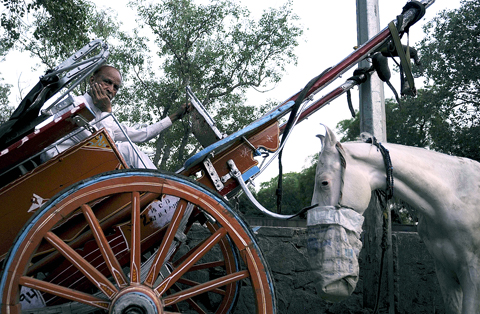
PHOTO: AFP
The decision is being challenged with a last-ditch appeal to the High Court and by a public outcry over what many see as an unnecessary effort to erase a part of the capital’s cultural heritage.
Delhi Mayor Prithvi Sawhney is unmoved.
“With traffic congestion increasing, a tonga ride is a waste of time and problematic for both passenger and driver,” Sawhney said.
“In the old days, tongas were used to carry passengers. Today they just carry luggage and a few tourists. Barely anyone uses them for daily travel,” he said, adding that the new metro system had “revolutionized” transport in the city.
In the absence of any last-minute reprieve, Kishen Lal, a third-generation tonga-wallah, could hang up his saddle and reins today for the last time.
The government has offered the drivers a path to alternative employment in the form of a vendor’s license, but those like Lal, who is 73, say it is far too late to change trades.
“We know no other profession except this,” said Lal, whose grandfather drove a tonga in Delhi back in the early 1940s, before independence.
“If they want to stop the tongas, they should do it in phases and not all in one go,” he said. “It will give us all great sadness if we have to stop riding tongas. They are the pride and majesty of this city.”
The decision to banish the tonga-wallahs coincides with the general facelift that Delhi is receiving ahead of the Commonwealth Games in October.
The government is looking to the Games to showcase the “new India” — an emerging economic powerhouse which aspires to the same sort of infrastructural transformation undertaken by China.
It’s a vision that has no place for the humble tonga — a fact that distresses people like Delhi historian and writer Radha Kumar.
“Growing up, I often used tongas to commute from Old to New Delhi. Feeding the horse was my biggest high,” recalled Kumar, while insisting that his objection to their disappearance wasn’t based on nostalgia alone.
The argument that expelling several hundred horse-drawn carriages would improve traffic congestion in a city of more than 20 million souls is, Kumar argues, barely credible.
“The government has no right to make arguments or decisions on the economic viability of such a small group of people,” he said.
“They are not causing any damage. You can maybe go after them on sanitation grounds — the hygiene of the stables, but you can’t just evict them,” he said.

When a hiker fell from a 55m waterfall in wild New Zealand bush, rescuers were forced to evacuate the badly hurt woman without her dog, which could not be found. After strangers raised thousands of dollars for a search, border collie Molly was flown to safety by a helicopter pilot who was determined to reunite the pet and the owner. A week earlier, an emergency rescue helicopter found the woman with bruises and lacerations after a fall at a rocky spot at the waterfall on the South Island’s West Coast. She was airlifted on March 24, but they were forced to

CONFIDENCE BOOSTER: ’After parkour ... you dare to do a lot of things that you think only young people can do,’ a 67-year-old parkour enthusiast said In a corner of suburban Singapore, Betty Boon vaults a guardrail, crawls underneath a slide, executes forward shoulder rolls and scales a steep slope, finishing the course to applause. “Good job,” the 69-year-old’s coach cheers. This is “geriatric parkour,” where about 20 retirees learned to tackle a series of relatively demanding exercises, building their agility and enjoying a sense of camaraderie. Boon, an upbeat grandmother, said learning parkour has aided her confidence and independence as she ages. “When you’re weak, you will be dependent on someone,” she said after sweating it out with her parkour classmates in suburban Toa Payoh,

Chinese dissident artist Gao Zhen (高兟), famous for making provocative satirical sculptures of former Chinese leader Mao Zedong (毛澤東), was tried on Monday over accusations of “defaming national heroes and martyrs,” his wife and a rights group said. Gao, 69, who was detained in 2024 during a visit from the US, faces a maximum three-year prison sentence, said his wife, Zhao Yaliang (趙雅良), and Shane Yi, a researcher at the Chinese Human Rights Defenders group which operates outside the nation. The closed-door, one-day trial took place at Sanhe City People’s Court in Hebei Province neighboring the capital, Beijing, and ended without a

‘TOXIC CLIMATE’: ‘I don’t really recognize Labour anymore... The idea that you can implement far-right ideas in order to stop the far right is nonsense,’ a protester said Tens of thousands of people on Saturday marched through central London to protest against the far right, weeks ahead of local elections and six months after Britain saw one of its largest far-right demonstrations. Organized by hundreds of civic groups, including trade unions, anti-racism campaigners and Muslim representative bodies, Saturday’s Together Alliance event was billed as the biggest in UK history to counter right-wing extremism. A separate pro-Palestinian march had also converged with the main rally. While organizers claimed 500,000 had turned out in total, the police gave a figure of about 50,000. Protesters carrying placards with slogans such as


 RSS
RSS