


In her police mug shot, the doe-eyed cartoon heroine with the bowl haircut has a black eye, battered lip and a bloody nose.
Dora the Explorer’s alleged crime?
“Illegal Border Crossing Resisting Arrest.”
The doctored picture, one of several circulating widely in the aftermath of Arizona’s controversial new immigration law, may seem harmless, ridiculous or even tasteless, but experts say the pictures and the rhetoric surrounding them online, in newspapers and at public rallies reveal some Americans’ attitudes about race, immigrants and where some of immigration reform debate may be headed.
For about a decade, the pint-sized Latina character has taught millions of children the English alphabet, colors and Spanish phrases on a Nickelodeon TV show and through a global empire. Her smiling cherub face is plastered on everything from backpacks to T-shirts to fruit snacks.
However, since the passage of the Arizona law — which requires authorities to question people about their immigration status if there’s reason to suspect they’re in the country illegally — Dora’s life and immigration status have been scrutinized and mocked.
“Dora is kind of like a blank screen onto which people can project their thoughts and feelings about Latinos,” said Erynn Masi de Casanova, a sociology professor at the University of Cincinnati. “They feel like they can say negative things because she’s only a cartoon character.”
The depictions, whether through irony or protest, are being used by those who oppose and support Arizona’s law. On one hand, she’s a likable symbol who many can relate to, and at the same time, perceived as an outsider who doesn’t belong anywhere.
It’s not the first time a children’s character has been dragged into a serious debate.
In the late 1990s, Tinky Winky of the Teletubbies, a purple children’s TV character with a triangle antenna, was called out by Christian leaders for being gay. Sesame Street roommates Bert and Ernie are often involved in statements on same-sex marriage.
Both shows’ producers say the characters aren’t gay.
In Dora’s case, especially because her image is so widely available, she’s an easy target as discussion ramps up on how lawmakers should address the estimated 12 million illegal immigrants living in the US.
Several Web sites, including the Huffington Post, have narrated Dora’s mock capture by immigration authorities.
The images have been used on all sides of the immigration reform debate.
Many immigrant families, particularly Latinos, see Dora as a symbol of freedom, someone to relate to. She’s a young girl with brown skin who lives in a borderless world and can travel anywhere she wants without consequence.
“It’s symbolic of the way many Latinos live ambiguously in the United States,” said Nicole Guidotti-Hernandez, who teaches gender studies at the University of Arizona. “It’s a shorthand for claiming our lives in the United States, especially for children.”
At the same time, Guidotti-Hernandez says the ambiguity and negative imagery makes Dora susceptible to being used by those who support the Arizona law.
The issue appears to have resonated little with Dora’s biggest fans, the millions of parents and their children who seem mostly unaware of the discussion encircling their beloved cartoon.
Altamise Leach, who has three children, said Dora’s ethnicity and citizenship are irrelevant.
“We have so many diverse cultures, let’s try to embrace everybody,” Leach said. “She puts a smile on my daughter’s face, that’s all I want.”
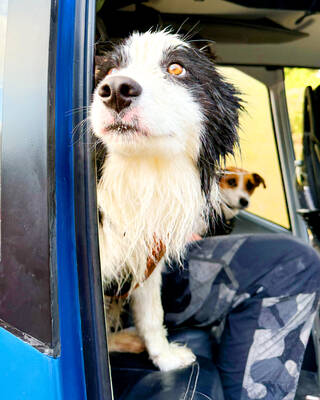
When a hiker fell from a 55m waterfall in wild New Zealand bush, rescuers were forced to evacuate the badly hurt woman without her dog, which could not be found. After strangers raised thousands of dollars for a search, border collie Molly was flown to safety by a helicopter pilot who was determined to reunite the pet and the owner. A week earlier, an emergency rescue helicopter found the woman with bruises and lacerations after a fall at a rocky spot at the waterfall on the South Island’s West Coast. She was airlifted on March 24, but they were forced to
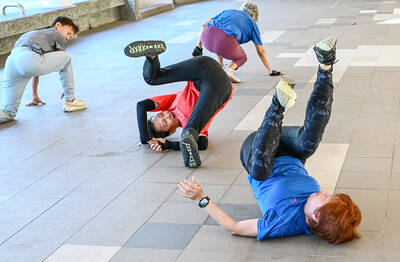
CONFIDENCE BOOSTER: ’After parkour ... you dare to do a lot of things that you think only young people can do,’ a 67-year-old parkour enthusiast said In a corner of suburban Singapore, Betty Boon vaults a guardrail, crawls underneath a slide, executes forward shoulder rolls and scales a steep slope, finishing the course to applause. “Good job,” the 69-year-old’s coach cheers. This is “geriatric parkour,” where about 20 retirees learned to tackle a series of relatively demanding exercises, building their agility and enjoying a sense of camaraderie. Boon, an upbeat grandmother, said learning parkour has aided her confidence and independence as she ages. “When you’re weak, you will be dependent on someone,” she said after sweating it out with her parkour classmates in suburban Toa Payoh,

Chinese dissident artist Gao Zhen (高兟), famous for making provocative satirical sculptures of former Chinese leader Mao Zedong (毛澤東), was tried on Monday over accusations of “defaming national heroes and martyrs,” his wife and a rights group said. Gao, 69, who was detained in 2024 during a visit from the US, faces a maximum three-year prison sentence, said his wife, Zhao Yaliang (趙雅良), and Shane Yi, a researcher at the Chinese Human Rights Defenders group which operates outside the nation. The closed-door, one-day trial took place at Sanhe City People’s Court in Hebei Province neighboring the capital, Beijing, and ended without a

‘TOXIC CLIMATE’: ‘I don’t really recognize Labour anymore... The idea that you can implement far-right ideas in order to stop the far right is nonsense,’ a protester said Tens of thousands of people on Saturday marched through central London to protest against the far right, weeks ahead of local elections and six months after Britain saw one of its largest far-right demonstrations. Organized by hundreds of civic groups, including trade unions, anti-racism campaigners and Muslim representative bodies, Saturday’s Together Alliance event was billed as the biggest in UK history to counter right-wing extremism. A separate pro-Palestinian march had also converged with the main rally. While organizers claimed 500,000 had turned out in total, the police gave a figure of about 50,000. Protesters carrying placards with slogans such as


 RSS
RSS