


Extra police and security staff stood guard yesterday as parents dropped off their children on the first day of classes in China since dozens of students were injured in three back-to-back attacks on schools last week.
In Beijing, police cars flashed lights outside some schools as guards in orange vests watched students enter gates. Guards in Guangzhou prevented parents from entering school premises without special permission. Parents in Shanghai discussed ways to strengthen security at kindergartens.
Child safety is an issue that touches nerves across Chinese society, particularly among members of the urban middle class who invest huge amounts of money and effort in the education and care of their only children.
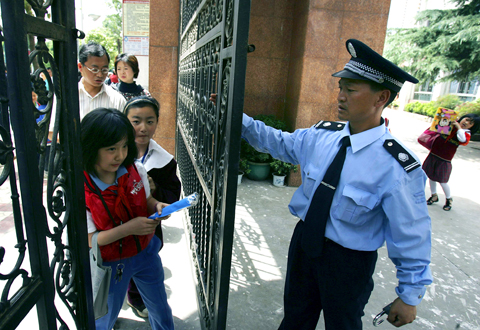
PHOTO: REUTERS
The education system in China is under pressure to strengthen security after the attacks, the latest of which was on Friday last week when a farmer struck five students with a hammer at a primary school in Weifang before pouring gasoline over his body and burning to death. No children were seriously hurt.
Parents in Beijing said they were glad to see the new security measures on the first day of school after a three-day public holiday.
“I was a little worried after seeing those reports on TV about the attacks,” said Liu Xingwu, who sent his seven-year-old granddaughter by bicycle to Shijia Elementary School in central Beijing. “The security measures are good. But we’ve also told her to be careful. ... If there are any problems, call the police.”
School security has been an increased focus for over a month since a man stabbed eight elementary schoolchildren to death in March in Fujian Province. That attacker was executed on April 28, the same day a 33-year-old former teacher broke into a primary school in Leizhou, Guangdong Province, and wounded 15 students and a teacher with a knife.
Then on Thursday last week in Taixing city in Jiangsu Province, a 47-year-old unemployed man armed with a 20cm knife wounded 29 kindergarten students — five of them seriously — plus two teachers and a security guard.
The Ministry of Public Security issued an emergency notice on Saturday to police departments around the country to strengthen patrols in and around schools at the beginning and end of the school day, as well as to inspect small hotels, Internet cafes and “recreational sites” next to schools.
“We must take fast action to strengthen security for schools and kindergartens to create a harmonious environment for children to study and grow up,” senior Chinese Communist Party leader Zhou Yongkang (周永康) told a conference on maintaining stability on Monday, Xinhua news agency said.
Some are taking the ministry’s directives to heart. In Chongqing, a city of over 30 million people, orders are for police to shoot to kill anyone attempting to harm students.
“The police have clear regulations in these odious cases where direct attacks occurring at or in the vicinity of schools have injured students or children,” the Chongqing Evening News reported on Monday.
At Shijia Elementary in Beijing, two guards stationed at the main entrance raised their arms to block parents accompanying their children past the stainless steel gate.
“Our main objective is to take safety precautions,” said Zhang Xinxiong, a teacher in charge of security. “These days every family has only one child, so of course they are expected to be worried.”
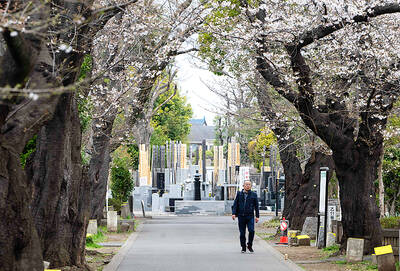
ROCKY RELATIONS: The figures on residents come as Chinese tourist numbers drop following Beijing’s warnings to avoid traveling to Japan The number of Chinese residents in Japan has continued to rise, even as ties between the two countries have become increasingly fractious, data released on Friday showed. As of the end of December last year, the number of Chinese residents had increased by 6.5 percent from the previous year to 930,428. Chinese people accounted for 22.6 percent of all foreign residents in Japan, making them by far the largest group, Japanese Ministry of Justice data showed. Beijing has criticized Tokyo in increasingly strident terms since Japanese Prime Minister Sanae Takaichi last year suggested that a military conflict around Taiwan could

A pro-Iran hacking group claimed to breach FBI Director Kash Patel’s personal e-mail inbox and posted some of the contents online. The e-mails provided by the hacking group include travel details, correspondence with leasing agents in Washington and global entry, and loyalty account numbers. The e-mail address the hackers claim to have compromised has been previously tied to Patel’s personal details, and the leaked e-mails contain photos of Patel and others, in addition to correspondence with family members and colleagues. “The FBI is aware of malicious actors targeting Director Patel’s personal email information,” the agency said in a statement on
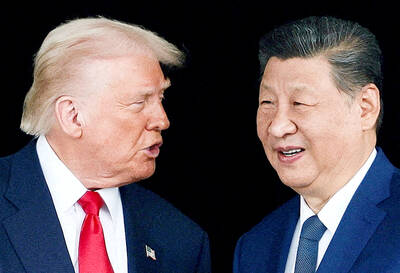
RIVALRY: ‘We know that these are merely symbolic investigations initiated by China, which is in fact the world’s most profligate disrupter of supply chains,’ a US official said China has started a pair of investigations into US trade practices, retaliating against similar probes by US President Donald Trump’s administration as the superpowers stake out positions before an expected presidential summit in May. The move, announced by the Chinese Ministry of Commerce on Friday, is a direct mirror of steps Trump took to revive his tariff agenda after the US Supreme Court last month struck down some of his duties. “China expresses its strong dissatisfaction and firm opposition to these actions,” a ministry spokesperson said in a statement, referring to the so-called Section 301 investigations initiated on March 11.

When a hiker fell from a 55m waterfall in wild New Zealand bush, rescuers were forced to evacuate the badly hurt woman without her dog, which could not be found. After strangers raised thousands of dollars for a search, border collie Molly was flown to safety by a helicopter pilot who was determined to reunite the pet and the owner. A week earlier, an emergency rescue helicopter found the woman with bruises and lacerations after a fall at a rocky spot at the waterfall on the South Island’s West Coast. She was airlifted on March 24, but they were forced to


 RSS
RSS