


A 13th century skeleton unearthed on the grounds of a friary may be the earliest physical evidence that Africans lived in England in medieval times, a team of researchers said on Sunday.
Forensics experts at the University of Dundee Scotland say that the bones most likely belonged to a man from modern-day Tunisia who spent about a decade living in England before he died.
“I believe that this is the first physical evidence of Africans in medieval England,” said Jim Bolton, an historian at Queen Mary, University of London, who wasn’t involved in the discovery.
“Finding a skeleton like this is of major interest,” he said.
The man — who appears to have died of a spinal abscess — was identified as African by studying his skeleton and the historical record of the friary where he was buried.
“It’s not just the skin tone, it’s a question of bone structure,” said Xanthe Mallett, an expert at the Center for Anatomy and Human Identification in Dundee.
She said the size of the nasal bone or the shape of the orbits differed depending on whether skeletons were European or African.
“You can have an idea of where somebody is from by looking at their skeletal features,” she said.
Researchers were able to pin the man to Tunisia using isotope analysis, a technique which looks at the mix of elements that build up in a person’s teeth, bones or other tissues. Since people from different areas tend to accumulate such elements in different ways, analysis of their remains can sometimes pinpoint where they grew up, where they lived or even their diet.
“Each area has a different isotopic signature,” she said.
It’s not clear how the man would have made his way from Tunisia to Ipswich, the southeast England town where his skeleton was unearthed in the 1990s.
The BBC’s History Cold Case program, which is publicizing the finding, suggested that he may have been brought back during the Crusades, although Mallett and Bolton both hypothesized he could have conceivably come through Spain, parts of which were then under Muslim rule.
His burial on consecrated ground suggests that not only must he have converted to Christianity, he may have gone on to become a respected member of society.
“He would have had to been of some note to be buried in the friary,” Mallett said.
Bolton said it was extremely difficult to find evidence of any Africans in England between the fall of the Roman Empire and the Age of Exploration. He added that the find illustrated that there was still a lot to learn about how often or widely people traveled — either within England, Europe, or the wider world — during that period.
“We don’t know much about the migration of ordinary people,” he said.
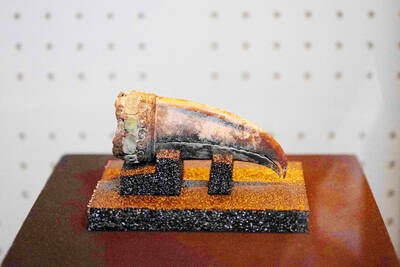
Archeologists in Peru on Thursday said they found the 5,000-year-old remains of a noblewoman at the sacred city of Caral, revealing the important role played by women in the oldest center of civilization in the Americas. “What has been discovered corresponds to a woman who apparently had elevated status, an elite woman,” archeologist David Palomino said. The mummy was found in Aspero, a sacred site within the city of Caral that was a garbage dump for more than 30 years until becoming an archeological site in the 1990s. Palomino said the carefully preserved remains, dating to 3,000BC, contained skin, part of the
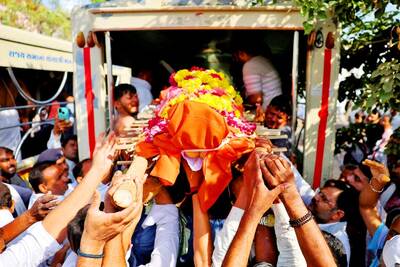
‘WATER WARFARE’: A Pakistani official called India’s suspension of a 65-year-old treaty on the sharing of waters from the Indus River ‘a cowardly, illegal move’ Pakistan yesterday canceled visas for Indian nationals, closed its airspace for all Indian-owned or operated airlines, and suspended all trade with India, including to and from any third country. The retaliatory measures follow India’s decision to suspend visas for Pakistani nationals in the aftermath of a deadly attack by shooters in Kashmir that killed 26 people, mostly tourists. The rare attack on civilians shocked and outraged India and prompted calls for action against their country’s archenemy, Pakistan. New Delhi did not publicly produce evidence connecting the attack to its neighbor, but said it had “cross-border” links to Pakistan. Pakistan denied any connection to

TRUMP EFFECT: The win capped one of the most dramatic turnarounds in Canadian political history after the Conservatives had led the Liberals by more than 20 points Canadian Prime Minister Mark Carney yesterday pledged to win US President Donald Trump’s trade war after winning Canada’s election and leading his Liberal Party to another term in power. Following a campaign dominated by Trump’s tariffs and annexation threats, Carney promised to chart “a new path forward” in a world “fundamentally changed” by a US that is newly hostile to free trade. “We are over the shock of the American betrayal, but we should never forget the lessons,” said Carney, who led the central banks of Canada and the UK before entering politics earlier this year. “We will win this trade war and

Armed with 4,000 eggs and a truckload of sugar and cream, French pastry chefs on Wednesday completed a 121.8m-long strawberry cake that they have claimed is the world’s longest ever made. Youssef El Gatou brought together 20 chefs to make the 1.2 tonne masterpiece that took a week to complete and was set out on tables in an ice rink in the Paris suburb town of Argenteuil for residents to inspect. The effort overtook a 100.48m-long strawberry cake made in the Italian town of San Mauro Torinese in 2019. El Gatou’s cake also used 350kg of strawberries, 150kg of sugar and 415kg of


 RSS
RSS