


Highlighting threats to social stability, Chinese Premier Wen Jiabao (溫家寶) said yesterday that more must to be done to create jobs, strengthen social welfare and boost development in restive regions such as Tibet.
In an annual policy speech, Wen pledged to narrow a yawning wealth gap, increase the stock of affordable housing, boost the moribund rural economy and fight rampant corruption.
“Everything we do, we do to ensure that the people live a happier life with more dignity and to make our society fairer and more harmonious,” Wen told the nearly 3,000 deputies gathered in the Great Hall of the People for the opening of the National People’s Congress.
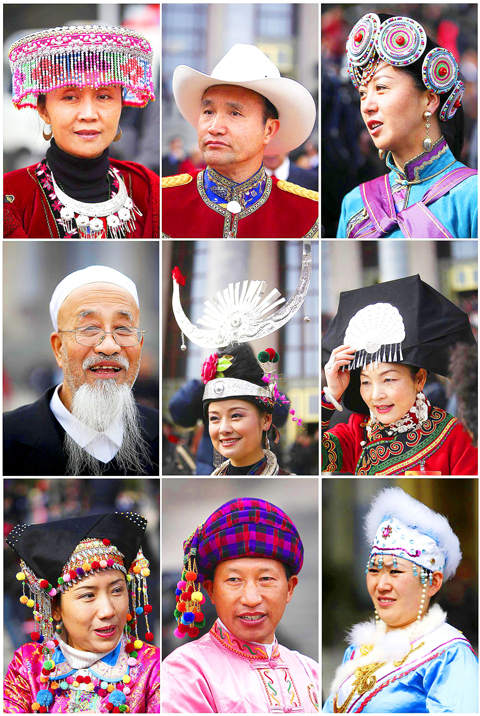
PHOTO: REUTERS
The Chinese Communist Party has staved off serious discontent by focusing on economic growth, and the country escaped the worst of the global downturn by way of a flood of US$1.4 trillion in bank lending and government stimulus. However, Wen said such measures would not be renewed and the increase in government spending would fall to 11.4 percent this year, half of what it was last year.
“This is a crucial year for continuing to deal with the global financial crisis,” Wen said in the two-hour speech. “We still face a very complex situation.”
He promised hefty outlays for pensions, education, healthcare and subsidies for farmers to buy small cars and household appliances — all to spread prosperity more fairly.
Although Wen did not mention anti-government protests by Tibetans in 2008 and ethnic fighting among Muslim Uighurs and the Han majority last year, he said a special effort will be made to raise living standards of minorities.
“We need to take a clear-cut stand against attempts to split the nation, safeguard national unity, and get ethnic minorities and the people of all ethnic groups who live in ethnic minority areas to feel the warmth of the motherland as one large family,” Wen said.
Few initiatives in Wen’s speech were new.
Overall, government spending is projected to rise to 8.45 trillion yuan (US$1.2 trillion), on the back of a deficit that will rise at 13 percent. Slated for higher outlays were education (9 percent), healthcare (8.8 percent), social security (8.7 percent) and low-income housing (14.8 percent).
Meanwhile, analysts said Wen’s speech also showed the soft-edged populism that has drawn both public devotees and political naysayers.
When Wen bows out in early 2013, he will have spent a decade at the pinnacle of the government. Analysts said he has left a marked but mixed imprint on policy, showing how stubbornly the ship of Chinese politics resists big turns, even if the captain shouts orders.
“Zhu Rongji had his iron fist and Wen Jiabao has had his tears, but in the end both men have found neither way works magic,” said Zheng Yongnian (鄭永年), director of the National University of Singapore’s East Asian Institute.
Wen’s achievements can be measured in the abolition of hated taxes on poor farmers, rising rural incomes and the makings of a broad social welfare net, Zheng said.
Wen has also faced frustrations with his hopes for coaxing growth away from cheap exports, big state projects and polluting factories.
“You can be popular by being soft, but eventually all policies have to be enforced by bureaucrats and special interests, and then crying doesn’t work,” Zheng said.
Wen is certainly popular among ordinary people.
“If China had a real democratic election today, Wen would probably win hands down,” said Li Zhiying (李智英), a political rights activist in Beijing who focuses on farmers’ complaints.

‘CROSSING THE LINE’: China’s embassy in Seoul criticized US Forces Korea Commander General Xavier Brunson, asking if his ‘hostile’ remarks were authorized by Washington South Korea and the US are in talks over recent public remarks by the commander of US Forces Korea, Seoul’s presidential office said yesterday, after the comments drew sharp criticism from China. In a recent podcast interview, US Forces Korea Commander General Xavier Brunson described South Korea as “the dagger in the heart of Asia” from China’s east coast, prompting the Chinese embassy in Seoul to say that he had “truly crossed the line.” The interview came amid growing speculation that Washington might seek to expand the role of US Forces Korea in countering the growing regional influence of China, a key

Through the noise of rushing papers and whirring belts at a print factory in Kyoto, two creators watch their photo essay come to life in broadsheet form — part of an effort to win new audiences in the age of artificial intelligence (AI). Despite the decline of the publishing industry, self-publication and handmade “zine” magazines are growing in popularity in Japan, reflecting the nation’s enduring love of paper in the digital era. While speaking to Agence France-Presse at the plant, his hands black with ink, one of the creators, Kazuma Obara, said: “I think [paper] is a medium that engages all five

Australian researchers have trained lab-grown brain cells on a silicon computer chip to play the 1990s shooter game Doom and said they are just scratching the surface of what the neurons could be capable of doing. It is the science-fiction work of biotech boffins at Cortical Labs, who researched and developed the technology that harnesses the workings of the brain’s networking system. Each so-called “biological computer” contains about 200,000 living human brain cells, grown from stem cells that were harvested from blood donations. Having mastered the simple computer game Pong, where a paddle is moved up and down to send a ball

France experienced its hottest spring on record, the French weather service said on Tuesday, after an exceptional early heat wave that also broke highs for the season in England and Wales. Meteo-France said the average nationwide temperature over March to May was 13.8°C — about 1.7°C above the norm, and surpassing records set in 2011 and 2020. “The warmest spring since records began in 1900,” it said in a bulletin. All three months were warmer than average, but the onset of an “unprecedented heatwave” late last month pushed the mercury to highs typically seen at the height of the summer. “Our country had never


 RSS
RSS