


The UK wants to block Sri Lanka from hosting the next Commonwealth heads of government meeting in 2011 in protest at Colombo’s military repression against the Tamil population earlier this year.
Speaking at the opening of the Commonwealth summit in Trinidad and Tobago on Friday, British Prime Minister Gordon Brown will tell fellow Commonwealth leaders that it would be unacceptable for Sri Lanka to be allowed to host the meeting of one of the world’s largest groups of democracies.
At the last Commonwealth heads of government meeting in 2007, Sri Lanka said it would like to host the 2011 Commonwealth summit.
“The prime minister has real concerns about Sri Lanka’s bid,” a London source said.
“We simply cannot be in a position where Sri Lanka — whose actions earlier this year had a huge impact on civilians, leading to thousands of displaced people without proper humanitarian access — is seen to be rewarded for its actions,” the source said.
“The prime minister will continue to talk to other leaders about this, but is clear this won’t wash,” he said.
Brown feels strongly about blocking Sri Lanka’s bid because he believes hosting the next meeting would give Colombo respectability.
The Commonwealth has 53 members from four continents, representing almost one-third of the world’s population.
BLOODY WAR
Colombo ended a 26-year civil war earlier this year with a brutal military campaign against the Tamil Tigers that was widely condemned around the world. Up to 300,000 people were detained as they fled the last days of the fighting.
The London Observer reported that an estimated 136,000 Tamils remain behind barbed wire, most in the Menik Farm complex, near the town of Vavuniya.
John Holmes, the head of the UN’s humanitarian agency, last week told Colombo it should free the internees, a process now due to start on Tuesday.
Brown told Sri Lankan President Mahinda Rajapaksa that he must ensure the suffering is minimised.
On June 16, Brown — who discussed Sri Lanka’s bid to host the Commonwealth meeting with Australian Prime Minister Kevin Rudd and Commonwealth Secretary-General Kamalesh Sharma — said: “Sri Lanka stands on the brink. We have called repeatedly for the violence to cease. The humanitarian agencies must be granted access to civilians caught in the crossfire of a dreadful conflict.”
“Sri Lanka must understand that there will be consequences for its actions,” he said.
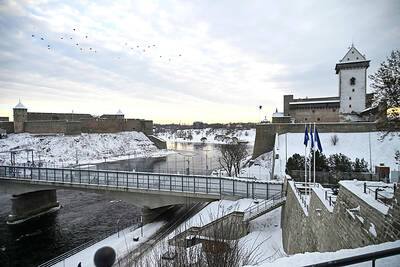
Two medieval fortresses face each other across the Narva River separating Estonia from Russia on Europe’s eastern edge. Once a symbol of cooperation, the “Friendship Bridge” connecting the two snow-covered banks has been reinforced with rows of razor wire and “dragon’s teeth” anti-tank obstacles on the Estonian side. “The name is kind of ironic,” regional border chief Eerik Purgel said. Some fear the border town of more than 50,0000 people — a mixture of Estonians, Russians and people left stateless after the fall of the Soviet Union — could be Russian President Vladimir Putin’s next target. On the Estonian side of the bridge,

Jeremiah Kithinji had never touched a computer before he finished high school. A decade later, he is teaching robotics, and even took a team of rural Kenyans to the World Robotics Olympiad in Singapore. In a classroom in Laikipia County — a sparsely populated grasslands region of northern Kenya known for its rhinos and cheetahs — pupils are busy snapping together wheels, motors and sensors to assemble a robot. Guiding them is Kithinji, 27, who runs a string of robotics clubs in the area that have taken some of his pupils far beyond the rural landscapes outside. In November, he took a team
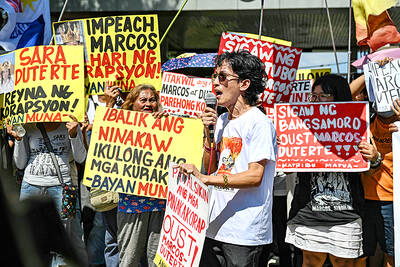
Civil society leaders and members of a left-wing coalition yesterday filed impeachment complaints against Philippine Vice President Sara Duterte, restarting a process sidelined by the Supreme Court last year. Both cases accuse Duterte of misusing public funds during her term as education secretary, while one revives allegations that she threatened to assassinate former ally Philippine President Ferdinand Marcos Jr. The filings come on the same day that a committee in the House of Representatives was to begin hearings into impeachment complaints against Marcos, accused of corruption tied to a spiraling scandal over bogus flood control projects. Under the constitution, an impeachment by the
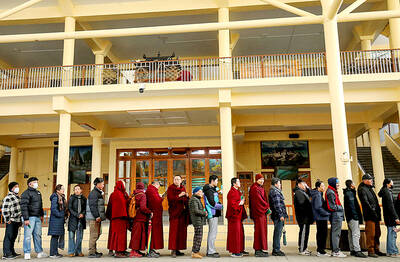
Exiled Tibetans began a unique global election yesterday for a government representing a homeland many have never seen, as part of a democratic exercise voters say carries great weight. From red-robed Buddhist monks in the snowy Himalayas, to political exiles in megacities across South Asia, to refugees in Australia, Europe and North America, voting takes place in 27 countries — but not China. “Elections ... show that the struggle for Tibet’s freedom and independence continues from generation to generation,” said candidate Gyaltsen Chokye, 33, who is based in the Indian hill-town of Dharamsala, headquarters of the government-in-exile, the Central Tibetan Administration (CTA). It


 RSS
RSS