


In countless biographies of Adolf Hitler the story of his final hours is recounted in the traditional version: committing suicide with Eva Braun, he took a cyanide pill and then shot himself on April 30, 1945, as the Russians bombarded Berlin.
Some historians expressed doubt that the Fuhrer had shot himself, speculating that accounts of Hitler’s death had been embellished to present his suicide in a suitably heroic light. But a fragment of skull, complete with bullet hole, which was taken from the bunker by the Russians and displayed in Moscow in 2000, appeared to settle the argument.
Until now. In the wake of new revelations, the histories of Hitler’s death may need to be rewritten — and left open-ended. US researchers claim to have demonstrated that the skull fragment, secretly preserved for decades by Soviet intelligence, belonged to a woman under 40, whose identity is unknown.
DNA analyses performed on the bone, now held by the Russian State Archive in Moscow, have been processed at the genetics lab of the University of Connecticut. The results, broadcast in the US by a History Channel documentary, Hitler’s Escape, astonished scientists.
Connecticut archaeologist and bone specialist Nick Bellantoni said it was clear from the outset that something was amiss.
“The bone seemed very thin; male bone tends to be more robust,” he said. “And the sutures where the skull plates come together seemed to correspond to someone under 40.” In April 1945 Hitler turned 56.
Bellantoni had flown to Moscow to inspect the gruesome Hitler trophies at the State Archive, which included the skull fragment as well as bloodstains from the bunker sofa on which Hitler and Braun were believed to have committed suicide. He was allowed only one hour with the Hitler trove, during which time he applied cotton swabs and took DNA samples.
“I had the reference photos the Soviets took of the sofa in 1945 and I was seeing the exact same stains on the fragments of wood and fabric in front of me, so I knew I was working with the real thing,” he said.
The samples were then flown back to Connecticut. At the university’s Center for Applied Genetics, Linda Strausbaugh closed her lab for three days to work exclusively on the Hitler project.
“We used the same routines and controls that would have been used in a crime lab,” she said.
To her surprise, a small amount of viable DNA was extracted. She then replicated this through a process known as molecular copying to provide enough material for analysis.
“We were very lucky to get a reading, despite the limited amount of genetic information,” she said.
The result was extraordinary. Witnesses said the bodies of Hitler and Braun had been wrapped in blankets and carried to the garden just outside the Berlin bunker, placed in a bomb crater, doused with gasoline and set ablaze.
But the skull fragment the Russians dug up outside the Fuhrerbunker in 1946 could never have belonged to Hitler. The skull DNA was incontestably female.
As the Soviet Army secured control of Berlin in May 1945, Russian forensic specialists dug up what was presumed to be Hitler’s body outside the bunker and performed a post-mortem examination behind closed doors. A part of the skull was absent, presumably blown away by Hitler’s suicide shot, but what remained of his jaw coincided with his dental records, a fact reportedly confirmed when the Russians showed his surviving dental work to the assistants of Hitler’s dentist. The autopsy also reported that Hitler, as had been rumored, had only one testicle.
But Josef Stalin remained suspicious. In 1946 a second secret mission was dispatched to Berlin. In the same crater from which Hitler’s body had been recovered, the new team found what it believed was the missing skull fragment with a bullet exit wound through it. The Russians also took fragments of Hitler’s bloodstained sofa.
Even this failed to satisfy Stalin, who clamped a secrecy order on all matters related to Hitler’s death. Unknown to the world, Hitler’s corpse was interred at a Smersh center in Magdeburg, East Germany. There it remained long after Stalin’s death in 1953. Finally, in 1970, the KGB dug up the corpse, cremated it and secretly scattered the ashes in a river. Only the jawbone, the skull fragment and the bloodstained sofa segments were preserved in the deep archives of Soviet intelligence. The bunker was destroyed in 1947 and eventually paved over.
Bellantoni is skeptical that the fragment of skull belong to Braun, who died at 33: “There is no report of Eva Braun having shot herself or having been shot afterwards. It could be anyone.”


Through the noise of rushing papers and whirring belts at a print factory in Kyoto, two creators watch their photo essay come to life in broadsheet form — part of an effort to win new audiences in the age of artificial intelligence (AI). Despite the decline of the publishing industry, self-publication and handmade “zine” magazines are growing in popularity in Japan, reflecting the nation’s enduring love of paper in the digital era. While speaking to Agence France-Presse at the plant, his hands black with ink, one of the creators, Kazuma Obara, said: “I think [paper] is a medium that engages all five
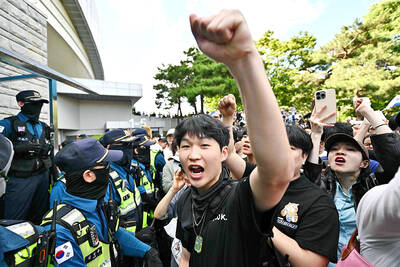
‘ABSURD MISTAKE’: The election commission said that there had been a failure to anticipate turnout after 14 polling stations ran short of ballot papers South Korean riot police yesterday cleared protesters from a Seoul polling station after a 35-hour blockade sparked by a shortage of ballot papers during local elections earlier this week. Wednesday’s election was the first nationwide vote since South Korean President Lee Jae-myung took office following the ouster of Yoon Suk-yeol over his short-lived martial law declaration. Lee’s ruling Democratic Party swept most races, but failed to flip the crucial Seoul mayoral seat. The South Korean National Election Commission apologized, blaming a failure to anticipate turnout after 14 polling stations in Seoul ran short of ballot papers. Some polling stations stayed open until 10pm to

France experienced its hottest spring on record, the French weather service said on Tuesday, after an exceptional early heat wave that also broke highs for the season in England and Wales. Meteo-France said the average nationwide temperature over March to May was 13.8°C — about 1.7°C above the norm, and surpassing records set in 2011 and 2020. “The warmest spring since records began in 1900,” it said in a bulletin. All three months were warmer than average, but the onset of an “unprecedented heatwave” late last month pushed the mercury to highs typically seen at the height of the summer. “Our country had never
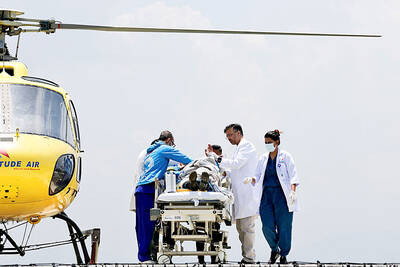
A Sherpa guide was found crawling to base camp on Mount Everest a week after he went missing and was reunited with his family, who had given up hope he would return. Dawa Sherpa was last seen on Friday last week descending the mountain, but he did not reach base camp even though his client did. The pair were among the last climbers on the mountain as the climbing season came to an end and the route was dismantled. Dawa was located by a cleaning crew on Thursday morning as he was crawling down the snowy slopes around the Khumbu Icefall, just above


 RSS
RSS