


His portrait gazes down on Tiananmen Square in the heart of the capital. His picture is emblazoned on every banknote. But to one military man, Mao Zedong (毛澤東) has a special place: not just as the founder of China, but as his grandfather.
Now Mao Xinyu (毛新宇), the Great Helmsman’s only grandson, is making waves himself following an apparent promotion to major-general, at 39, the youngest in the People’s Liberation Army (PLA).
His elevation has not been announced formally, but state media said he was recently introduced by the new title while making a speech as a researcher for the Academy of Military Sciences.
The news comes ahead of Oct. 1 celebrations marking 60 years since his grandfather proclaimed the founding of the People’s Republic.
Mao Xinyu appears to be the very model of a modern major-general, with his own blog. In addition to his official duties he works to uphold the family name, having written a biography, Grandfather Mao Zedong, and sung songs in his honor.
In an interview with Southern People Weekly last week, Mao Xinyu said he had hoped to continue researching classical literature: “But my mother firmly required me to study Mao Zedong Thought. Now I see this was a completely correct decision.”
“It was after joining the army that I began to really understand grandpa. If I hadn’t joined the army and the party, I would feel more relaxed when facing grandpa, just like a grandson in an ordinary family,” he said. “However, I couldn’t. As a soldier, I regard him as our leader and commander-in-chief.”
Mao Xinyu is the child of Mao Zedong’s son Mao Anqing (毛岸青), borne by his second wife Yang Kaihui (楊開慧), who was killed by a warlord in 1930, aged 29. Mao Anqing died two years ago, aged 84. Mao Xinyu’s mother Shao Hua (邵華) became a major-general in the PLA in 1995.
Mao’s granddaughter, Kong Dongmei (孔東梅), has also written about her forebear in books including Open My Family’s Old Photo Album: Grandfather Mao Zedong in My Heart, although she never met him.
In an interview with a Chinese paper three years ago she described him as “a son, a husband and a father first, a statesman second.”
Her mother, Li Min (李敏), and aunt, Li Na (李訥), are members of the Chinese People’s Political Consultative Conference, an advisory body to the country’s largely rubber-stamp parliament.
Li Na has said that Mao Zedong was very strict with his children, telling a Chinese newspaper: “He didn’t wish for us to become famous. He only wanted us to work with our own hands. He said he would be satisfied if we could become common laborers.”
None of them followed quite that path, but unlike the offspring of other top party leaders, they did not end up as business tycoons.
The family’s political commitment is likely to continue: Mao Xinyu said he would like to take his six-year-old son to revolutionary sites once he grew a bit older, and allow him to study Maoist thought once he turned 15.

Through the noise of rushing papers and whirring belts at a print factory in Kyoto, two creators watch their photo essay come to life in broadsheet form — part of an effort to win new audiences in the age of artificial intelligence (AI). Despite the decline of the publishing industry, self-publication and handmade “zine” magazines are growing in popularity in Japan, reflecting the nation’s enduring love of paper in the digital era. While speaking to Agence France-Presse at the plant, his hands black with ink, one of the creators, Kazuma Obara, said: “I think [paper] is a medium that engages all five
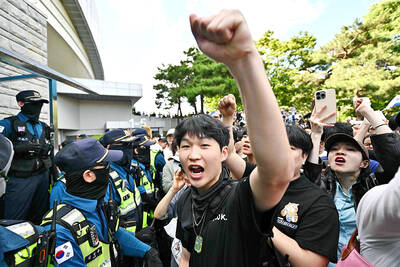
‘ABSURD MISTAKE’: The election commission said that there had been a failure to anticipate turnout after 14 polling stations ran short of ballot papers South Korean riot police yesterday cleared protesters from a Seoul polling station after a 35-hour blockade sparked by a shortage of ballot papers during local elections earlier this week. Wednesday’s election was the first nationwide vote since South Korean President Lee Jae-myung took office following the ouster of Yoon Suk-yeol over his short-lived martial law declaration. Lee’s ruling Democratic Party swept most races, but failed to flip the crucial Seoul mayoral seat. The South Korean National Election Commission apologized, blaming a failure to anticipate turnout after 14 polling stations in Seoul ran short of ballot papers. Some polling stations stayed open until 10pm to

Australian researchers have trained lab-grown brain cells on a silicon computer chip to play the 1990s shooter game Doom and said they are just scratching the surface of what the neurons could be capable of doing. It is the science-fiction work of biotech boffins at Cortical Labs, who researched and developed the technology that harnesses the workings of the brain’s networking system. Each so-called “biological computer” contains about 200,000 living human brain cells, grown from stem cells that were harvested from blood donations. Having mastered the simple computer game Pong, where a paddle is moved up and down to send a ball

France experienced its hottest spring on record, the French weather service said on Tuesday, after an exceptional early heat wave that also broke highs for the season in England and Wales. Meteo-France said the average nationwide temperature over March to May was 13.8°C — about 1.7°C above the norm, and surpassing records set in 2011 and 2020. “The warmest spring since records began in 1900,” it said in a bulletin. All three months were warmer than average, but the onset of an “unprecedented heatwave” late last month pushed the mercury to highs typically seen at the height of the summer. “Our country had never


 RSS
RSS