


British Prime Minister Gordon Brown has backed calls for access to a uranium bank for states that renounce nuclear weapons but want to develop atomic energy.
Brown, in the US for meetings of the UN General Assembly and the G20, called for a “new era of collaboration” to tackle a range of issues from the economy to climate change. Writing in the New York Times, Brown said a new nuclear non-proliferation agreement was needed urgently.
“To this end, Britain proposes a new and comprehensive grand bargain on nuclear proliferation: access to civil atomic energy via an international uranium bank for states that renounce current or future nuclear arms, together with a reduction of nuclear weapons by nuclear weapons states,” he said.

PHOTO: REUTERS
The call echoes proposals from the head of nuclear watchdog the International Atomic Energy Agency (IAEA) for a fuel bank.
The idea has made little headway, but has been supported by US President Barack Obama and gained additional impetus from Western concerns that Iran’s expanding uranium enrichment program could be used to make atomic bombs.
Brown was set to tell the UN Security Council today that Britain was not ready to give up its status as a nuclear power but was prepared to reduce the nuclear submarine fleet from four to three when they are replaced over the next 15 years.
“If we are serious about the ambition of a nuclear-free world we will need statesmanship, not brinkmanship,” he will say, according to an extract from his speech provided to journalists traveling with him for this week’s UN and G20 meetings.
A subcommittee, including Britain’s relevant government ministers, the chiefs of staff and the heads of the intelligence agencies, are expected to be instructed to come forward with detailed recommendations by the end of the year.
The future of Britain’s nuclear arsenal has become a hot topic of debate in recent weeks as concerns over the country’s public finances have escalated — borrowing has soared as tax revenues have plummeted during the recession and spending has escalated to pay for unemployment benefits and the bailout of the banks.
The nuclear issue was one of five priorities for the international community that Brown was to highlight in his UN speech, together with the economy, climate change, terrorism and poverty.
Turning to the economy in his New York Times piece, Brown said the world’s leading nations must deliver on expansionary measures designed to drag the global economy out of the deepest recession in decades.
“The world has to decide whether to stay the course and deliver the promised fiscal stimulus this year and in 2010,” he wrote.
“We need a clear commitment from the Group of 20 on a global compact to provide a framework for jobs, growth and stability over the medium to long term — one that perhaps even includes objectives for global growth,” he wrote.
Meanwhile the foreign ministers of the so-called E3+3 group of Britain, France and Germany, plus the US, Russia and China were to meet yesterday, ahead of talks next week with Iran aimed at persuading it to give up any ambitions to construct nuclear weapons.

An American scientist convicted of lying to US authorities about payments from China while he was at Harvard University has rebuilt his research lab in Shenzhen, China, to pursue technology the Chinese government has identified as a national priority: embedding electronics into the human brain. Charles Lieber, 67, is among the world’s leading researchers in brain-computer interfaces. The technology has shown promise in treating conditions such as amyotrophic lateral sclerosis and restoring movement in paralyzed people. It also has potential military applications: Scientists at the Chinese People’s Liberation Army have investigated brain interfaces as a way to engineer super soldiers by boosting
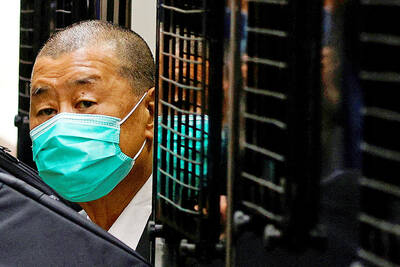
Jailed media entrepreneur Jimmy Lai (黎智英) has been awarded Deutsche Welle’s (DW) freedom of speech award for his contribution to Hong Kong’s pro-democracy movement. The German public broadcaster on Thursday said Lai would be presented in absentia with the 12th iteration of the award on June 23 at the DW Global Media Forum in Bonn. Deutsche Welle director-general Barbara Massing praised the 78-year-old founder of the now-shuttered news outlet Apple Daily for standing “unwaveringly for press freedom in Hong Kong at great personal risk.” “With Apple Daily, he gave journalists a platform for free reporting and a voice to the democracy movement in
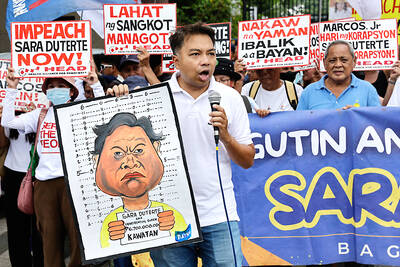
PHILIPPINE COMMITTEE: The head of the committee that made the decision said: ‘If there is nothing to hide, there is no reason to hide, there is no reason to obstruct’ A Philippine congressional committee on Wednesday ruled that there was “probable cause” to impeach Philippine Vice President Sara Duterte after hearing allegations of unexplained wealth, misuse of state funds and threats to have the president assassinated. The unanimous decision of the 53-member committee in the Philippine House of Representatives sends the two impeachment complaints to deliberations and voting by the entire lower chamber, which has more than 300 lawmakers. The complaints centered on Duterte’s alleged illegal use and mishandling of intelligence funds from the vice president’s office, and from her time as education secretary under Philippine President Ferdinand Marcos Jr. Duterte and the

Burmese President Min Aung Hlaing yesterday cut all prisoners’ sentences by one-sixth, a blanket measure that a source close to deposed leader Aung San Suu Kyi said would further shorten her detention. Aung San Suu Kyi has been sequestered since a 2021 military coup, but the senior member of her dissolved National League for Democracy (NLD) party said that while her term had been reduced, her remaining sentence is still unclear. “We also don’t know exactly how many years she has left,” the source told reporters, speaking on condition of anonymity for security reasons. The military toppled Aung San Suu Kyi’s elected government


 RSS
RSS