


Brashly shouting out his lyrics in crowded, smoky clubs, Alexei Nikonov zeroes in on provocative themes that most musicians here ignore — authoritarianism and injustice in today’s Russia.
Nikonov, the outspoken singer of Saint Petersburg-based punk rock band PTVP, saves much of his venom for Russian Prime Minister Vladimir Putin, referring to him as a “pig” in one of his most strident songs.
“We live in a feudal society,” Nikonov fumed in a backstage interview before a recent concert. “Everything is decided by one person, the dictator. The dictator decides everything.”
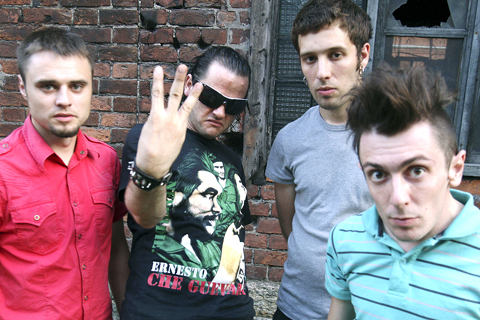
PHOTO: AFP
This is not the sort of opinion one can find anymore on Russian TV channels or most radio stations, where criticism of the government faded away after Putin became president in 2000. Though Putin stepped down last year to become prime minister, he is still widely seen as Russia’s true ruler.
Meanwhile Russian rock music lost much of its rebellious spirit after being at the forefront of perestroika, the liberal reforms introduced by Soviet leader Mikhail Gorbachev in the 1980s, musicians and critics say. Ironically, some of the leading figures in 1980s rock now perform at patriotic concerts organized by the Kremlin. But in Saint Petersburg, a city long seen as Russia’s “window to the West,” a handful of bands have defied the trend and continue to speak out. They include PTVP, whose full name translates as “The Last Tanks in Paris,” and some veteran bands who complain of being marginalized on TV and radio because of their politics.
“Most bands, for some reason, have become conformist and most music is just fun,” said Sergey Chernov, a music columnist for the St. Petersburg Times newspaper who has followed Russian rock since the 1980s. “PTVP are unique in touching on political and social subjects. There are probably two or three well-known bands who do this.”
In 1981, when Saint Petersburg was called Leningrad, Communist authorities allowed the opening of the Soviet Union’s first legal rock-music club. Though closely overseen by the KGB [secret police], the Leningrad Rock Club became the heart of a vibrant scene in which many bands inserted veiled protest messages into their songs, which won enormous popularity as perestroika anthems. But with the 1991 collapse of the Soviet Union, the old censorship vanished and capitalism became the new master of Russia’s music industry.
The result was the “degradation” of Russian rock, said Mikhail Borzykin, the frontman of Televizor, a band which got its start in the Leningrad Rock Club and which is now one of Russia’s few politically outspoken rock groups.
“When it comes one’s position as a citizen, it has become unfashionable to express it openly. There is an attitude that politics should be separate from art,” Borzykin said.
The crushing of media freedom under Putin also had a devastating effect, as TV and radio stations were taken over by Kremlin-friendly owners who feared the slightest hint of dissent, Borzykin said.
“All show-business managers are connected, through rent or other financial obligations, to officials,” he said. “So they are very afraid of losing their small business by getting into any conflicts, even petty ones, with the authorities.”
Last year, Televizor — which means “Television” — got into a conflict with a Saint Petersburg television channel that asked them to do a live performance, then canceled it after reviewing the songs Borzykin planned to sing. The channel said it was because the songs contained inappropriate words, but Borzykin called it political censorship.
For radically outspoken PTVP, which was founded in 1996 in the small town of Vyborg near Russia’s border with Finland, the problems are even worse. Several times over the years, police rushed the stage and stopped concerts after Nikonov sang about Putin, and once in Vyborg he was hauled off to jail before being freed without charges, band members recalled.
“It is mostly provincial towns that are afraid,” Nikonov said.
The band is undoubtedly disrespectful to Putin, especially in its 2002 song FSB Whore, whose title refers to the KGB’s post-Soviet successor agency, which Putin once led. The song’s lyrics are: “Don’t listen to anything!/He always lies to you!/Putin, Putin, Putin!/A pig will find filth everywhere!”
Whether due to censorship or simply the limited appeal of its raw punk rock, PTVP’s songs virtually never appear on TV or radio. The band plays at clubs where it has a small but loyal following.
“They have a clear point of view on what’s happening in Russia today on the political front,” said Pavel Isakov, a young fan at the recent PTVP concert in Saint Petersburg. “They have the right approach to this, the position that young people share, and not what the media like to promote.”

‘CROSSING THE LINE’: China’s embassy in Seoul criticized US Forces Korea Commander General Xavier Brunson, asking if his ‘hostile’ remarks were authorized by Washington South Korea and the US are in talks over recent public remarks by the commander of US Forces Korea, Seoul’s presidential office said yesterday, after the comments drew sharp criticism from China. In a recent podcast interview, US Forces Korea Commander General Xavier Brunson described South Korea as “the dagger in the heart of Asia” from China’s east coast, prompting the Chinese embassy in Seoul to say that he had “truly crossed the line.” The interview came amid growing speculation that Washington might seek to expand the role of US Forces Korea in countering the growing regional influence of China, a key

Through the noise of rushing papers and whirring belts at a print factory in Kyoto, two creators watch their photo essay come to life in broadsheet form — part of an effort to win new audiences in the age of artificial intelligence (AI). Despite the decline of the publishing industry, self-publication and handmade “zine” magazines are growing in popularity in Japan, reflecting the nation’s enduring love of paper in the digital era. While speaking to Agence France-Presse at the plant, his hands black with ink, one of the creators, Kazuma Obara, said: “I think [paper] is a medium that engages all five

Australian researchers have trained lab-grown brain cells on a silicon computer chip to play the 1990s shooter game Doom and said they are just scratching the surface of what the neurons could be capable of doing. It is the science-fiction work of biotech boffins at Cortical Labs, who researched and developed the technology that harnesses the workings of the brain’s networking system. Each so-called “biological computer” contains about 200,000 living human brain cells, grown from stem cells that were harvested from blood donations. Having mastered the simple computer game Pong, where a paddle is moved up and down to send a ball

A surprising gut feeling may help pigeons find their way home. Animals use various techniques to navigate, including following the stars and remembering key landmarks. Birds, fish and turtles orient themselves using Earth’s magnetic field as a compass, but it is not yet clear how exactly they do this. Pigeons are a well-known group of frequent flyers that can traverse hundreds of kilometers in a single day. For thousands of years, humans have used them to carry news, notes and military messages. Scientists have long tried to untangle how pigeons travel without getting lost. Some think the birds detect magnetic cues using light-sensitive


 RSS
RSS