


Australia said yesterday it was set to raise its swine flu alert level as the number of victims hit by the pandemic continued to mount, while Thailand urged calm after a sharp increase in cases.
Australian Health Minister Nicola Roxon said that, with the national tally nearing 1,500 cases, the whole country would soon move to the “sustain” phase, in line with hot spot state Victoria.
The “sustain” phase, Australia’s second-highest, gives authorities the power to cancel sports events, close schools and restrict travel.
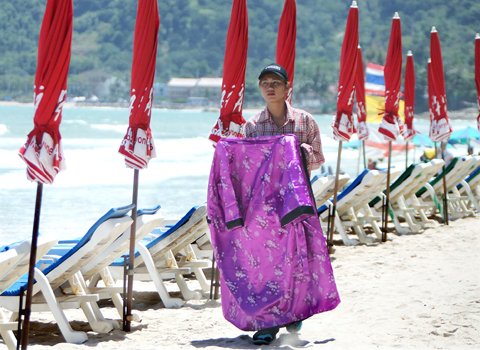
PHOTO: EPA
Government officials said, however, that extreme measures such as closing national borders were unlikely.
The WHO raised its global alert to a maximum level six on Thursday, saying swine flu had reached pandemic status because of its geographical spread.
Swine flu has so far infected almost 30,000 people in 74 countries and claimed 145 lives since it was first detected in Mexico in April, according to WHO figures released on Friday.
A total of 1,458 cases of the virus have been counted in Australia, the worst-hit Asia-Pacific country, with the fifth-highest number of cases worldwide.
“As the numbers gradually increase in jurisdictions there will be steps over the coming days to move to a consistent alert level,” Roxon said.
“It’s inevitable that the disease will spread. That’s the nature of this type of flu,” she said.
Meanwhile, Thai Prime Minister Abhisit Vejjajiva urged the country not to panic after swine flu cases suddenly soared and a cluster emerged in a key tourist hub.
Health authorities reported 106 confirmed cases of the virus late on Saturday — nearly seven times the tally just three days earlier.
Officials last week said 21 of the new infections were found among nightclub workers in the coastal city of Pattaya, who were tested after two Taiwanese tourists said on returning home they had contracted the disease there.
“People should not panic. The death ratio for the new flu is probably lower than normal flu,” Abhisit said in his weekly television program.
He said the government was taking extra measures whenever cases were reported to stop the spread of the disease.

DOUBLE-MURDER CASE: The officer told the dispatcher he would check the locations of the callers, but instead headed to a pizzeria, remaining there for about an hour A New Jersey officer has been charged with misconduct after prosecutors said he did not quickly respond to and properly investigate reports of a shooting that turned out to be a double murder, instead allegedly stopping at an ATM and pizzeria. Franklin Township Police Sergeant Kevin Bollaro was the on-duty officer on the evening of Aug. 1, when police received 911 calls reporting gunshots and screaming in Pittstown, about 96km from Manhattan in central New Jersey, Hunterdon County Prosecutor Renee Robeson’s office said. However, rather than responding immediately, prosecutors said GPS data and surveillance video showed Bollaro drove about 3km

Tens of thousands of people on Saturday took to the streets of Spain’s eastern city of Valencia to mark the first anniversary of floods that killed 229 people and to denounce the handling of the disaster. Demonstrators, many carrying photos of the victims, called on regional government head Carlos Mazon to resign over what they said was the slow response to one of Europe’s deadliest natural disasters in decades. “People are still really angry,” said Rosa Cerros, a 42-year-old government worker who took part with her husband and two young daughters. “Why weren’t people evacuated? Its incomprehensible,” she said. Mazon’s
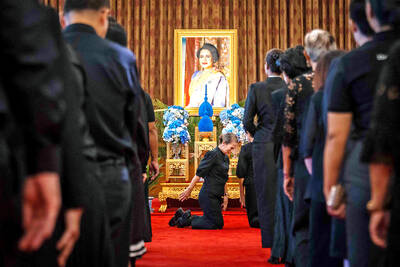
‘MOTHER’ OF THAILAND: In her glamorous heyday in the 1960s, former Thai queen Sirikit mingled with US presidents and superstars such as Elvis Presley The year-long funeral ceremony of former Thai queen Sirikit started yesterday, with grieving royalists set to salute the procession bringing her body to lie in state at Bangkok’s Grand Palace. Members of the royal family are venerated in Thailand, treated by many as semi-divine figures, and lavished with glowing media coverage and gold-adorned portraits hanging in public spaces and private homes nationwide. Sirikit, the mother of Thai King Vajiralongkorn and widow of the nation’s longest-reigning monarch, died late on Friday at the age of 93. Black-and-white tributes to the royal matriarch are being beamed onto towering digital advertizing billboards, on
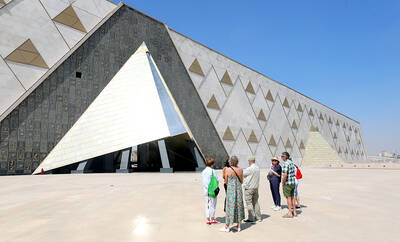
With much pomp and circumstance, Cairo is today to inaugurate the long-awaited Grand Egyptian Museum (GEM), widely presented as the crowning jewel on authorities’ efforts to overhaul the country’s vital tourism industry. With a panoramic view of the Giza pyramids plateau, the museum houses thousands of artifacts spanning more than 5,000 years of Egyptian antiquity at a whopping cost of more than US$1 billion. More than two decades in the making, the ultra-modern museum anticipates 5 million visitors annually, with never-before-seen relics on display. In the run-up to the grand opening, Egyptian media and official statements have hailed the “historic moment,” describing the


 RSS
RSS