


Finding five minutes in his 14-hour day to eat at his desk is tough enough for Sicilian magistrate Nicolo Marino. The real challenge is walking down the corridor to the espresso machine. That has required an armed escort ever since a Mafia clan tried to blow him up in his office more than a decade ago.
Sicilian by birth, Marino has the kind of intensity and energy needed to fight the Mafia in the hinterland town of Caltanissetta, but there are not many like him. While Italy’s jobless rates soar, only four applications trickled in to fill 55 empty positions for magistrates in Sicily this year, making it the most unpopular job in Italy, possibly in Europe.
“Will the Mafia kill me? You just never think about it,” said Marino, who has signed 500 Mafia arrest warrants in four years at the solid wooden desk he inherited from a magistrate who was murdered by mobsters in Palermo in 1980.
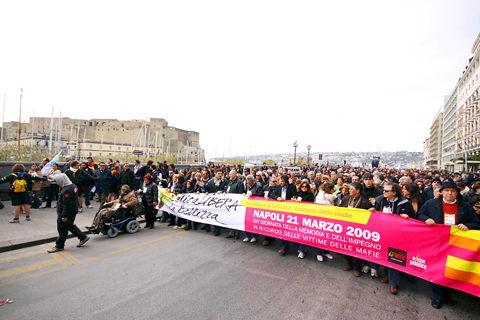
PHOTO: EPA
Following the spectacular arrests of bosses Bernardo Provenzano and Salvatore Lo Piccolo as well as the mounting resistance by businesses to paying the pizzo, as protection money is known, Sicily’s Cosa Nostra has been described as on the back foot.
But the Mafia is very much on the minds of prosecutors at the crumbling justice building in Caltanissetta, which sits among grim tower blocks that edge out into the rolling hills, citrus orchards and eucalyptus copses of central Sicily.
About 700 Cosa Nostra affiliates lurk in the province, pressuring well over half the shops in the town to pay pizzo and forcing public works contractors to hand over an estimated 10 million euro (US$13.3 million) a year — 2 percent to 3 percent on contracts — to avoid workplace “accidents.”
Last week felt like old times in Sicily. Marino arrested local mobsters suspected of planning to kidnap a Sicilian banker for ransom at Easter, while in Palermo a politician was sent a goat’s head, complete with a bullet in its forehead.
To stem the crime wave in Caltanissetta, the justice building has offices for seven anti-Mafia magistrates, but today only three are occupied, following the government’s decision in 2006 to stop dispatching young magistrates to earn their spurs in unpopular postings.
Of the four magistrates who applied to work in Sicily this year, none wanted to come to Caltanissetta.
Funding cuts imposed by Italian Prime Minister Silvio Berlusconi’s cash-strapped administration, which halved the team’s spending in January, do not make the place more appealing.
After a frenetic morning spent meeting the clerks, policemen and lawyers who line up outside his office, Marino dons a robe to duck into a courtroom on the second floor, where a handsome man locked in a cage is calmly staring down anyone who dares to make eye contact with him.
Francesco Ghiando, a leading member of the local Mazzarino clan, stands accused of the shotgun slaying of two men he believed killed his brother in a drug-dealing dispute.
Ballistics evidence is given in a brief hearing, the case is adjourned to allow the judge to move on to another trial and Marino is back in the corridor with his bodyguards.
“Trials are staggered like this because we need them opened quickly so that pre-trial custody orders for suspects don’t expire,” he said.
Down the corridor from Marino’s crowded office, fellow anti-Mafia prosecutor Stefano Luciani has hung photos of his home city, Rome, behind his desk, leaving space for a framed shot of his heroes, magistrates Paolo Borsellino and Giovanni Falcone, both assassinated by the Mafia in 1992.
“They are heroes for me because, despite challenges, they did their job,” said the 37-year-old, who was a young law student when they were killed.
Luciani now has that same job, and he claims it is the one he has always dreamed of, but it is not leaving him a life.
“Here it’s just home to office to home and you think twice about making friends,” said Luciani, who lives in an isolated house outside town to give his dog space, and is unruffled by the arson attack on a judge’s country house last year that nearly killed him and his family.
“Experience suggests that, if they really want to get you, bodyguards can be a deterrent, but cannot stop them,” he said.
To explain who “they” are, Luciani pulls out a map of the province, which is split into four Mafia zones of control or mandamenti, each with its own boss who in turn rules over local clans, 20 listed in all in a province with a population of 287,000. Such intelligence is shaped by wiretaps.
“Do we fear moles in the justice building? Yes, it happens,” said Luciani. “That’s why documents circulating between offices are sealed.”
For Marino, the Mafia in Caltanissetta remains entrenched in society.
Against such odds, said Lari, victories are being scored, but the empty offices in the justice building and the clapped-out cars outside give the Mafia an edge at a crucial moment.

An American scientist convicted of lying to US authorities about payments from China while he was at Harvard University has rebuilt his research lab in Shenzhen, China, to pursue technology the Chinese government has identified as a national priority: embedding electronics into the human brain. Charles Lieber, 67, is among the world’s leading researchers in brain-computer interfaces. The technology has shown promise in treating conditions such as amyotrophic lateral sclerosis and restoring movement in paralyzed people. It also has potential military applications: Scientists at the Chinese People’s Liberation Army have investigated brain interfaces as a way to engineer super soldiers by boosting
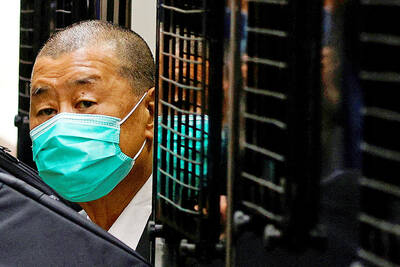
Jailed media entrepreneur Jimmy Lai (黎智英) has been awarded Deutsche Welle’s (DW) freedom of speech award for his contribution to Hong Kong’s pro-democracy movement. The German public broadcaster on Thursday said Lai would be presented in absentia with the 12th iteration of the award on June 23 at the DW Global Media Forum in Bonn. Deutsche Welle director-general Barbara Massing praised the 78-year-old founder of the now-shuttered news outlet Apple Daily for standing “unwaveringly for press freedom in Hong Kong at great personal risk.” “With Apple Daily, he gave journalists a platform for free reporting and a voice to the democracy movement in
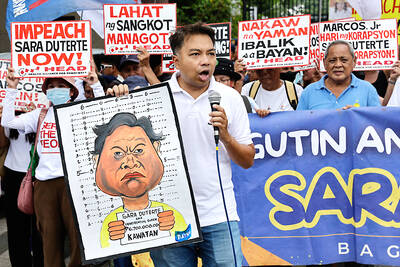
PHILIPPINE COMMITTEE: The head of the committee that made the decision said: ‘If there is nothing to hide, there is no reason to hide, there is no reason to obstruct’ A Philippine congressional committee on Wednesday ruled that there was “probable cause” to impeach Philippine Vice President Sara Duterte after hearing allegations of unexplained wealth, misuse of state funds and threats to have the president assassinated. The unanimous decision of the 53-member committee in the Philippine House of Representatives sends the two impeachment complaints to deliberations and voting by the entire lower chamber, which has more than 300 lawmakers. The complaints centered on Duterte’s alleged illegal use and mishandling of intelligence funds from the vice president’s office, and from her time as education secretary under Philippine President Ferdinand Marcos Jr. Duterte and the

Burmese President Min Aung Hlaing yesterday cut all prisoners’ sentences by one-sixth, a blanket measure that a source close to deposed leader Aung San Suu Kyi said would further shorten her detention. Aung San Suu Kyi has been sequestered since a 2021 military coup, but the senior member of her dissolved National League for Democracy (NLD) party said that while her term had been reduced, her remaining sentence is still unclear. “We also don’t know exactly how many years she has left,” the source told reporters, speaking on condition of anonymity for security reasons. The military toppled Aung San Suu Kyi’s elected government


 RSS
RSS