


An Australian writer jailed for insulting the Thai royal family flew home to a tearful reunion with his family yesterday after being pardoned by the king and freed from jail.
Feeling “bewildered, dazed and nauseous,” Harry Nicolaides touched down in the city of Melbourne yesterday after spending five months in a Bangkok prison on charges of slandering the Thai monarchy.
Thai officials said 41-year-old Nicolaides was released on Friday evening after officials approved a royal pardon — the result of intense lobbying by Canberra.
“I was informed I had a royal pardon and asked to kneel before a portrait of the king — a royal audience of sorts,” Nicolaides told reporters on arrival at Melbourne airport. “A few hours before that, I was climbing out of a sewerage tank that I fell into in the prison.”
“I ran out of tears, but I never ran out of hope or love,” he added, after an emotional homecoming with his family.
Nicolaides was sentenced to three years in jail after pleading guilty to lese majeste, or slandering the monarchy, in his 2005 novel titled Verisimilitude.
He expressed anger, confusion and frustration at his imprisonment, saying Australians enjoyed “rare privileges” of democracy and free speech.
His lawyer, Mark Dean, said the previous Thai administration had imprisoned Nicolaides to send a strong message of intolerance to dissent at the height of political unrest in Bangkok.
“I think it’s fair to say that Harry was a political prisoner and that the reasons for the commencement of this case against him were inextricably linked to the political crisis in Thailand in August 2008,” Dean said. “Since then conditions have changed in Thailand, there has been a change of government and the current Thai government has done everything it can to support Harry’s case.”
A spokesman from Australia’s foreign affairs department said diplomats in Bangkok and Canberra had worked closely to resolve the writer’s case.
“We appreciate the expeditious handling of the pardon by Thai authorities,” the spokesman said.
Speaking at his son’s side, Nicolaides’ father Socrates said the ordeal had been a “living death” for the family.
“But now I feel I have come alive again,” he said.
Brother Forde Nicolaides said he was “ecstatic” at the outcome.
“Our emphasis to the Thai government was ... for them to consider Harry’s case compassionately and expeditiously,” he told national newswire AAP. “I think everyone was on the same page, as they have been reasonably expeditious with the application. We are very grateful for that.”
Nicolaides, who had previously worked as a university lecturer in Thailand, has been in prison since his arrest at Bangkok airport’s departure lounge on Aug. 31.
The charge against him related to a passage in the novel, of which Nicolaides says only a handful of copies were sold.
Thailand has some of the strictest laws in the world protecting revered King Bhumibol Adulyadej and his family from insult, but media freedom groups have accused authorities of abusing the law to suppress dissent.
Thai authorities have banned nearly 4,000 Web sites in recent months for allegedly insulting the monarchy. Police said last week that more than 17 criminal cases of insulting the royal family are currently active.


Through the noise of rushing papers and whirring belts at a print factory in Kyoto, two creators watch their photo essay come to life in broadsheet form — part of an effort to win new audiences in the age of artificial intelligence (AI). Despite the decline of the publishing industry, self-publication and handmade “zine” magazines are growing in popularity in Japan, reflecting the nation’s enduring love of paper in the digital era. While speaking to Agence France-Presse at the plant, his hands black with ink, one of the creators, Kazuma Obara, said: “I think [paper] is a medium that engages all five
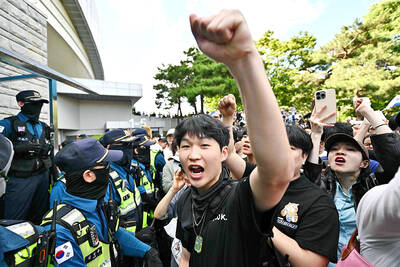
‘ABSURD MISTAKE’: The election commission said that there had been a failure to anticipate turnout after 14 polling stations ran short of ballot papers South Korean riot police yesterday cleared protesters from a Seoul polling station after a 35-hour blockade sparked by a shortage of ballot papers during local elections earlier this week. Wednesday’s election was the first nationwide vote since South Korean President Lee Jae-myung took office following the ouster of Yoon Suk-yeol over his short-lived martial law declaration. Lee’s ruling Democratic Party swept most races, but failed to flip the crucial Seoul mayoral seat. The South Korean National Election Commission apologized, blaming a failure to anticipate turnout after 14 polling stations in Seoul ran short of ballot papers. Some polling stations stayed open until 10pm to

France experienced its hottest spring on record, the French weather service said on Tuesday, after an exceptional early heat wave that also broke highs for the season in England and Wales. Meteo-France said the average nationwide temperature over March to May was 13.8°C — about 1.7°C above the norm, and surpassing records set in 2011 and 2020. “The warmest spring since records began in 1900,” it said in a bulletin. All three months were warmer than average, but the onset of an “unprecedented heatwave” late last month pushed the mercury to highs typically seen at the height of the summer. “Our country had never
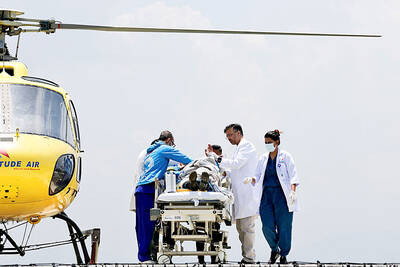
A Sherpa guide was found crawling to base camp on Mount Everest a week after he went missing and was reunited with his family, who had given up hope he would return. Dawa Sherpa was last seen on Friday last week descending the mountain, but he did not reach base camp even though his client did. The pair were among the last climbers on the mountain as the climbing season came to an end and the route was dismantled. Dawa was located by a cleaning crew on Thursday morning as he was crawling down the snowy slopes around the Khumbu Icefall, just above


 RSS
RSS