


The doomed man’s eyes stare blankly ahead as he shuffles down a dark corridor, spreading a hush through the death-row cells. The hangman pushes a black hood over the convict’s head and tightens a noose around his neck. The trapdoor opens beneath his feet with a clang that reverberates around the stone walls. A gurgle, one last rattle of chains, then silence.
Through the iron bars of his cell near the gallows of this Nigerian prison, Arthur Judah Angel watched the hangman do his morbid work for almost a decade, witnessing the hangings of more than 450 of his fellow convicts. He committed their names to memory and many of their images to paper.
Now, 51 drawings that survived Angel’s incarceration are attracting the attention of human rights activists and art lovers alike, allowing the artist to turn his years of horror into activism against the death penalty.
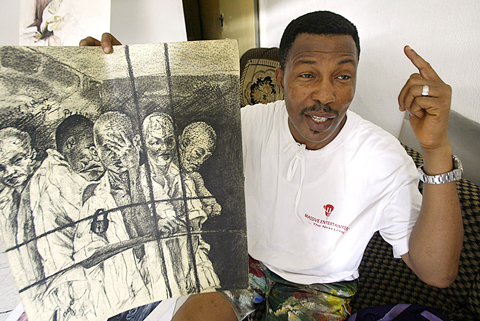
PHOTO: AP
“I had to document our ugly world,” said Angel, 46, who spent a total of 16 years in prison for a murder he says he didn’t commit before being freed in 2000. “It was drawing that kept me going in there. It gave me a purpose.”
Angel was beaten and thrown behind bars in January 1984 when he went to visit a friend who had been taken into custody at a neighborhood police station. He was 21 then and planned to begin university that year.
Five days later he was charged with murdering a policeman. Police asked for a bribe to free him, but his mother was too poor to pay, he says. So Angel was held for two years until his case went to court. After a six-day trial in which police were both the complainants and the only witnesses, he was sentenced to hang.
On death row, he lived in a 2.1m2 cell with up to 13 other condemned criminals. A bucket in the corner was the toilet. At night the cellmates had to lie down side-by-side to sleep. If one wanted to turn in the night, he would have to stand and then squeeze himself back in.
The cell was one of 18 that housed over 200 condemned men in Enugu prison — one of Nigeria’s largest.
A detailed pencil drawing by Angel on rough pink cardboard shows the semi-naked prisoners hunched in awkward positions. Scrawled across the grimy walls are the names of previous occupants and the dates of their execution. Angel named the drawing Sleeping in Limbo.
“That existence is one between life and death. You don’t belong to either world,” Angel said.
Condemned criminals were not allowed to keep pens or paper so Angel’s first prison drawing was done on a cell wall with charcoal smuggled from the kitchen. It was a cartoon cowboy designed to cheer up his cellmates, but it also caught the eye of the wardens.
“They started coming to me and asking me to do drawings for them,” he said. “I would draw cards or portraits for them and in return they would allow me a pencil and a spare piece of paper.”
By night, Angel turned his artistic focus from the images he was commissioned to do, to the macabre sights around him.
The cell’s concrete roof had a small hole in the center that provided a circle of light when the moon shone. Angel would jostle for position beneath the hole and squat with a sheet of paper on his knees to do his secret drawings.
The 51 that endured were smuggled out by his parents when they visited. These now provide a unique insight into daily life on death row.
“I once saw 58 executed in one day,” Angel said. “But I wasn’t meant to die in there.”
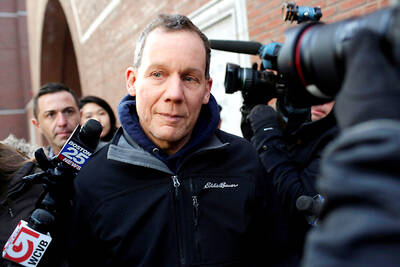
An American scientist convicted of lying to US authorities about payments from China while he was at Harvard University has rebuilt his research lab in Shenzhen, China, to pursue technology the Chinese government has identified as a national priority: embedding electronics into the human brain. Charles Lieber, 67, is among the world’s leading researchers in brain-computer interfaces. The technology has shown promise in treating conditions such as amyotrophic lateral sclerosis and restoring movement in paralyzed people. It also has potential military applications: Scientists at the Chinese People’s Liberation Army have investigated brain interfaces as a way to engineer super soldiers by boosting
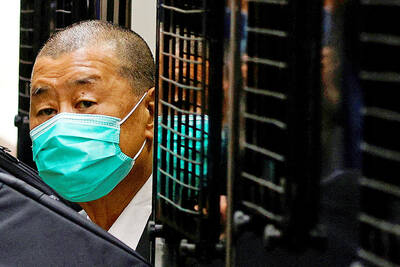
Jailed media entrepreneur Jimmy Lai (黎智英) has been awarded Deutsche Welle’s (DW) freedom of speech award for his contribution to Hong Kong’s pro-democracy movement. The German public broadcaster on Thursday said Lai would be presented in absentia with the 12th iteration of the award on June 23 at the DW Global Media Forum in Bonn. Deutsche Welle director-general Barbara Massing praised the 78-year-old founder of the now-shuttered news outlet Apple Daily for standing “unwaveringly for press freedom in Hong Kong at great personal risk.” “With Apple Daily, he gave journalists a platform for free reporting and a voice to the democracy movement in
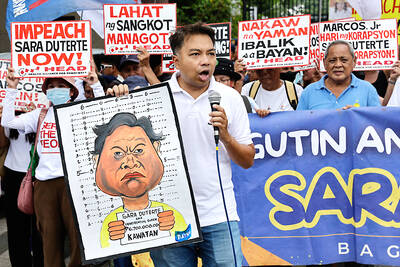
PHILIPPINE COMMITTEE: The head of the committee that made the decision said: ‘If there is nothing to hide, there is no reason to hide, there is no reason to obstruct’ A Philippine congressional committee on Wednesday ruled that there was “probable cause” to impeach Philippine Vice President Sara Duterte after hearing allegations of unexplained wealth, misuse of state funds and threats to have the president assassinated. The unanimous decision of the 53-member committee in the Philippine House of Representatives sends the two impeachment complaints to deliberations and voting by the entire lower chamber, which has more than 300 lawmakers. The complaints centered on Duterte’s alleged illegal use and mishandling of intelligence funds from the vice president’s office, and from her time as education secretary under Philippine President Ferdinand Marcos Jr. Duterte and the

Burmese President Min Aung Hlaing yesterday cut all prisoners’ sentences by one-sixth, a blanket measure that a source close to deposed leader Aung San Suu Kyi said would further shorten her detention. Aung San Suu Kyi has been sequestered since a 2021 military coup, but the senior member of her dissolved National League for Democracy (NLD) party said that while her term had been reduced, her remaining sentence is still unclear. “We also don’t know exactly how many years she has left,” the source told reporters, speaking on condition of anonymity for security reasons. The military toppled Aung San Suu Kyi’s elected government


 RSS
RSS