


Some stood with arms crossed, anger etched on their faces. Others expressed disappointment, even fear. Still others wiped away tears and grumbled when Senator John McCain congratulated his opponent, America’s first black president, for making history.
And it was clear on an election night like no other that the hard feelings of a hard-fought campaign would not fade anytime soon.
Jeri Mott, 58, of Tucson, listened to McCain’s concession speech with her arms tightly crossed and a look of disgust on her face.
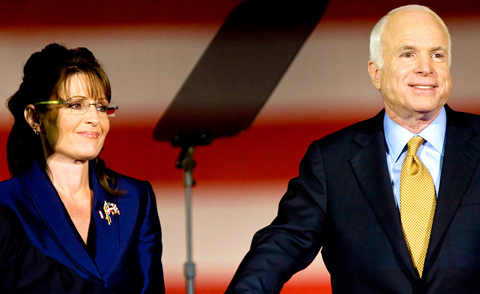
PHOTO: AFP
“I’m thinking that I’m real worried about what’s going to happen tomorrow, especially about my troops,” said Mott, whose son recently enlisted in the Army. “He’d better be paying close attention to what he’s doing with our troops,” she said of Democrat Barack Obama. “Don’t leave them with nothing.”
As for the historic nature of the night, Mott didn’t much care.
“I have no problem with an African American at the helm. It’s his vision of what he wants to do that I have a big problem with,” she said.
PHOTO: AFP
“The wrong African American,” she called Obama.
Molly Pinckney, 60, of Phoenix stood frowning, the red pom pom she earlier had waved tucked by her side.
“I’m really sad. I’m sad for our country,” she said. “It really depends on how Obama behaves ... whether he’s going to let rabble-rousers tear this country apart.”
The night began appropriately enough with Elton John’s I’m Still Standing booming from the speakers at the Arizona Biltmore resort, the same place where, 28 years ago, McCain and his wife, Cindy, celebrated their wedding.
Hundreds of supporters wore buttons and T-shirts proclaiming “Victory 2008,” chanted their guy’s name and, like the candidate they gathered to honor, projected optimism and faith.
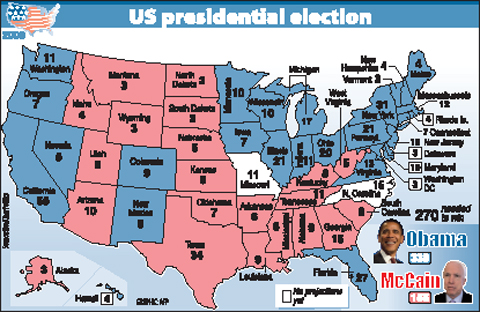
But as the night wore on, organizers temporarily stopped broadcasting the returns overhead and announced few results, as if not to put a damper on the party. Those they did disclose lagged behind national projections showing Obama gaining on McCain.
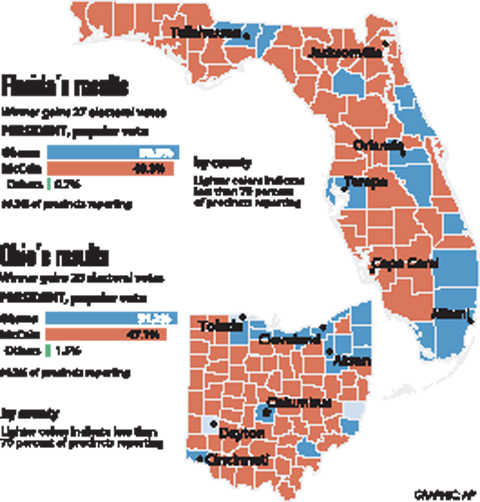
Even after Obama had been declared the winner in Pennsylvania and Ohio, former Louisiana Governor Buddy Roemer walked on stage to tell the crowd about “another state in the McCain category. It’s the great state of Louisiana!”
A roar erupted, and Roemer promised: “This election still has some anxious moments to go.”
Returns unavailable to them, supporters instead danced to Hank Williams Jr singing, “Mac is going to survive.”
“He’s already lost Ohio. They think. Right?” said John Moore said from the back of the crowded ballroom. “I’m wondering why they’re not showing us that much. I wish I had a BlackBerry so I could track it myself.”
But around 8:30pm, US Senator Jon Kyl took to the stage to deliver what sounded like a eulogy to McCain’s quest for the presidency.
“The truth of the matter is it is uphill. This has always been an uphill race. Yet John McCain kept clawing back, he kept clawing back until tonight.”
He applauded McCain’s “fighting spirit,” while still telling the crowd the race was too close to call.
In closing, Kyl cited a Bible passage that seemed as appropriate an ending to McCain’s campaign as any.
2 Timothy 4:7: “I have fought a good fight. I have finished my course. I have kept the faith.”
Meanwhile, it wasn’t the party they hoped for when several hundred people gathered for an Election Night rally in Republican vice presidential candidate Alaska Governor Sarah Palin’s hometown.
A pall was cast over the crowd when running mate John McCain, with the Alaska governor by his side, conceded the race to Democrat Barack Obama.
The concession was broadcast on large-screen TVs inside the city’s sports center.
“I think America made a big mistake,” said Phil Straka, a photographer from Wasilla who was selling buttons with the words “McCain-Palin” superimposed over Alaska scenes. “If there was another month before the election, I think they would have won.”
Residents of the Anchorage suburb were ready to cheer Palin from Wasilla to the White House.
Their former mayor provided a much-needed boost to McCain’s popularity in Alaska, where he finished fourth in the Republican caucuses. Her appeal helped McCain easily win the state and its three electoral votes.
At the Mug-Shot Saloon, where moose stew made from Palin’s own recipe was served, a military couple was divided on Obama’s victory.
Jeremy Jonas, 22, who served in Iraq with the Army, said the Democrat’s pledge to withdraw most US combat troops from Iraq within 16 months resonated with him.
“His wanting to get out of Iraq is a big thing with me,” he said.
But that pledge upset his girlfriend, 23-year-old Danielle Tichenor, who has joined the Army Reserves for an eight-year stint.
“If Obama pulls the troops out, everyone who has been there will have died in vain,” she said. “I supported McCain because he was a POW and he knows everything that is going on overseas.”
Back at the sports complex, several people expressed hope for whatever future role Palin may play in politics.
“It’s just the beginning for Sarah. She’ll be on the ticket in 2012,” said Beryl Kring of Anchorage.
Straka, the photographer with the McCain-Palin buttons, was willing to give them away after McCain’s concession speech. He said he’d make more buttons if she runs again.

Through the noise of rushing papers and whirring belts at a print factory in Kyoto, two creators watch their photo essay come to life in broadsheet form — part of an effort to win new audiences in the age of artificial intelligence (AI). Despite the decline of the publishing industry, self-publication and handmade “zine” magazines are growing in popularity in Japan, reflecting the nation’s enduring love of paper in the digital era. While speaking to Agence France-Presse at the plant, his hands black with ink, one of the creators, Kazuma Obara, said: “I think [paper] is a medium that engages all five
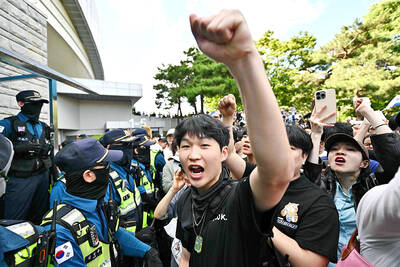
‘ABSURD MISTAKE’: The election commission said that there had been a failure to anticipate turnout after 14 polling stations ran short of ballot papers South Korean riot police yesterday cleared protesters from a Seoul polling station after a 35-hour blockade sparked by a shortage of ballot papers during local elections earlier this week. Wednesday’s election was the first nationwide vote since South Korean President Lee Jae-myung took office following the ouster of Yoon Suk-yeol over his short-lived martial law declaration. Lee’s ruling Democratic Party swept most races, but failed to flip the crucial Seoul mayoral seat. The South Korean National Election Commission apologized, blaming a failure to anticipate turnout after 14 polling stations in Seoul ran short of ballot papers. Some polling stations stayed open until 10pm to

Australian researchers have trained lab-grown brain cells on a silicon computer chip to play the 1990s shooter game Doom and said they are just scratching the surface of what the neurons could be capable of doing. It is the science-fiction work of biotech boffins at Cortical Labs, who researched and developed the technology that harnesses the workings of the brain’s networking system. Each so-called “biological computer” contains about 200,000 living human brain cells, grown from stem cells that were harvested from blood donations. Having mastered the simple computer game Pong, where a paddle is moved up and down to send a ball
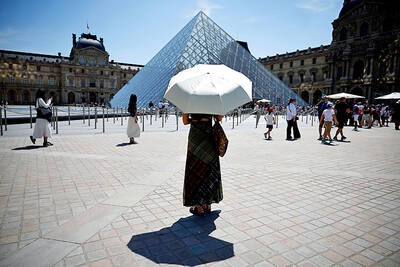
France experienced its hottest spring on record, the French weather service said on Tuesday, after an exceptional early heat wave that also broke highs for the season in England and Wales. Meteo-France said the average nationwide temperature over March to May was 13.8°C — about 1.7°C above the norm, and surpassing records set in 2011 and 2020. “The warmest spring since records began in 1900,” it said in a bulletin. All three months were warmer than average, but the onset of an “unprecedented heatwave” late last month pushed the mercury to highs typically seen at the height of the summer. “Our country had never


 RSS
RSS