


The Croatian prime minister has pledged to relentlessly pursue the killers of a journalist slain in a bombing, promising that no criminal would sleep calmly until this case and other major crimes were solved.
Croatian Prime Minister Ivo Sanader convened an emergency session of the national security council on Friday to discuss the death of Ivo Pukanic, 47, who owned and edited Nacional, an influential publication known for its investigative journalism.
Nacional’s marketing director, Niko Franjic, also died when an explosive device was placed near their car in the capital, Zagreb.
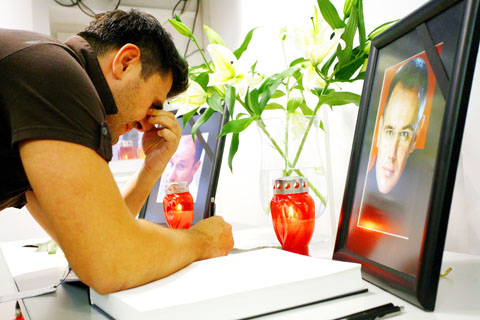
PHOTO: AFP
“We will fight organized crime or terrorism — whatever is behind this murder — to its very end,” Sanader said after the security council’s meeting. “From now on, no criminal can sleep calmly.”
Sanader also said there was no need to introduce the national state of emergency as some have suggested, but that all relevant institutions would be mobilized.
Croatian TV channels showed Pukanic’s gutted Lexus and two bodies draped with cloth beside the car. The blast also slightly injured two others and shattered windows of neighboring buildings.
Pukanic’s killing came just two weeks after the 26-year-old daughter of a prominent lawyer was shot twice in the head in the capital, in what authorities described as a mafia-style slaying. No suspects have been arrested.
The bold killings, coupled with several recent beatings in Zagreb, triggered national outrage and accusations that the government was powerless against crime.
The EU has warned Croatia to crack down on crime and corruption if it hopes to join the 27-nation bloc. In Brussels, Belgium, Olli Rehn, the EU enlargement official, condemned the killing and said he believed Croatian officials would “duly investigate” and bring the perpetrators to justice.
Krunoslav Borovec, a senior police official, said authorities had questioned 150 people and were exploring all motives, ranging “from banal ones to those with organized crime background.”
He said the attack was “undoubtedly carried out by professionals” and added that country’s best policemen were investigating the case.
Borovec said police experts were preparing a sketch from witness accounts of the man suspected of planting an explosive device near Pukanic’s car. They were also examining security camera footage.
Pukanic had claimed six months ago that someone had tried to shoot him dead, but missed. Police gave him protection briefly afterward, but he asked in August to have it discontinued, Interior Minister Tomislav Karamarko said on Thursday.
Nacional, however, claimed that Pukanic faced “police pressure” to accept the withdrawal of his 24-hour protection.
“Because he had police protection taken away, despite the dangers that still threatened him, those who made that decision were directly responsible for his death,” the paper said in a statement posted on its Web site.
Pukanic’s Nacional, launched in 1995, had been praised by some for disclosing murky political or business deals.
But he also was often criticized for being too close to certain politicians, secret agents and even a man believed to be a criminal gang’s boss — and was therefore not widely trusted as an impartial journalist.

Through the noise of rushing papers and whirring belts at a print factory in Kyoto, two creators watch their photo essay come to life in broadsheet form — part of an effort to win new audiences in the age of artificial intelligence (AI). Despite the decline of the publishing industry, self-publication and handmade “zine” magazines are growing in popularity in Japan, reflecting the nation’s enduring love of paper in the digital era. While speaking to Agence France-Presse at the plant, his hands black with ink, one of the creators, Kazuma Obara, said: “I think [paper] is a medium that engages all five

‘CROSSING THE LINE’: China’s embassy in Seoul criticized US Forces Korea Commander General Xavier Brunson, asking if his ‘hostile’ remarks were authorized by Washington South Korea and the US are in talks over recent public remarks by the commander of US Forces Korea, Seoul’s presidential office said yesterday, after the comments drew sharp criticism from China. In a recent podcast interview, US Forces Korea Commander General Xavier Brunson described South Korea as “the dagger in the heart of Asia” from China’s east coast, prompting the Chinese embassy in Seoul to say that he had “truly crossed the line.” The interview came amid growing speculation that Washington might seek to expand the role of US Forces Korea in countering the growing regional influence of China, a key

Australian researchers have trained lab-grown brain cells on a silicon computer chip to play the 1990s shooter game Doom and said they are just scratching the surface of what the neurons could be capable of doing. It is the science-fiction work of biotech boffins at Cortical Labs, who researched and developed the technology that harnesses the workings of the brain’s networking system. Each so-called “biological computer” contains about 200,000 living human brain cells, grown from stem cells that were harvested from blood donations. Having mastered the simple computer game Pong, where a paddle is moved up and down to send a ball

France experienced its hottest spring on record, the French weather service said on Tuesday, after an exceptional early heat wave that also broke highs for the season in England and Wales. Meteo-France said the average nationwide temperature over March to May was 13.8°C — about 1.7°C above the norm, and surpassing records set in 2011 and 2020. “The warmest spring since records began in 1900,” it said in a bulletin. All three months were warmer than average, but the onset of an “unprecedented heatwave” late last month pushed the mercury to highs typically seen at the height of the summer. “Our country had never


 RSS
RSS