


Mexican authorities said on Sunday that they had arrested more than a dozen members of an alleged drug-trafficking ring in an upscale neighborhood of this capital city, seizing weapons, vehicles — and lions.
Eleven Colombians, an American, two Mexicans and a Uruguayan were detained during a raid in a sprawling mansion in Desierto de los Leones on Saturday, Marisela Morales, a organized-crime prosecutor, told a news conference.
Morales identified the leader as Teodoro Fino Restrepo, who allegedly arranged for sea-borne cocaine shipments from Colombia to Mexico’s Beltran Leyva cartel.
Also detained in the police raid was American Raul Munoz Montalvo, of Texas. Police did not release the name of his hometown, and no one from the US embassy in Mexico was available to comment.
All the suspects are being held on suspicion of drug trafficking, money laundering and organized-crime activities, Morales said.
Nine Mexicans working as waiters and disk jockeys were briefly held and released.
Authorities had been investigating the group since 2005, the prosecutor said.
“This is important, because it breaks a logistic link in the chain that supplies Mexican cartels with cocaine,” Morales said.
The mansion, whose walls, ceilings and furniture are made almost entirely of ornately carved wood, appeared to have been used by the traffickers for parties on nights and weekends, authorities said.
Those who received invitations were picked up at nearby shopping-center parking lots in vehicles with blacked-out windows to prevent them from seeing where they were going.
The mansion was equipped with a private zoo housing a collection of animals including two tigers and two lions. Police turned the exotic animals over to prosecutors. It was unclear what they planned to do with them.
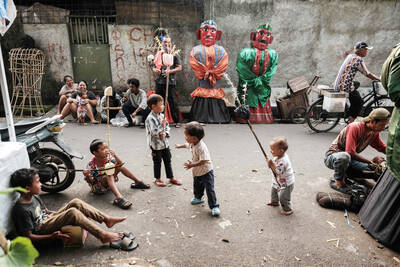
In the sweltering streets of Jakarta, buskers carry towering, hollow puppets and pass around a bucket for donations. Now, they fear becoming outlaws. City authorities said they would crack down on use of the sacred ondel-ondel puppets, which can stand as tall as a truck, and they are drafting legislation to remove what they view as a street nuisance. Performances featuring the puppets — originally used by Jakarta’s Betawi people to ward off evil spirits — would be allowed only at set events. The ban could leave many ondel-ondel buskers in Jakarta jobless. “I am confused and anxious. I fear getting raided or even
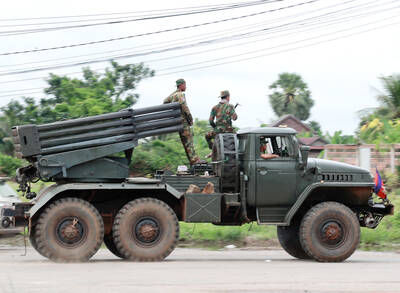
POLITICAL PATRIARCHS: Recent clashes between Thailand and Cambodia are driven by an escalating feud between rival political families, analysts say The dispute over Thailand and Cambodia’s contested border, which dates back more than a century to disagreements over colonial-era maps, has broken into conflict before. However, the most recent clashes, which erupted on Thursday, have been fueled by another factor: a bitter feud between two powerful political patriarchs. Cambodian Senate President and former prime minister Hun Sen, 72, and former Thai prime minister Thaksin Shinawatra, 76, were once such close friends that they reportedly called one another brothers. Hun Sen has, over the years, supported Thaksin’s family during their long-running power struggle with Thailand’s military. Thaksin and his sister Yingluck stayed
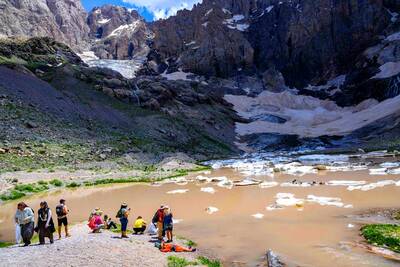
Kemal Ozdemir looked up at the bare peaks of Mount Cilo in Turkey’s Kurdish majority southeast. “There were glaciers 10 years ago,” he recalled under a cloudless sky. A mountain guide for 15 years, Ozdemir then turned toward the torrent carrying dozens of blocks of ice below a slope covered with grass and rocks — a sign of glacier loss being exacerbated by global warming. “You can see that there are quite a few pieces of glacier in the water right now ... the reason why the waterfalls flow lushly actually shows us how fast the ice is melting,” he said.
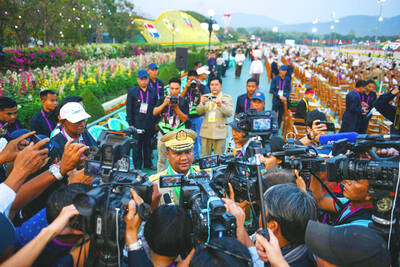
RESTRUCTURE: Myanmar’s military has ended emergency rule and announced plans for elections in December, but critics said the move aims to entrench junta control Myanmar’s military government announced on Thursday that it was ending the state of emergency declared after it seized power in 2021 and would restructure administrative bodies to prepare for the new election at the end of the year. However, the polls planned for an unspecified date in December face serious obstacles, including a civil war raging over most of the country and pledges by opponents of the military rule to derail the election because they believe it can be neither free nor fair. Under the restructuring, Myanmar’s junta chief Min Aung Hlaing is giving up two posts, but would stay at the


 RSS
RSS