


Three astronauts who conducted China’s first-ever space walk landed safely back on Chinese soil yesterday, state media reported.
The descent capsule of the Shenzhou 7 spacecraft was seen drifting down onto a landing in Inner Mongolia in footage broadcast live on state-run China Central TV.
All three men were all in good health after the landing on the region’s open plains, Xinhua news agency said.
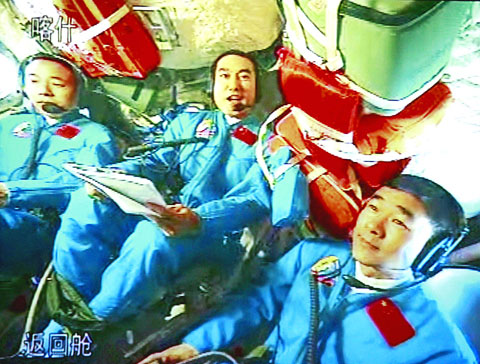
PHOTO: AP/XINHUA NEWS AGENCY
Earlier, photos of a flag-waving astronaut floating in space had been splashed across the front pages of state-run newspapers yesterday as China celebrated its first-ever space walk.
Led by mission commander Zhai Zhigang (翟志剛), the manned space flight was launched on Thursday and was expected to return yesterday afternoon.
Saturday’s space walk, which was broadcast live and watched by crowds gathered around outdoor TV screens, further stoked national pride one month after the close of the Beijing Olympics.
“A small step by Zhai Zhigang in space is a big step in the history of the Chinese nation,” said a commentary by Xinhua carried by the Beijing Daily newspaper.
“This historical step shows the ample strengths that have been accumulated since the reform and opening up,” the article said, referring to when China embarked on free-market reforms almost 30 years ago.
On most newspaper front pages were pictures of Zhai clutching a Chinese flag as he hovered in space outside the Shenzhou 7 vessel, alongside photos of Chinese President Hu Jintao (胡錦濤) on a telephone as he spoke to the astronauts.
“The first Chinese footprint has been left in the vast outer space” proclaimed the China Youth Daily.
Yesterday’s midday newscast by state broadcaster China Central Television replayed video footage of the spacewalk and showed crowds applauding in schools, shops and on streets across the country.
State media’s coverage reflected much of the glory onto Hu, who was present at the launch and watched the spacewalk at Beijing’s ground control center.
“Your success represents a new breakthrough in our manned space program,” Hu told the astronauts in a scripted exchange that was also broadcast live.
“The motherland and the people thank you,” said Hu, who chairs the Chinese Communist Party and government military committees that oversee the space program.
The spacewalk was mainly aimed at testing China’s mastery of the technology involved.
Zhai’s sole task was to retrieve a rack attached to the outside of the orbital module containing an experiment involving solid lubricants.
Tethered to handles attached to the Shenzhou 7 ship’s orbital module, Zhai remained outside for about 13 minutes before climbing back inside.
“Greetings to all the people of the nation and all the people of the world,” Zhai, facing an external camera, said as he floated halfway out of the open hatch.
Fellow astronaut Liu Boming (劉伯明) also emerged briefly from the capsule to hand Zhai a Chinese flag. The third crew member, Jing Haipeng (景海鵬), monitored the ship from inside the re-entry module.
While successful, the spacewalk wasn’t without its anxious moments.
Zhai, a 41-year-old fighter pilot, appeared to struggle with the hatch and a fire alarm was triggered in the orbiter as he began the spacewalk.
Wang Zhaoyao (王兆耀), deputy director of manned space flight, conceded that the combined effects of weightlessness and depressurization on the hatch opening operation hadn’t been fully anticipated. He blamed a faulty sensor for the fire alarm.

An American scientist convicted of lying to US authorities about payments from China while he was at Harvard University has rebuilt his research lab in Shenzhen, China, to pursue technology the Chinese government has identified as a national priority: embedding electronics into the human brain. Charles Lieber, 67, is among the world’s leading researchers in brain-computer interfaces. The technology has shown promise in treating conditions such as amyotrophic lateral sclerosis and restoring movement in paralyzed people. It also has potential military applications: Scientists at the Chinese People’s Liberation Army have investigated brain interfaces as a way to engineer super soldiers by boosting
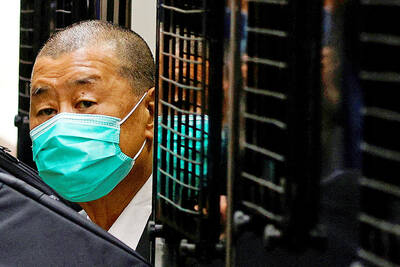
Jailed media entrepreneur Jimmy Lai (黎智英) has been awarded Deutsche Welle’s (DW) freedom of speech award for his contribution to Hong Kong’s pro-democracy movement. The German public broadcaster on Thursday said Lai would be presented in absentia with the 12th iteration of the award on June 23 at the DW Global Media Forum in Bonn. Deutsche Welle director-general Barbara Massing praised the 78-year-old founder of the now-shuttered news outlet Apple Daily for standing “unwaveringly for press freedom in Hong Kong at great personal risk.” “With Apple Daily, he gave journalists a platform for free reporting and a voice to the democracy movement in
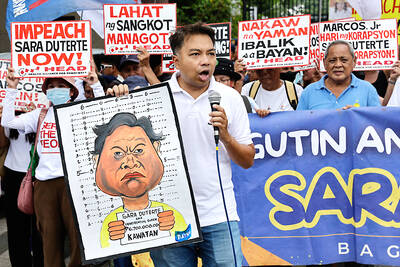
PHILIPPINE COMMITTEE: The head of the committee that made the decision said: ‘If there is nothing to hide, there is no reason to hide, there is no reason to obstruct’ A Philippine congressional committee on Wednesday ruled that there was “probable cause” to impeach Philippine Vice President Sara Duterte after hearing allegations of unexplained wealth, misuse of state funds and threats to have the president assassinated. The unanimous decision of the 53-member committee in the Philippine House of Representatives sends the two impeachment complaints to deliberations and voting by the entire lower chamber, which has more than 300 lawmakers. The complaints centered on Duterte’s alleged illegal use and mishandling of intelligence funds from the vice president’s office, and from her time as education secretary under Philippine President Ferdinand Marcos Jr. Duterte and the
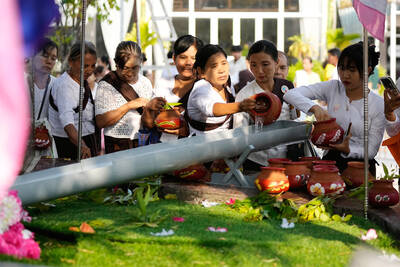
Burmese President Min Aung Hlaing yesterday cut all prisoners’ sentences by one-sixth, a blanket measure that a source close to deposed leader Aung San Suu Kyi said would further shorten her detention. Aung San Suu Kyi has been sequestered since a 2021 military coup, but the senior member of her dissolved National League for Democracy (NLD) party said that while her term had been reduced, her remaining sentence is still unclear. “We also don’t know exactly how many years she has left,” the source told reporters, speaking on condition of anonymity for security reasons. The military toppled Aung San Suu Kyi’s elected government


 RSS
RSS