


An elderly German woman has been reunited with her North Korean husband after 47 years apart during her first visit to the communist nation, a news report said on Tuesday.
Renate Hong, 71, married Hong Ok-gun in 1960 when the North Korean man was a student in then-East Germany. But their life together ended a year later after he and all other North Korean students were recalled to their Stalinist homeland.
Renate lost contact with her husband in 1963 but never remarried, raising their two sons alone and waiting for a chance to reunite with the man she fell in love with at first sight.
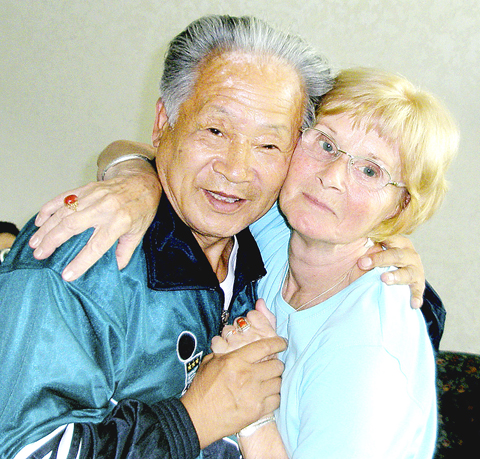
PHOTO: AP
South Korea’s JoongAng Ilbo newspaper reported that Renate and her two middle-aged sons were on a visit to North Korea after the government there approved their trip. They arrived on July 25 in Pyongyang.
“Today is the day when my dream is coming true,” the paper quoted Renate as saying before her departure. “At last, I get to finalize the last chapter of my case.”
The daily carried a picture of her and their two sons, now 47 and 48, showing off their passports stamped with North Korean visas.
The paper also carried a picture of gray-haired Ok-gun, saying the couple had resumed correspondence.
Renate learned last year that her 74-year-old husband was still alive in the North with a new family.
She had been pursuing a visit to the communist nation and traveled last year to the South Korean capital, Seoul, to deliver letters addressed to leaders of the two Koreas ahead of a summit meeting to plead her case.
Thousands of South and North Koreans divided by their heavily armed border have met for reunions since 2000 as part of reconciliation efforts between the two Koreas. However, Renate is believed to be the first foreigner invited for such a reunion with a North Korean relative, the newspaper said.

An American scientist convicted of lying to US authorities about payments from China while he was at Harvard University has rebuilt his research lab in Shenzhen, China, to pursue technology the Chinese government has identified as a national priority: embedding electronics into the human brain. Charles Lieber, 67, is among the world’s leading researchers in brain-computer interfaces. The technology has shown promise in treating conditions such as amyotrophic lateral sclerosis and restoring movement in paralyzed people. It also has potential military applications: Scientists at the Chinese People’s Liberation Army have investigated brain interfaces as a way to engineer super soldiers by boosting
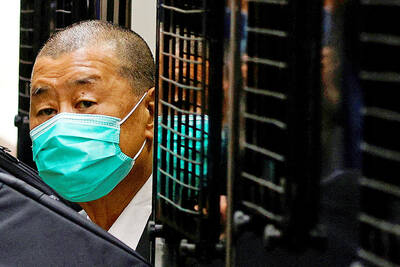
Jailed media entrepreneur Jimmy Lai (黎智英) has been awarded Deutsche Welle’s (DW) freedom of speech award for his contribution to Hong Kong’s pro-democracy movement. The German public broadcaster on Thursday said Lai would be presented in absentia with the 12th iteration of the award on June 23 at the DW Global Media Forum in Bonn. Deutsche Welle director-general Barbara Massing praised the 78-year-old founder of the now-shuttered news outlet Apple Daily for standing “unwaveringly for press freedom in Hong Kong at great personal risk.” “With Apple Daily, he gave journalists a platform for free reporting and a voice to the democracy movement in
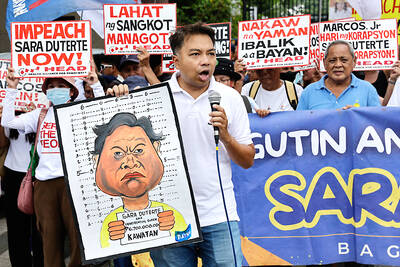
PHILIPPINE COMMITTEE: The head of the committee that made the decision said: ‘If there is nothing to hide, there is no reason to hide, there is no reason to obstruct’ A Philippine congressional committee on Wednesday ruled that there was “probable cause” to impeach Philippine Vice President Sara Duterte after hearing allegations of unexplained wealth, misuse of state funds and threats to have the president assassinated. The unanimous decision of the 53-member committee in the Philippine House of Representatives sends the two impeachment complaints to deliberations and voting by the entire lower chamber, which has more than 300 lawmakers. The complaints centered on Duterte’s alleged illegal use and mishandling of intelligence funds from the vice president’s office, and from her time as education secretary under Philippine President Ferdinand Marcos Jr. Duterte and the

Burmese President Min Aung Hlaing yesterday cut all prisoners’ sentences by one-sixth, a blanket measure that a source close to deposed leader Aung San Suu Kyi said would further shorten her detention. Aung San Suu Kyi has been sequestered since a 2021 military coup, but the senior member of her dissolved National League for Democracy (NLD) party said that while her term had been reduced, her remaining sentence is still unclear. “We also don’t know exactly how many years she has left,” the source told reporters, speaking on condition of anonymity for security reasons. The military toppled Aung San Suu Kyi’s elected government


 RSS
RSS