


A day after surrendering to the army, a one-eyed, battle-hardened female rebel commander urged other guerrillas yesterday to follow her example and abandon their decades-long struggle.
Nelly Avila Moreno, better known as “Karina,” denied her bloody reputation during a news conference. She said she surrendered because she was encircled, had a bounty on her head and was spooked by the recent murder of a fellow rebel leader by one of his bodyguards.
Avila, 40, nevertheless expressed admiration for Venezuelan President Hugo Chavez, who has been implicated in seeking to arm and finance the rebels in documents the Colombian government says it found on the computer of a different slain guerrilla.

PHOTO: AFP
Her surrender on Sunday was a major propaganda victory for Colombian President Alvaro Uribe, who has made defeating the leftist Revolutionary Armed Forces of Colombia (FARC) the cornerstone of his administration.
In recent months, the army had been closing in on Avila, who had a US$1 million bounty on her head. Just two weeks ago, Uribe appealed directly for her to turn herself in. She had been on the government’s most wanted list since 2002.
“To my comrades: Change this life that you are leading in the guerrilla group and re-enter society with the government’s reinsertion plan,” Avila told reporters yesterday, saying she had spent 24 years with FARC.
She said she was not sure of her legal status, but she should be able to apply for leniency under a law designed to encourage demobilization that caps prison terms at eight years.
Avila had commanded a contingent operating in northwest Colombia’s coffee-growing zone, where she said the rebels are now “breaking up.”
“The decision [to surrender] was made because of the pressure by the army in the area,” she said almost matter-of-factly, standing alongside her boyfriend, who surrendered with her and her daughter.
Authorities said Avila was wanted for murder, terrorism, rebellion and kidnapping. The presidency said she led a number of major attacks including a 2000 ambush that killed 13 soldiers. The chief prosecutor’s office said she was wanted for three massacres in 1999 and 2002, but provided no details.
Colombian Defense Minister Juan Manuel Santos said Avila “had the guts to do any type of operation and managed to occupy one of the highest posts a woman has ever reached in the ranks of these terrorists.”
Avila denied being as “bloodthirsty” as she has been portrayed and rejected unsourced media reports implicating her in the 1983 killing of Uribe’s father.
She said she decided to give up on Sunday and contacted the army to send a helicopter. Images released by authorities show her and her boyfriend on a mountainside next to a bonfire they built to identify the pickup site.
While FARC estimates that about a third of their fighters are women, female commanders are still a rarity.
Avila’s comments gave a glimpse into how some parts of FARC are faring under a withering US-backed offensive by Colombia’s military, which has recently claimed the lives of several top commanders and isolated its leadership.
Avila said she had been virtually cut off for the past two years and out of contact with the guerrillas’ seven-member ruling secretariat. She said she had fewer than 50 rebels under her command when she decided to surrender.
She admitted to being shaken by the March killing of Secretariat member Ivan Rios by one of his bodyguards, who cut off Rios’ hand and delivered it with his laptop in return for a reward.
“It’s a difficult situation: You have a lot of fighters by your side, but you don’t know what each one is thinking,” Avila said. “Some of them are thinking of their economic situation.”
In response to a reporter’s question, Avila said she had no knowledge of Chavez arming or funding FARC.
Asked what the Venezuelan president means to the rebels, she simply said: “We admire Chavez for the way he is.”

An American scientist convicted of lying to US authorities about payments from China while he was at Harvard University has rebuilt his research lab in Shenzhen, China, to pursue technology the Chinese government has identified as a national priority: embedding electronics into the human brain. Charles Lieber, 67, is among the world’s leading researchers in brain-computer interfaces. The technology has shown promise in treating conditions such as amyotrophic lateral sclerosis and restoring movement in paralyzed people. It also has potential military applications: Scientists at the Chinese People’s Liberation Army have investigated brain interfaces as a way to engineer super soldiers by boosting
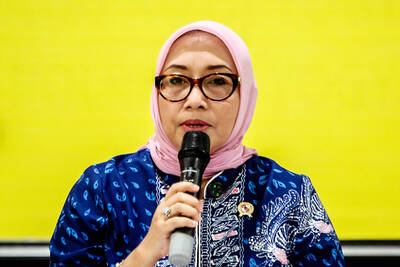
Indonesian police have arrested 13 people after shocking images of alleged abuse against small children at a daycare center went viral, sparking outrage across the nation, officials said on Monday. Police on Friday last week raided Little Aresha, a daycare center in Yogyakarta on Java island, following a report from a former employee. CCTV footage circulating on social media showed children, most younger than two, lying on the floor wearing only diapers, their hands and feet bound with rags. The police have confirmed that the footage is authentic. Police said they also found 20 children crammed into a room just 3m by 3m. “So
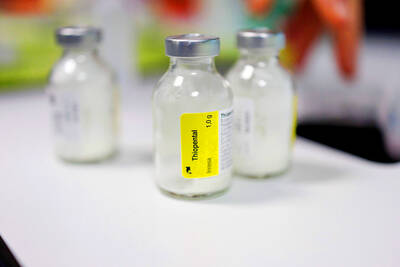
A grieving mother has ended her life at a clinic in Switzerland four years after the death of her only child. Wendy Duffy, 56, a physically healthy woman, died at the Pegasos clinic in Basel after struggling to cope with the death of her 23-year-old son, Marcus. The former care worker, from the West Midlands, England, had previously attempted to take her own life. The case comes as assisted dying would not become law in England and Wales after proposed legislation, branded “hopelessly flawed” by opponents, ran out of time. Ruedi Habegger, the founder of Pegasos, described Duffy’s death as

From post offices and parks to stations and even the summit of Mount Fuji, Japan’s vending machines are ubiquitous, but with the rapid pace of inflation cooling demand for their drinks, operators are being forced to rethink the business. Last month beverage giant DyDo Group Holdings announced it would remove about 20,000 vending machines — about 7 percent of their stock nationwide — by January next year, to “reconstruct a profitable network.” Pokka Sapporo Food & Beverage, based in Nagoya, also said last month it would sell its 40,000-machine operation to Osaka-based Lifedrink Co. “The strength of the vending machine


 RSS
RSS