


East Timor held emotional ceremonies under tight security yesterday to celebrate six years of independence and mourn the country’s long and bloody struggle for liberation.
The hacienda-style government palace on Dili’s waterfront was bedecked with flags — including those of former occupiers Indonesia and Portugal — as East Timor’s red-and-black standard was raised under a baking sun.
East Timorese President Jose Ramos-Horta reviewed a guard of honor from the back of a jeep and called for peace and unity in Asia’s troubled newest state, under the watch of foreign stabilization force snipers positioned on the palace roof.

PHOTO: AFP
“On this day of independence we have to maintain peace in our nation, fight poverty and protect national unity. This is an obligation of all the people,” he said in a speech.
The celebrations come just three months after Ramos-Horta was shot and nearly killed in a Feb. 11 rebel attack, which also targeted Prime Minister Xanana Gusmao.
The rebels surrendered last month, but fears of a return to instability are overshadowing the Independence Day cheer.
Security remained tight around the country’s leaders, and international troops from a stabilization force which entered the country in the wake of factional fighting two years ago closely watched yesterday’s ceremony.
“What happened on February 11 showed that state institutions in our nation are still fragile. But this ceremony also shows that over the past six years we have achieved a lot,” the president said.
East Timor, a former Portuguese colony, was invaded by Indonesian forces in 1975. Approximately 200,000 East Timorese died as a result of conflict and preventable illnesses over the next two-and-a-half decades.
The country voted for independence in a 1999 UN-backed referendum but was laid to waste by pro-Indonesian militia in the wake of the vote.
It finally gained formal independence in 2002, but was flung into instability again by the mass desertion of 600 soldiers in 2006, which triggered street violence between rival factions that killed at least 37.
That rebellion came to an end after the death of rebel leader Alfredo Reinado in the attack on the home of Ramos-Horta and the surrender of his followers last month.
UN police deputy commissioner Tony McLeod said this year’s Independence Day was “a bit of a test to give us a feel for the overall security situation.”
“It’s gone pretty well up till now,” he said.
Ado Amaral, a 45-year-old farmer who came down from the hills outside Dili to witness the festivities, said he was glad the event passed without trouble.
“I’m very happy,” Amaral said, “because everything is going well.”
“There’s no provocation between people, no disturbances,” he said. “It’s better than other years. I find it hard to think about 2006 but now I see that everything is going well.”
But analysts say the seeds of instability remain in the country of 1 million, and political tensions were on show even as leaders assembled on the dais for the Independence Day speeches.

An American scientist convicted of lying to US authorities about payments from China while he was at Harvard University has rebuilt his research lab in Shenzhen, China, to pursue technology the Chinese government has identified as a national priority: embedding electronics into the human brain. Charles Lieber, 67, is among the world’s leading researchers in brain-computer interfaces. The technology has shown promise in treating conditions such as amyotrophic lateral sclerosis and restoring movement in paralyzed people. It also has potential military applications: Scientists at the Chinese People’s Liberation Army have investigated brain interfaces as a way to engineer super soldiers by boosting

Indonesian police have arrested 13 people after shocking images of alleged abuse against small children at a daycare center went viral, sparking outrage across the nation, officials said on Monday. Police on Friday last week raided Little Aresha, a daycare center in Yogyakarta on Java island, following a report from a former employee. CCTV footage circulating on social media showed children, most younger than two, lying on the floor wearing only diapers, their hands and feet bound with rags. The police have confirmed that the footage is authentic. Police said they also found 20 children crammed into a room just 3m by 3m. “So
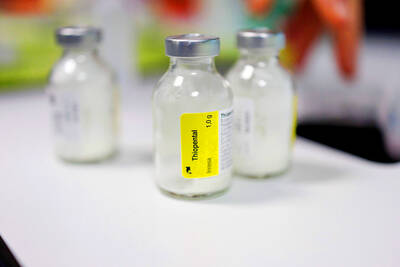
A grieving mother has ended her life at a clinic in Switzerland four years after the death of her only child. Wendy Duffy, 56, a physically healthy woman, died at the Pegasos clinic in Basel after struggling to cope with the death of her 23-year-old son, Marcus. The former care worker, from the West Midlands, England, had previously attempted to take her own life. The case comes as assisted dying would not become law in England and Wales after proposed legislation, branded “hopelessly flawed” by opponents, ran out of time. Ruedi Habegger, the founder of Pegasos, described Duffy’s death as

From post offices and parks to stations and even the summit of Mount Fuji, Japan’s vending machines are ubiquitous, but with the rapid pace of inflation cooling demand for their drinks, operators are being forced to rethink the business. Last month beverage giant DyDo Group Holdings announced it would remove about 20,000 vending machines — about 7 percent of their stock nationwide — by January next year, to “reconstruct a profitable network.” Pokka Sapporo Food & Beverage, based in Nagoya, also said last month it would sell its 40,000-machine operation to Osaka-based Lifedrink Co. “The strength of the vending machine


 RSS
RSS