


A rare and primitive frog living in a remote Borneo stream has no lungs and apparently absorbs oxygen through its skin, researchers reported on Wednesday.
The aquatic frog has evolved backwards, reacquiring a primordial trait, David Bickford of the National University of Singapore and colleagues reported.
Studying the frog could help shed light on how lungs evolved in the first place, they wrote in the journal Current Biology.
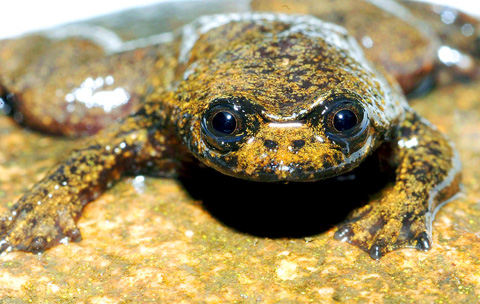
PHOTO: EPA
They also said that illegal gold mining in the area may threaten the unique species.
“The evolution of lunglessness in tetrapods [amphibians, reptiles, birds and mammals] is exceedingly rare, previously known only from amphibians — two families of salamanders and a single species of caecilian [blindworm],” they wrote.
“Here we report the first case of complete lunglessness in a frog, Barbourula kalimantanensis, from the Indonesian portion of Borneo,” they wrote.
The frog, nicknamed “Barbie” — short for its scientific name — may be endangered because of mining activity, the researchers said.
“In August 2007, we visited ... near NangaPinoh, Western Kalimantan, but found that illegal gold mining had destroyed all suitable habitats in the vicinity,” they wrote.
They snorkeled, waded and turned over boulders to find their quarry.
“The originally cool, clear, fast-flowing rivers are now warm and turbid. Water quality around the ... locality is no longer suitable for the species, but we were able to rediscover two new populations upstream,” they said.
“We knew that we would have to be very lucky just to find the frog,” Bickford said in a statement.
Animals evolved lungs when they moved from the sea to land millions of years ago.
Animals have only lost this important adaptation a few times, Bickford’s team said.
“The discovery of lunglessness in a secretive Bornean frog, supports the idea that lungs are a malleable trait in the Amphibia, the sister group of all living tetrapods,” the researchers wrote. “Amphibians maybe more prone to lunglessness since they readily utilize other methods for gas exchange.”
“This is an endangered frog that we know practically nothing about, with an amazing ability to breathe entirely through its skin, whose future is being destroyed by illegal gold mining by people who are marginalized and have no other means of supporting themselves,” Bickford said in an interview.
Only animals with small body sizes, slow metabolisms and living in fast-flowing cold water where oxygen and carbon dioxide are exchanged quickly may be able to survive without lungs, the researchers said.
Bickford said that he hoped the find would spur more research into Southeast Asian wildlife, much of which is threatened by development and other losses of habitat.
“The discovery is not so much a surprise to the scientific community, as much as a surprise that it has taken so long to find it,” Bickford was quoted as saying in a report in the Strait Times.
“We strongly encourage conservation of remaining habitats of this species,” the researchers said.

An American scientist convicted of lying to US authorities about payments from China while he was at Harvard University has rebuilt his research lab in Shenzhen, China, to pursue technology the Chinese government has identified as a national priority: embedding electronics into the human brain. Charles Lieber, 67, is among the world’s leading researchers in brain-computer interfaces. The technology has shown promise in treating conditions such as amyotrophic lateral sclerosis and restoring movement in paralyzed people. It also has potential military applications: Scientists at the Chinese People’s Liberation Army have investigated brain interfaces as a way to engineer super soldiers by boosting

Indonesian police have arrested 13 people after shocking images of alleged abuse against small children at a daycare center went viral, sparking outrage across the nation, officials said on Monday. Police on Friday last week raided Little Aresha, a daycare center in Yogyakarta on Java island, following a report from a former employee. CCTV footage circulating on social media showed children, most younger than two, lying on the floor wearing only diapers, their hands and feet bound with rags. The police have confirmed that the footage is authentic. Police said they also found 20 children crammed into a room just 3m by 3m. “So

From post offices and parks to stations and even the summit of Mount Fuji, Japan’s vending machines are ubiquitous, but with the rapid pace of inflation cooling demand for their drinks, operators are being forced to rethink the business. Last month beverage giant DyDo Group Holdings announced it would remove about 20,000 vending machines — about 7 percent of their stock nationwide — by January next year, to “reconstruct a profitable network.” Pokka Sapporo Food & Beverage, based in Nagoya, also said last month it would sell its 40,000-machine operation to Osaka-based Lifedrink Co. “The strength of the vending machine
A grieving mother has ended her life at a clinic in Switzerland four years after the death of her only child. Wendy Duffy, 56, a physically healthy woman, died at the Pegasos clinic in Basel after struggling to cope with the death of her 23-year-old son, Marcus. The former care worker, from the West Midlands, England, had previously attempted to take her own life. The case comes as assisted dying would not become law in England and Wales after proposed legislation, branded “hopelessly flawed” by opponents, ran out of time. Ruedi Habegger, the founder of Pegasos, described Duffy’s death as


 RSS
RSS