


For time beyond memory on this remote bay of neon fish and underwater gardens, people have avoided the masalai, taboo waters, where a monster octopus might lurk or spirits dwell in coral caves. Now it's science that wants no-go zones in Kimbe Bay, and it's because of a new fear.
From the Caribbean to the Indian Ocean to the central Pacific, global warming and the sea's rising temperatures have been "bleaching" and killing the world's coral reefs.
It's here in Kimbe Bay, and in the surrounding triangle of sea stretching from Indonesia up to the Philippines and down to the Solomon Islands, that the strange, beautiful life form known as coral may someday have to make its last stand.
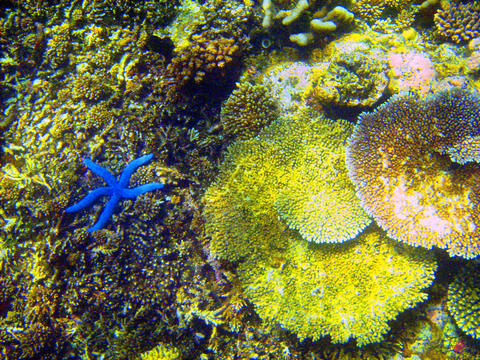
PHOTO: AP
"The Coral Triangle is going to hold out, and it's tremendously important that it does, because what's holding out is the center of world marine diversity," said marine biologist Charlie Veron, an expert on reef-building coral.
The region, epitomized by a volcano-ringed bay on the Pacific's western fringe, shelters more than half of all the world's coral and 75 percent of its hundreds of species. Half the world's species of reef fish swim its waters.
Over eons, Veron said, the triangle "has exported this diversity to the rest of the world."
In other words, its coral's homeland.
Veron, Australian author of the three-volume Corals of the World, spoke with The Associated Press at the UN climate conference on Bali, where regional governments this week were announcing a new partnership to protect the Coral Triangle.
The US-based environmental group Nature Conservancy is leading the way with an ambitious plan to establish 15 restricted zones in the 8,500km2 Kimbe Bay.
It's one of the first plans for "marine protected areas" dealing specifically with climate change.
The Nature Conservancy's Annisah Supal said her Papua New Guinean neighbors don't realize what they have.
"We tell them about the uniqueness of the bay, and they say, `Wow!'" she said. "Kimbe Bay is a paradise, and our job is to preserve that paradise."
Beneath Kimbe Bay's surface, "paradise" unfolds in a rainbow of stunning variety -- of hard coral in green and red, purple and white, of vividly striped clownfish and starfish of iridescent blue, of brooding groupers and darting flashes of finned indigo. Many depend on the reefs for food and shelter.
Kimbe Bay, a collection of various habitats, including isolated seamounts, coastal mangrove forests and seagrass beds, is also home to sperm whales and sea turtles, sharks and dugong.
Reef-building coral is a fragile organism, a tiny polyp-like animal that builds a calcium-carbonate shell around itself and survives in a symbiotic relationship with types of algae -- each providing sustenance to the other.
Even a 1oC rise in normal maximum sea temperatures can disrupt that relationship, leading to bleaching as the colored algae flee. If prolonged, the warming can lead to coral death.
In a series of reports this year, the Intergovernmental Panel on Climate Change, the UN climate-science network, said projected global warming indicates "bleaching will recur more often than reefs can sustain."
That's not necessarily so in Kimbe Bay and the Coral Triangle, Veron said. These arms of the equatorial western Pacific have experienced "pulses" of warm water over millions of years, conditioning coral to climate change, he said.
The key, he said, is to protect these resources from other damaging pressures -- land-erosion runoff, toxic agricultural chemicals, coral harvesting, overfishing and fishing by dynamiting reefs or poisoning reef fish.
With the aid of an advanced computer program assessing marine resources block by block across Kimbe Bay, the Nature Conservancy over three years developed its plan for 15 protected zones, ranging in size from 5.8 to 620km2, places where fishing, shellfish harvesting and other activities would be banned or restricted.
The political challenge, convincing communities to establish the zones, will be at least as daunting as the scientific one. The island waters of one "area of interest," for example, are shared among nine New Guinean clans, all with a say over its use.
The conservationists believe, nonetheless, they'll clear final hurdles to establishing two of the protected areas by year's end, and hope next year for six more, out of the 15. In some cases, Supal noted, the new no-go zones incorporate the old -- the masalai taboo areas.
Ultimately, the Nature Conservancy views Kimbe Bay as a "platform site" for expanding preserves throughout the Bismarck Sea, a large swath of the Coral Triangle.

School bullies in Singapore are to face caning under new guidelines, but the education minister on Tuesday said it would be meted out only as a last resort with strict safeguards. Human rights groups regularly criticize Singapore for the use of corporal punishment, which remains part of the school and criminal justice systems, but authorities have defended it as a deterrent to crime and serious misconduct. Caning was discussed in the parliament after legislators asked how it would be used in relation to bullying in schools. The debate followed stricter guidelines on serious student misconduct, including bullying, unveiled by the Singaporean Ministry of

As evening falls in Fiji’s capital, a steady stream of people approaches a makeshift clinic that is a first line of defense against one of the world’s fastest-growing HIV epidemics. In the South Pacific nation — a popular tourist destination of just under a million people — more than 2,000 new HIV cases were recorded last year, a 26 percent increase from 2024. The government has declared an HIV outbreak and described it as a national crisis. “It’s spreading like wildfire,” said Siteri Dinawai, 46, who came to be tested. The Moonlight Clinic, a converted minibus parked in a suburban cul-de-sac in Suva, is

A MESSAGE: Japan’s participation in the Balikatan drills is a clear deterrence signal to China not to attack Taiwan while the US is busy in the Middle East, an analyst said The Japan Self-Defense Forces yesterday fired a Type 88 anti-ship missile during a joint maritime exercise with US, Australian and Philippine forces, hitting a decommissioned Philippine Navy ship in waters facing the disputed South China Sea, in drills that underscore Tokyo’s rising willingness to project military power on China’s doorstep. The drill took place as Manila and Tokyo began talks on a potential defense equipment transfer, made possible by Japan’s decision to scrap restrictions on military exports. The discussions include the possible early transfer of Abukuma-class destroyers and TC-90 aircraft to the Philippines, Japanese Minister of Defense Shinjiro Koizumi said. Philippine Secretary of
Separatists in Alberta are preparing to submit a petition tomorrow that they said has enough signatures to force a referendum on independence for the oil-rich Canadian province. Polls indicate the pro-independence camp remains a minority among Alberta’s 5 million people, but has hit a historic high of roughly 30 percent. Alberta separatists are also closer than ever to forcing a referendum, riding momentum fueled by intensifying grievances over Ottawa’s control of the provincial oil industry. They have also undeniably gotten a boost from the return to power of US President Donald Trump. After launching a petition in January, Stay Free Alberta, the group


 RSS
RSS