


A judge yesterday sentenced four al-Qaeda-inspired plotters to life in prison for attempting to bomb London's transit system on July 21, 2005, two weeks after suicide bombers killed 52 commuters.
Judge Adrian Fulford said the men must spend at least 40 years in jail before becoming eligible for parole.
A jury on Monday found Muktar Said Ibrahim, 29; Yassin Omar, 26; Ramzi Mohammed, 25; and Hussain Osman, 28, guilty of conspiracy to murder in a plot to detonate explosives in knapsacks on three subway trains and a bus.
The bombs failed to explode and no one was injured.
The judge said that that if the bombs had gone off, "at least 50 people would have died, hundreds of people would have been wounded, thousands would have had their lives permanently damaged, disfigured or otherwise, whether they were Christian, Muslim, Jewish, Hindu, Sikh, Buddhist, agnostic or atheist."
He said that the July 7 and July 21 plots "were both part of an al-Qaeda-inspired and controlled sequence of attacks."
Two other suspects, Manfo Kwaku Asiedu, 34, and Adel Yahya, 24, will be retried after the jury failed to reach a verdict.
Prosecutors said the July 21 attacks were a deliberate mirror image of the July 7 transit bombings, though the planning started long before.
Police suspect, but could not prove, that there were links between the two groups of bombers.
Fulford said the events of July 7 meant the July 21 plotters knew how deadly their bombs were likely to be.
"The family and friends of the dead and the injured, the hundreds, indeed thousands, captured underground in terrifying circumstances, the smoke, the screams of the wounded and the dying -- this each defendant knew," the judge said.
"They planned this, they prepared for it. They had spent many hours making viable bombs. After 7/7, each defendant knew exactly what the result would be," he said.
All six defendants denied the charges, saying the devices were duds and their actions a protest against the Iraq war. But police and prosecutors said scientific tests proved the bombs were all viable. They do not know why they did not work.
"Exactly two weeks after the terrorist attacks on 7/7 these men targeted the same transport system and tried to cause the same level of death and destruction," said Sue Hemming, head of counter-terrorism at the Crown Prosecution Service.
"While the implementation of their plan was incompetent, their aim was clear. They wanted to kill and maim on a massive scale," she said.
The four convicted men attempted to detonate explosives-laden backpacks on three subway trains and a bus, as in the July 7, 2005, attacks. The devices -- made from a volatile mix of hydrogen peroxide and flour packed into tubs and surrounded by bolts and screws -- did not explode.
Unlike three of the four July 7 bombers, who were British-born, those in the July 21 plot had come to Britain as youths from countries in the Horn of Africa. Some had become British citizens, while others had refugee status.
Police believe the planning for the attack started after Ibrahim returned to Britain from a trip to Pakistan in March 2005. He was in that country at the same time as two of the July 7 bombers -- Shezhad Tanweer and Mohammed Sidique Khan -- but officials do not know if they ever met.
In both cases, the main ingredient in the bombs was the same -- hydrogen peroxide, an easily available chemical commonly used in hair dying and coloring.
Police believe the transit system was not the group's original target, but was chosen following the successful attacks two weeks earlier.
The failed attack sparked a huge police manhunt for the would-be suicide bombers. The prosecution's case rested largely on testimony and transportation system video footage.

When a hiker fell from a 55m waterfall in wild New Zealand bush, rescuers were forced to evacuate the badly hurt woman without her dog, which could not be found. After strangers raised thousands of dollars for a search, border collie Molly was flown to safety by a helicopter pilot who was determined to reunite the pet and the owner. A week earlier, an emergency rescue helicopter found the woman with bruises and lacerations after a fall at a rocky spot at the waterfall on the South Island’s West Coast. She was airlifted on March 24, but they were forced to
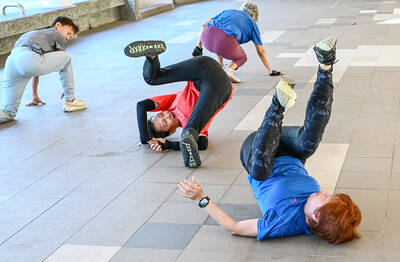
CONFIDENCE BOOSTER: ’After parkour ... you dare to do a lot of things that you think only young people can do,’ a 67-year-old parkour enthusiast said In a corner of suburban Singapore, Betty Boon vaults a guardrail, crawls underneath a slide, executes forward shoulder rolls and scales a steep slope, finishing the course to applause. “Good job,” the 69-year-old’s coach cheers. This is “geriatric parkour,” where about 20 retirees learned to tackle a series of relatively demanding exercises, building their agility and enjoying a sense of camaraderie. Boon, an upbeat grandmother, said learning parkour has aided her confidence and independence as she ages. “When you’re weak, you will be dependent on someone,” she said after sweating it out with her parkour classmates in suburban Toa Payoh,

Chinese dissident artist Gao Zhen (高兟), famous for making provocative satirical sculptures of former Chinese leader Mao Zedong (毛澤東), was tried on Monday over accusations of “defaming national heroes and martyrs,” his wife and a rights group said. Gao, 69, who was detained in 2024 during a visit from the US, faces a maximum three-year prison sentence, said his wife, Zhao Yaliang (趙雅良), and Shane Yi, a researcher at the Chinese Human Rights Defenders group which operates outside the nation. The closed-door, one-day trial took place at Sanhe City People’s Court in Hebei Province neighboring the capital, Beijing, and ended without a
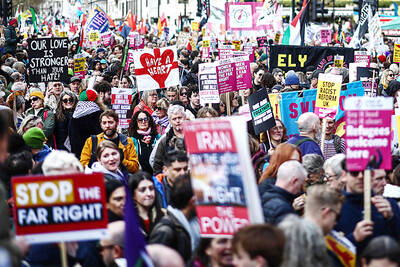
‘TOXIC CLIMATE’: ‘I don’t really recognize Labour anymore... The idea that you can implement far-right ideas in order to stop the far right is nonsense,’ a protester said Tens of thousands of people on Saturday marched through central London to protest against the far right, weeks ahead of local elections and six months after Britain saw one of its largest far-right demonstrations. Organized by hundreds of civic groups, including trade unions, anti-racism campaigners and Muslim representative bodies, Saturday’s Together Alliance event was billed as the biggest in UK history to counter right-wing extremism. A separate pro-Palestinian march had also converged with the main rally. While organizers claimed 500,000 had turned out in total, the police gave a figure of about 50,000. Protesters carrying placards with slogans such as


 RSS
RSS