


With their dinner-suit plumage and waddling gait, penguins are among the most unusual and endearing members of the bird kingdom. A new fossil find, however, has revealed that one of their ancestors was a far more fearsome beast. The fossils, which were found in Peru and were described in detail yesterday by scientists, reveal a creature that was over 1.5m tall and weighed as much as a person. The 36 million-year-old tropical bird's intimidating appearance was topped off with powerful arms, a chunky neck and a potentially vicious 18cm beak.
The discovery of the giant bird has shaken scientists' understanding of penguin evolution. The find indicates that penguins made the journey to equatorial regions much earlier in their evolutionary history than researchers had realized.
And because the penguins lived during a period when the Earth was experiencing a "greenhouse" climate, the pair of species are challenging what researchers thought they knew about how animal species may adapt to hotter temperatures.
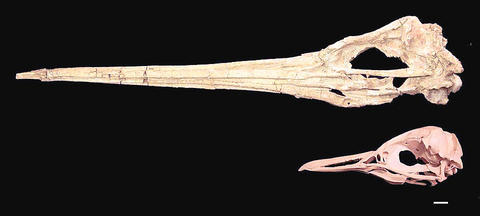
PHOTO: EPA
"It's a monster," said Julia Clarke at North Carolina State University, who described the fossils with her team in Proceedings of the National Academy of Sciences yesterday. The two main finds are remarkably complete and well preserved.
The giant species has been named Icadyptes salasi. If it were alive today, Icadyptes would tower over the largest penguins on the planet -- the 1.2m emperors, whose epic migration across the Antarctic wilderness to bring food to their chicks was celebrated in the film March of the Penguins.
The team does not have any direct evidence for the new discovery's diet, but the wings were adapted for swimming and found in sediments laid down just off shore. The elongated beak would have been capable of snaring large fish, but its shape is so unusual that the team believes it used a previously unknown technique for catching prey.
"It is distinct from anything we have in living penguins," Clarke said.
Attachment points for neck muscles are also very large suggesting that it had a powerful neck, perhaps for spearing prey.
The discovery goes against what was considered the general rule that as climatic conditions get warmer, species tend to evolve into a smaller body size.
The theory is that large size is useful in the cold because it reduces the ratio of surface area to volume, making it easier to conserve heat. But Icadyptes was found in a region that resembled the modern day Atacama desert at a time when the Earth was experiencing an extremely warm period in its history.
The team are keen to point out that although these species were adapted to the tropics, it does not mean that current penguin species will be able to adapt quickly to climate change.
"Current global warming is occurring on a significantly shorter timescale. The data from these new fossil species cannot be used to argue that warming wouldn't negatively impact living penguins," Clarke said.
The Icadyptes' fossil is the most complete of any giant penguin yet discovered.
However it may be smaller than the largest giant known. Anthropornis nordenskjoeldi, Nordenskjoeld's giant penguin, which is thought to have lived up to six million years ago and whose fossils were found in New Zealand, could have been up to 2m high and weighed 100kg.

An American scientist convicted of lying to US authorities about payments from China while he was at Harvard University has rebuilt his research lab in Shenzhen, China, to pursue technology the Chinese government has identified as a national priority: embedding electronics into the human brain. Charles Lieber, 67, is among the world’s leading researchers in brain-computer interfaces. The technology has shown promise in treating conditions such as amyotrophic lateral sclerosis and restoring movement in paralyzed people. It also has potential military applications: Scientists at the Chinese People’s Liberation Army have investigated brain interfaces as a way to engineer super soldiers by boosting

Indonesian police have arrested 13 people after shocking images of alleged abuse against small children at a daycare center went viral, sparking outrage across the nation, officials said on Monday. Police on Friday last week raided Little Aresha, a daycare center in Yogyakarta on Java island, following a report from a former employee. CCTV footage circulating on social media showed children, most younger than two, lying on the floor wearing only diapers, their hands and feet bound with rags. The police have confirmed that the footage is authentic. Police said they also found 20 children crammed into a room just 3m by 3m. “So

A grieving mother has ended her life at a clinic in Switzerland four years after the death of her only child. Wendy Duffy, 56, a physically healthy woman, died at the Pegasos clinic in Basel after struggling to cope with the death of her 23-year-old son, Marcus. The former care worker, from the West Midlands, England, had previously attempted to take her own life. The case comes as assisted dying would not become law in England and Wales after proposed legislation, branded “hopelessly flawed” by opponents, ran out of time. Ruedi Habegger, the founder of Pegasos, described Duffy’s death as

From post offices and parks to stations and even the summit of Mount Fuji, Japan’s vending machines are ubiquitous, but with the rapid pace of inflation cooling demand for their drinks, operators are being forced to rethink the business. Last month beverage giant DyDo Group Holdings announced it would remove about 20,000 vending machines — about 7 percent of their stock nationwide — by January next year, to “reconstruct a profitable network.” Pokka Sapporo Food & Beverage, based in Nagoya, also said last month it would sell its 40,000-machine operation to Osaka-based Lifedrink Co. “The strength of the vending machine


 RSS
RSS