


International security forces backed by helicopters raided a rebel hide-out in East Timor early yesterday and killed four suspected insurgents, officials said, though their leader escaped.
Australian-led forces had been surrounding Alfredo Reinado's base in the mountain town of Same since last week. The rebel leader, who led a revolt that plunged the tiny nation into chaos last May and is wanted for his alleged role in deadly clashes that brought down the government, has ignored repeated calls to turn himself in. Reinado evaded capture and denied any of his men had been killed.
East Timor, one of the world's youngest and poorest nations, is struggling to regain stability after factional fighting between armed forces spilled into the streets of the capital, Dili, last year, killing at least 37 people and sending 155,000 fleeing from their homes.
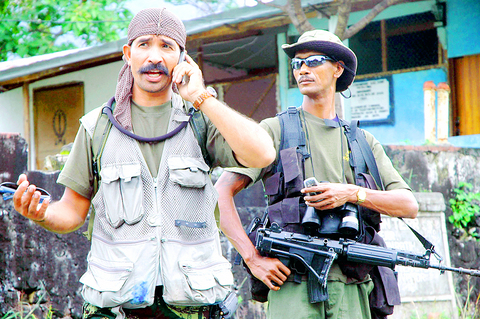
PHOTO: AFP
Relative calm was restored with the arrival of foreign peacekeepers and the installation of a new government.
However, deadly fights continue between rival gangs, and there are fears presidential elections next month could trigger more violence.
"The international security forces are continuing to hunt for him," President Xanana Gusmao told reporters after acknowledging that Reinado escaped capture in the pre-dawn raid. "If he surrenders, the country will treat him well."
"There was no ISF [international security force] member killed or injured in the operation," a Department of Defence spokesman said, adding that four East Timorese fighting with Renaldo had been killed.
Reinado has been on the run since he escaped from jail in East Timor's capital Dili last August along with 50 other inmates.
"The number of soldiers is still complete. Only one person was wounded," Reinado said, adding some Australian troops were shot.
Gusmao ordered security forces to arrest Reinado following accusations the rebel led a raid on a police post and made off with 25 automatic weapons last month.
Reinado denied attacking the police post, saying that police had given him the weapons. Gusmao urged Reinado to surrender.
"The state will not change the policies in Reinado's matters ... The purpose of this operation is not to kill anyone, it is to force them to hand in all the weapons they have and to surrender," Gusmao told a news conference.
On Saturday, Reinado told reporters he was willing to negotiate with the government but would not surrender to international troops.
Australia has 800 troops to keep peace in East Timor following last year's violence.
Reinado has made several public appearances since the escape, including a meeting with the country's military chief. Security forces did not make any attempt to arrest the fugitive.
The standoff between Reinado and the troops has raised fears of violence ahead of a presidential election next month.
East Timor voted in a 1999 referendum for independence from Indonesia, which annexed it after Portugal ended its colonial rule in 1975. The country became fully independent in 2002 after a period of UN administration.
But an east-west divide in the impoverished nation erupted into chaos and gang violence in May following the sacking of 600 soldiers. Youth unemployment is also high.

‘CROSSING THE LINE’: China’s embassy in Seoul criticized US Forces Korea Commander General Xavier Brunson, asking if his ‘hostile’ remarks were authorized by Washington South Korea and the US are in talks over recent public remarks by the commander of US Forces Korea, Seoul’s presidential office said yesterday, after the comments drew sharp criticism from China. In a recent podcast interview, US Forces Korea Commander General Xavier Brunson described South Korea as “the dagger in the heart of Asia” from China’s east coast, prompting the Chinese embassy in Seoul to say that he had “truly crossed the line.” The interview came amid growing speculation that Washington might seek to expand the role of US Forces Korea in countering the growing regional influence of China, a key

SEEKING ORDER: Rodrigo Paz said that ‘anyone who wants to destroy the nation will have to deal with this president and the full force of the constitution’ Bolivian President Rodrigo Paz on Wednesday said that the nation was at a “breaking point” after nearly a month of protests that have caused shortages of food, fuel and medicine. Paz, who took office six months ago amid the worst economic crisis there in four decades, is battling a groundswell of fury over his policies. The political capital, La Paz, has been besieged by low-income workers and members of the indigenous majority calling for his resignation. “The country needs order and is reaching breaking point,” the 58-year-old said at a public event in La Paz, renewing his appeal for dialogue. On Tuesday, the Bolivian

Through the noise of rushing papers and whirring belts at a print factory in Kyoto, two creators watch their photo essay come to life in broadsheet form — part of an effort to win new audiences in the age of artificial intelligence (AI). Despite the decline of the publishing industry, self-publication and handmade “zine” magazines are growing in popularity in Japan, reflecting the nation’s enduring love of paper in the digital era. While speaking to Agence France-Presse at the plant, his hands black with ink, one of the creators, Kazuma Obara, said: “I think [paper] is a medium that engages all five

Australian researchers have trained lab-grown brain cells on a silicon computer chip to play the 1990s shooter game Doom and said they are just scratching the surface of what the neurons could be capable of doing. It is the science-fiction work of biotech boffins at Cortical Labs, who researched and developed the technology that harnesses the workings of the brain’s networking system. Each so-called “biological computer” contains about 200,000 living human brain cells, grown from stem cells that were harvested from blood donations. Having mastered the simple computer game Pong, where a paddle is moved up and down to send a ball


 RSS
RSS