


Only in Beirut do war scars and champagne chic blend so easily. In Achrafiye, an upmarket district of hip restaurants and nightclubs where a bottle of bubbly can cost US$1,000, a ravaged building totters over a street corner.
Bullet holes pock the walls and the windows have long disappeared. Rubbish and barbed wire clog the front door and weeds sprout from the upper floors.
The lonely ruin is what remains of the Green Line, the infamous boundary that divided Christian East and Muslim West Beirut during the 17-year-old civil war of the 1970s and 1980s. Until recently it was a reminder of a bitter conflict most Lebanese thought was over.
But since this summer's 34-day war with Israel, there are fears of fresh divisions within Lebanese society that could heave the country into a new era of turmoil. The new green line wobbles uncertainly around the role of Hezbollah.
As Israeli warplanes pulverized Lebanon's infrastructure and laid entire villages to waste, many Lebanese silently rallied around the fighters' resistance.
But since a ceasefire took hold 11 days ago, sectarian dissent has slowly swelled.
Druze, Sunni and some Christian leaders blame Hezbollah for provoking Israel and are demanding the group submit to the national government.
"The [political] situation has become dramatically worse since July 12," said Michael Young, an editor at the Daily Star newspaper. "The perception among non-Shia communities is that Hezbollah went to war without consulting with anyone."
Some quietly suggest Israel should have gone further to crush the militant group.
"I wish with all my heart this war had not ended," one Christian woman, who asked not to be named, said in the southern city of Tyre.
An exception is the Christian leader Michel Aoun, who has forged an alliance with Hezbollah in what he depicts as an effort to build bridges with Muslims. But this is controversial among other Christians, who say Hezbollah has let countries such as Syria and Iran use Lebanon as a battleground for their interests.
The fiercest argument centers on disarmament. Israel, the US and the UN say Hezbollah must surrender its arms to ensure peace.
"To play a patriotic role they don't need weapons," said Elias Attallah of the Democratic Left party. "An army and a resistance movement cannot live side by side. In Lebanon no community can accept domination by an-other. Otherwise it will lead to war."
Others say such demands may be incendiary.
"If the government persists in trying to disarm Hezbollah and if the US keeps pushing them, this will create sectarian tensions, a split in the army, and could very well lead to a civil war," said Amal Saad-Ghorayeb, a lecturer at the American University of Beirut.
Among its Shia supporters, at least, Hezbollah is riding a wave of popularity. In Beirut yesterday officials handed out thick wads of US dollars to war refugees whose houses had been destroyed. The funding is widely believed to come from oil-rich Iran, Hezbollah's main sponsor.
Musa Trablisi, 57, slipped US$12,000 into his pocket, the maximum under Hezbollah's compensation system. His house in Ainata near the Israeli border has been flattened, he said.

VAGUE: The criteria of the amnesty remain unclear, but it would cover political violence from 1999 to today, and those convicted of murder or drug trafficking would not qualify Venezuelan Acting President Delcy Rodriguez on Friday announced an amnesty bill that could lead to the release of hundreds of prisoners, including opposition leaders, journalists and human rights activists detained for political reasons. The measure had long been sought by the US-backed opposition. It is the latest concession Rodriguez has made since taking the reins of the country on Jan. 3 after the brazen seizure of then-Venezuelan president Nicolas Maduro. Rodriguez told a gathering of justices, magistrates, ministers, military brass and other government leaders that the ruling party-controlled Venezuelan National Assembly would take up the bill with urgency. Rodriguez also announced the shutdown
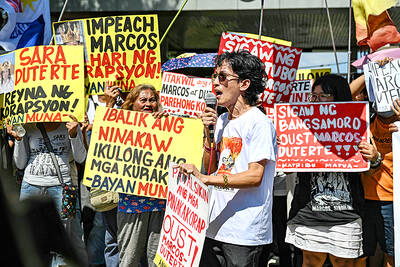
Civil society leaders and members of a left-wing coalition yesterday filed impeachment complaints against Philippine Vice President Sara Duterte, restarting a process sidelined by the Supreme Court last year. Both cases accuse Duterte of misusing public funds during her term as education secretary, while one revives allegations that she threatened to assassinate former ally Philippine President Ferdinand Marcos Jr. The filings come on the same day that a committee in the House of Representatives was to begin hearings into impeachment complaints against Marcos, accused of corruption tied to a spiraling scandal over bogus flood control projects. Under the constitution, an impeachment by the

China executed 11 people linked to Myanmar criminal gangs, including “key members” of telecom scam operations, state media reported yesterday, as Beijing toughens its response to the sprawling, transnational industry. Fraud compounds where scammers lure Internet users into fake romantic relationships and cryptocurrency investments have flourished across Southeast Asia, including in Myanmar. Initially largely targeting Chinese speakers, the criminal groups behind the compounds have expanded operations into multiple languages to steal from victims around the world. Those conducting the scams are sometimes willing con artists, and other times trafficked foreign nationals forced to work. In the past few years, Beijing has stepped up cooperation
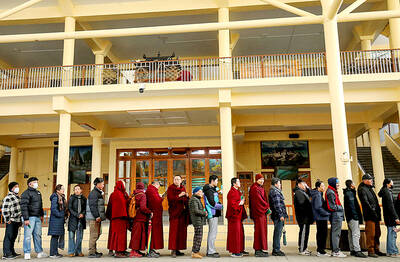
Exiled Tibetans began a unique global election yesterday for a government representing a homeland many have never seen, as part of a democratic exercise voters say carries great weight. From red-robed Buddhist monks in the snowy Himalayas, to political exiles in megacities across South Asia, to refugees in Australia, Europe and North America, voting takes place in 27 countries — but not China. “Elections ... show that the struggle for Tibet’s freedom and independence continues from generation to generation,” said candidate Gyaltsen Chokye, 33, who is based in the Indian hill-town of Dharamsala, headquarters of the government-in-exile, the Central Tibetan Administration (CTA). It


 RSS
RSS