


The Philippines appealed yesterday for help to combat the country's worst ever oil spill which has polluted a major marine reserve and threatened the livelihoods of thousands of fishermen.
Coast Guard officials said they were struggling to cope with the scale of the environmental disaster caused by the sinking of the tanker Solar I last week with more than 1.97 million liters of industrial fuel on board.
The tanker went down last Friday in rough seas in the Panay Gulf between the central islands of Panay and Guimaras. Eighteen of the crew were rescued but two remain missing, the Coast Guard said.
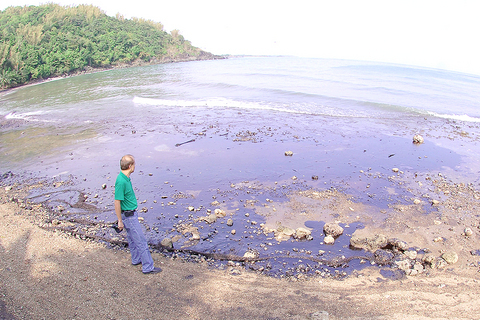
PHOTO: AP
"We don't have the capability right now to salvage sunken vessels this deep. That's why we're seeking international support," Coast Guard spokesman Lieutenant-Commander Joseph Coyme said.
Other Coast Guard officials said the government wanted to hire foreign salvage crews to re-float the tanker and well as specialist vessels to contain the slick, which is around 460km south of Manila.
Coyme said the challenge was to contain the 36km-long slick off the southern coast of Guimaras and to plug the leaking tanker which is resting on the seabed in around 900m of water.
Local salvage crews have so far attempted to put booms around the spill to prevent it spreading, but their work has been severely hampered by rough seas.
The slick has hit more than 200km of coastline damaging mangrove swamps, seaweed plantations and coral reefs containing popular dive sites, said Guimaras Province Governor Joaquin Carlos Nava.
He estimated the spill, which has been described by the Coast Guard as the worst in the nation's history, would take over a year to clean up.
Three coast guard vessels have been dispatched from Manila and the nearby port of Batangas to help combat the pollution that Coyme said threatened to spread to the north and south towards the Visayan Sea.
"If we can't apply physical barriers it will pass through the Visayan Sea," he said.
However Coyme said the slick was unlikely to reach Boracay off Panay's northern coast. The island is the top tourist attraction in the Philippines and is famous for its white sand beaches.
Nava said that in his province alone up to 10,000 fishermen and their families were being affected by the disaster.
"It is not only the coastline and fishing industries that are affected but also the tourism industry," he said.
"We are looking at the possible evacuation and support for our displaced fisherfolk. We don't know how long this [cleanup] will take," he told ABS-CBN television.
"I don't think we can do this alone. All we can do is try to mitigate the impact of the spill on our shoreline," he said.

An American scientist convicted of lying to US authorities about payments from China while he was at Harvard University has rebuilt his research lab in Shenzhen, China, to pursue technology the Chinese government has identified as a national priority: embedding electronics into the human brain. Charles Lieber, 67, is among the world’s leading researchers in brain-computer interfaces. The technology has shown promise in treating conditions such as amyotrophic lateral sclerosis and restoring movement in paralyzed people. It also has potential military applications: Scientists at the Chinese People’s Liberation Army have investigated brain interfaces as a way to engineer super soldiers by boosting

Indonesian police have arrested 13 people after shocking images of alleged abuse against small children at a daycare center went viral, sparking outrage across the nation, officials said on Monday. Police on Friday last week raided Little Aresha, a daycare center in Yogyakarta on Java island, following a report from a former employee. CCTV footage circulating on social media showed children, most younger than two, lying on the floor wearing only diapers, their hands and feet bound with rags. The police have confirmed that the footage is authentic. Police said they also found 20 children crammed into a room just 3m by 3m. “So

A grieving mother has ended her life at a clinic in Switzerland four years after the death of her only child. Wendy Duffy, 56, a physically healthy woman, died at the Pegasos clinic in Basel after struggling to cope with the death of her 23-year-old son, Marcus. The former care worker, from the West Midlands, England, had previously attempted to take her own life. The case comes as assisted dying would not become law in England and Wales after proposed legislation, branded “hopelessly flawed” by opponents, ran out of time. Ruedi Habegger, the founder of Pegasos, described Duffy’s death as

From post offices and parks to stations and even the summit of Mount Fuji, Japan’s vending machines are ubiquitous, but with the rapid pace of inflation cooling demand for their drinks, operators are being forced to rethink the business. Last month beverage giant DyDo Group Holdings announced it would remove about 20,000 vending machines — about 7 percent of their stock nationwide — by January next year, to “reconstruct a profitable network.” Pokka Sapporo Food & Beverage, based in Nagoya, also said last month it would sell its 40,000-machine operation to Osaka-based Lifedrink Co. “The strength of the vending machine


 RSS
RSS